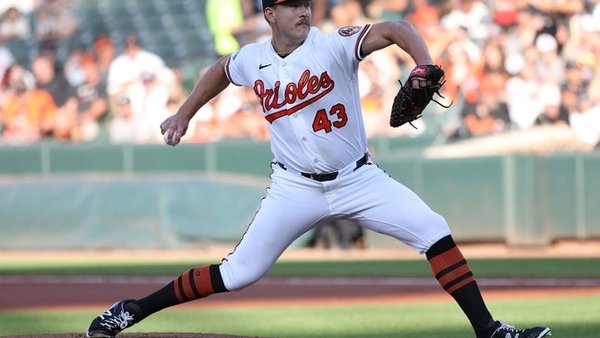
Gibson’s 5.81 ERA and 5.82 BB/9 rate point decisively one way — the Angels’ -120 moneyline is barely a coin flip away from even. A shorthanded Baltimore lineup missing Rutschman and Holliday makes the arm gap wider than the price is reflecting, and that friction between pitcher profiles and market number is exactly where this edge lives.
Trey Gibson vs Jose Soriano: Baltimore Orioles at Los Angeles Angels Betting Preview
After Tuesday’s 5-1 Angels win behind Ryan Johnson’s six shutout innings, the series finale shifts to a pitching matchup that isn’t as close as the moneyline suggests. Jose Soriano at -120 against Trey Gibson — a starter with a 5.81 ERA and 17 walks in just 26.1 innings — represents a moderate edge worth backing in a spot the market may be underpricing. The numbers favor a quality arm at near-even money, and the Baltimore lineup showing up today is missing three of its better contributors.
The core argument here is simple: this is a pitcher-driven edge, not a team-quality endorsement. The Angels are 33-48, one of the worst records in the AL, and Mike Trout is on the 10-Day IL with a hamstring injury. Nobody is confusing this Angels club for a contender. But the lean here is about backing Soriano at a price that doesn’t fully account for the gap between these two arms — and a Baltimore lineup that’s missing Adley Rutschman (7-Day IL, concussion), Jackson Holliday (groin, third straight game out), and Blaze Alexander (knee, day-to-day).
The numbers project the Angels winning 4.7 to 4.1, with a 73.8% home win probability priced at -120. There’s a real gap there, though a 33-48 team with a depleted roster keeps this in the moderate-confidence range rather than a slam dunk. The pitching mismatch is the engine. Everything else confirms it.
Game Info & Betting Lines
- Date/Time: Wednesday, June 24, 2026 | 4:07 PM ET
- Venue: Angel Stadium (Park Factor: 0.95 — slight run suppressor)
- Probable Starters: Trey Gibson (BAL) vs Jose Soriano (LAA)
- Moneyline: Baltimore Orioles +102 / Los Angeles Angels -120
- Run Line: Los Angeles Angels +1.5 (-194) / Baltimore Orioles -1.5 (+160)
- Total: 9.5 (Over -102 / Under -120)
Why This Number Is Close
The market is set where it is for real reasons. Both clubs are sub-.500 — Baltimore at 38-43, the Angels at 33-48 — and neither offense has been lighting up scoreboards consistently. The Angels are missing Trout, their best bat. Baltimore, when healthy, has averaged 4.64 runs per game with 96 home runs on the season, and their offense showed genuine pop earlier in this very trip (18 runs over two games before Tuesday). The market isn’t wrong to keep this close.
But here’s the problem: the line is priced as if Gibson is a functional starter, and the data doesn’t support that framing. A 5.81 ERA, a 1.71 WHIP, and 17 walks in 26.1 innings is not a starter you price at near-even money against an arm with 92 innings of sub-3.10 work. The market may be anchoring too heavily on team-level records and not enough on tonight’s individual starter gap. That’s where the lean lives.
The concern is that -120 is still paying juice on a 33-48 team. If this were a neutral site game between two bad teams, the price would feel thin. But the pitching mismatch is meaningful enough — and Baltimore’s lineup depleted enough — that -120 clears the value threshold at a moderate confidence level.
What Separates the Pitching
Jose Soriano has been one of the quietly better starters in the American League this season: 8-4, 3.03 ERA, 1.27 WHIP, 9.59 K/9, 2.41 WAR across 92 innings. His two fastballs generate swing-and-miss volume — a 97.5 mph four-seamer at a 23.1% whiff rate and a 96.7 mph sinker at 19.9% — though it’s worth noting both pitches allow average-to-slightly-above-average contact quality when hitters do connect (.406 xwOBA on the four-seamer, .392 on the sinker). Where Soriano genuinely suppresses damage is his secondary arsenal. His knuckle-curve generates a 41.2% whiff rate and holds hitters to a .252 xwOBA on 24.3% usage. His split-finger is even more dominant: a .195 xwOBA and a 38.3% whiff rate. The real value of his fastballs is setting up those secondaries — and against a strikeout-prone Baltimore lineup, that combination creates a genuine weapon even if his heaters don’t themselves suppress contact at an elite level.
The Baltimore bats Soriano faces are capable but compromised. Pete Alonso sits at a .453 xwOBA with a 6.7% barrel rate and is the legitimate danger in this lineup. Coby Mayo brings a .391 xwOBA but carries a 30.6% strikeout rate and a 28.7% whiff rate — a profile Soriano’s secondary stuff was built to exploit. Samuel Basallo at .414 xwOBA is another live bat, but with Rutschman and Holliday gone, the lineup thins considerably around that core.
Gibson is the mirror image. His 5.81 ERA and 1.71 WHIP tell one story; the command data screams another. Seventeen walks in 26.1 innings is a 5.82 BB/9 rate — elite pitchers walk fewer than 2 per nine. His curveball generates a 29.6% whiff rate, and his slider sits at 28.1% — there’s some pitch quality there — but his cutter is producing a troubling .429 xwOBA, and his sweeper has a .618 xwOBA against with zero whiffs in limited usage. Zach Neto (.411 xwOBA, 6.4% barrel) leads off for the Angels and makes Gibson work early. Nolan Schanuel is contact-oriented (.334 xwOBA, 14.8% K rate) — the type who extends at-bats and runs pitch counts up on a starter who already struggles to throw strikes.
The gap between these two arms is the entire thesis. Soriano creates short innings with swings and misses. Gibson creates long innings with free passes and elevated pitch counts.
The Pushback
The strongest case against the Angels here starts with their record. Thirty-three wins and 48 losses isn’t a bad-luck story — it’s a bad team. Trout on the IL removes the one bat in this lineup capable of changing a game with one swing. The Angels’ own bullpen has been a liability all year (4.62 team ERA, 1.416 WHIP), meaning even if Soriano pitches well into the sixth or seventh, the back end is a genuine vulnerability. Baltimore’s lineup — even shorthanded — still has Pete Alonso, Gunnar Henderson, and Samuel Basallo. If Gibson escapes the first couple innings without imploding, this game gets to bullpens faster than anyone wants, and that’s not Angels territory.
There’s also the recent series context. Baltimore came into this trip and torched the Angels for six runs on Monday before the Angels bounced back Tuesday. These teams have exchanged blows all series. The Orioles are 38-43, not a club so far gone they can’t win a day game behind a starter getting healthy opposition run support. The case for +102 Baltimore isn’t crazy — it’s just that the pitching mismatch is real enough to lean the other way.
Run Environment & Game Shape
Angel Stadium plays as a mild run suppressor at a 0.95 park factor, and the projected total of 8.8 runs (against a posted 9.5) suggests the under has some value on its own — but that’s a separate conversation. For the moneyline, the run environment actually helps frame the game shape in Soriano’s favor. In a lower-scoring environment where individual starter quality matters more, the gap between a 3.03 ERA arm and a 5.81 ERA arm is amplified. Soriano limiting Baltimore’s half of the run total becomes a decisive factor — if he keeps the Orioles’ depleted lineup to two or three runs through five or six innings, he gives the Angels’ offense enough margin to work with against Gibson, who figures to generate traffic early and often.
The Angels don’t need to erupt offensively. They need Gibson to walk two or three batters, give up an earned run or two by the fourth inning, and let the Angels convert on the opportunities he creates. Given that Gibson has walked 17 men in just 26.1 innings this season, that’s a reasonable expectation — not a stretch.
This isn’t a high-conviction spot given the Angels’ record and bullpen concerns. But at -120, backing the clearly superior starting arm against a shorthanded lineup, in a mild pitcher’s park, is a bet worth making at measured size.
Bet: Los Angeles Angels Moneyline -120 — 2 units, moderate confidence.