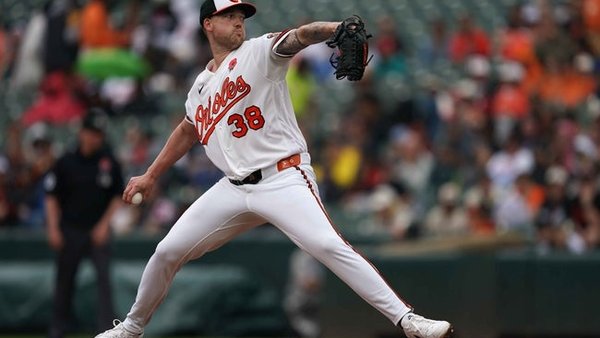
Kyle Bradish’s 4.79 BB/9 and 39 walks in 73.1 innings stand in sharp contrast to George Kirby’s 2.25 BB/9 — yet the total is sitting at 7.5 as though both arms are manufacturing the same run environment. That walk-rate gap is the kind of process difference ERA symmetry buries, and it points toward a messier game than the posted number accounts for.
Kyle Bradish vs. George Kirby: Baltimore Orioles at Seattle Mariners Betting Preview
After Tuesday’s 3-1 Mariners win — Logan Gilbert fanning 10 and Cal Raleigh delivering the knockout blow in the seventh — the series shifts to a pitching matchup that tells a different story on the total. The market has set this line at 7.5, and at first glance it looks reasonable: two starters with ERAs in the 4.00-4.30 range, a mild pitcher-friendly park, and two offenses that have been cooling off. But ERA symmetry is misleading here. The underlying process data separates these two arms in ways that point to a messier, higher-scoring game than 7.5 implies.
The moneyline at Seattle -142 is where most bettors will anchor, and there’s a real case for it. But -142 is past the price point where I’m comfortable committing a full unit to a modest edge. What the pitching gap and lineup matchups actually point toward is a game that plays over, not under — and the total at -110 gives a cleaner entry into that same thesis without chasing inflated juice.
Game Info & Betting Lines
- Date/Time: Wednesday, June 17, 2026 — 9:40 PM ET
- Venue: T-Mobile Park (Park Factor: 0.92 — mild run suppressor, dome)
- Probable Starters: Kyle Bradish (BAL, 3-7, 4.30 ERA) vs. George Kirby (SEA, 5-6, 4.07 ERA)
- Moneyline: Baltimore Orioles +120 / Seattle Mariners -142
- Run Line: Seattle Mariners -1.5 (+146) / Baltimore Orioles +1.5 (-176)
- Total: 7.5 (Over -110 / Under -110)
Why This Number Is Off
The market set 7.5 for sensible reasons. T-Mobile Park plays roughly 8% below league average in run scoring — a legitimate suppressor. Both offenses have been cold recently, and the surface-level ERA comparison between Bradish (4.30) and Kirby (4.07) looks like a wash. If you squint, a 7-6 or 3-2 final both feel plausible, and the book is pricing those outcomes roughly equally.
But here’s the problem: ERA doesn’t capture the process differences between these two starters, and the process differences are significant. Bradish is posting a 1.5681 WHIP with 39 walks in 73.1 innings — that’s a 4.79 BB/9, which means base runners are being manufactured at an alarming rate before the lineup even does anything. Free passes create scoring chances that a simple ERA number buries. The numbers project a combined 8.3 runs — a 0.8-run gap above the posted total. That’s not enormous, but at -110 juice on both sides, it represents real value.
The legitimate counter is that both offenses have struggled to generate consistent run production recently. Baltimore has averaged roughly 2 runs per game over their last three outings (1 run Tuesday vs. Seattle, 2 runs Sunday vs. San Diego, 3 runs Saturday vs. San Diego). Seattle hasn’t been much better, averaging around 2.3 runs per game over the same stretch (3 runs Tuesday vs. Baltimore, 1 run Sunday vs. Washington, 3 runs Saturday vs. Washington). The cold-stretch flag is real. But season-long rates and underlying process are more reliable than a short soft patch, and Bradish’s walk tendencies don’t disappear because the calendar flipped.
What Separates the Pitching
The gap between these two arms is less about stuff and more about command — and command determines how many base runners accumulate per inning.
George Kirby is built around a 48.4% four-seam fastball that sits 95.6 mph and generates a 22.7% whiff rate with a .290 xwOBA against — genuinely elite contact suppression for a pitch he throws nearly half the time. His sweeper (14.4% usage, 84.2 mph) is the real wipeout offering: 37.9% whiff rate and a .257 xwOBA. His changeup is the cherry on top — .172 xwOBA and 20.6% put-away rate. What ties it all together is the walk rate: 21 BB in 84 IP, a 2.25 BB/9 that keeps innings clean. Kirby doesn’t beat himself. When his stuff is right, batters are forced to earn everything.
Kyle Bradish is a different equation. His knuckle curve (32.7% usage, 85.3 mph) is a genuine weapon — 28.5% whiff rate and .291 xwOBA when it’s located. The problem is his four-seamer (.364 xwOBA) and especially his changeup (.474 xwOBA, only 3.8% put-away rate) are getting hit hard. More damaging: 39 walks in 73.1 innings. When Bradish misses the zone, those base runners compound. Pete Alonso (.450 xwOBA, 6.8% barrel rate) and Dominic Canzone (.452 xwOBA, 9.8% barrel rate) are the type of hitters who punish pitchers who can’t get back into counts. Bradish’s free passes give those hitters extra chances. That’s where the over lives.
The Pushback
The honest case against the over starts with the park. T-Mobile is a dome that plays 8% below league average — not a dramatic suppressor, but consistently so. On nights where both starters command their secondary offerings, 7.5 is more ceiling than floor. Kirby in particular can run through lineups in a way that keeps the run total comfortably under.
The second concern is genuine: both lineups have been low-scoring recently. Seattle averaged 2.3 runs per game over the last three, and Baltimore averaged 2.0. If Kirby is dialed in — his sweeper at 37.9% whiff and his fastball at 22.7% — the Mariners’ half of the total could be limited to three or four runs, putting serious pressure on Bradish to provide the other half. That’s not an unreasonable scenario. It’s why this is a lean, not a max bet.
The third issue is Seattle’s injury situation. Randy Arozarena (hamstring), Brendan Donovan (groin), and Luke Raley (back) are all listed as day-to-day or on the IL, thinning out a lineup that wasn’t deep to begin with. That matters when you’re leaning on the offense to push a total over a half-run threshold.
Projected Score & The Bottom Line
The numbers land at Seattle 5, Baltimore 4 — a combined 9 that clears the 7.5 line with room to spare. The edge isn’t enormous, but it’s consistent: Bradish’s walk rate inflates Baltimore’s run-scoring environment regardless of recent offensive trends, and the Mariners’ lineup — even shorthanded — has enough quality contact in the top five spots to push across multiple runs against a starter with a .474 xwOBA changeup.
On the run line: I looked at Seattle -1.5 at +146, but I’d rather not need the two-run cushion to cash. The projected margin is tight — roughly one run separating these clubs — and a one-run Seattle win would still cash the over while burning a run line ticket. When the projected gap doesn’t support a two-run win with confidence, there’s no reason to add that constraint. The total at -110 is the cleaner expression of the same thesis.
Pick: Over 7.5 (-110) — lean/small play.