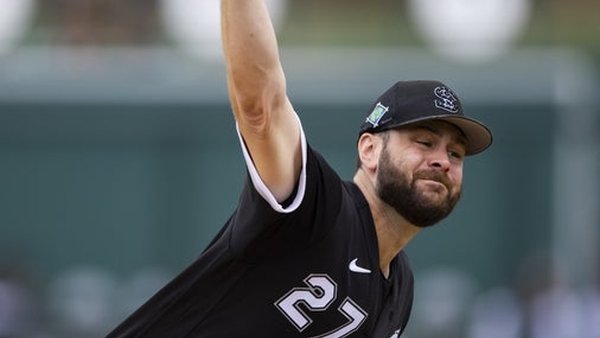
Lucas Giolito’s 2.70 ERA is propped up by a 10-inning sample hiding a 7.2 BB/9 and a 4.5 K/9 — a walk-heavy, swing-and-miss-light profile facing a Nationals lineup with 72 home runs and the best hitter in this game. The moneyline is priced like a coin flip, but the pitching profiles are not pointing in the same direction.
Lucas Giolito vs. Paxton Schultz: San Diego Padres at Washington Nationals Betting Preview
The market has this game priced almost identically, with Washington at -102 and San Diego at -116 — a remarkably flat line for a game with a significant pitching gap hiding underneath the surface. That flatness is the opportunity. The Nationals are projected to win outright in a 4.7-4.4 game, and they’re available at near-even money while fielding the better lineup, the more reliable starter, and the home-field advantage.
Giolito’s ERA is a headline number that doesn’t hold up to scrutiny. Eight walks in ten innings — a 7.2 BB/9 — is not a sustainable profile for any pitcher, and a 4.5 K/9 in the same sample means he isn’t compensating with swing-and-miss. He’s relying on contact management in a razor-thin sample. Washington’s lineup is constructed to exploit free passes.
Paxton Schultz has his own blemishes — a 5.30 ERA and an 0-2 record that doesn’t inspire confidence. But his underlying numbers tell a different story than Giolito’s: 21 strikeouts in 18.2 innings, a 10.125 K/9, and only five walks. The case for the Nationals isn’t built on Schultz being dominant — it’s built on Schultz being the steadier of two flawed options, backed by a lineup that’s materially better than anything Giolito will face tonight.
Game Info & Betting Lines
- Date/Time: Friday, May 29, 2026 | 6:45 PM ET
- Venue: Nationals Park | Park Factor: 0.98 (neutral)
- Probable Starters: Lucas Giolito (SD) vs. Paxton Schultz (WSH)
- Moneyline: San Diego Padres -116 / Washington Nationals -102
- Run Line: Washington Nationals +1.5 (-172) / San Diego Padres -1.5 (+142)
- Total: 9 (O -110 / U -110)
Why This Number Is Off
The market is doing something reasonable here: it’s weighing San Diego’s superior team ERA (3.83 vs. Washington’s 4.64) and the Padres’ winning record (31-24) against a Nationals squad sitting at 29-28. On paper, San Diego is the better-constructed team, and at -116 moneyline, the market isn’t asking bettors to pay a heavy premium for that status. That logic has merit.
But the market appears to be leaning on ERA as a primary signal without interrogating what’s underneath it. Giolito’s 2.70 ERA over 10 innings is a sample too small to anchor a betting decision. A pitcher posting a 7.2 BB/9 who hasn’t allowed a home run yet is living on borrowed time — that HR column reads 0, but his control issues will eventually meet a power-heavy lineup. Washington’s is exactly that lineup, with 72 team home runs on the season compared to San Diego’s 55.
The flip side is that Schultz’s ERA is genuinely ugly, and his 0-2 record signals he hasn’t found a way to translate peripherals into wins yet. The market may not be wrong to price this close — it’s just slightly wrong about which side deserves the edge at these numbers. A 10-point implied probability advantage for the Nationals (61.4% per the numbers vs. roughly 51% implied by -102) is not a gap the market has closed.
What Separates the Pitching
The statistical gap between these two starters is more pronounced than the win-loss records suggest, and it runs in Washington’s favor. Start with Giolito’s arsenal: his four-seam fastball sits at 90.4 mph with a 42.4% usage rate, generating only a 15.4% whiff rate and a concerning .369 xwOBA against. His changeup is his best weapon — a 78.3 mph offering with a 24.0% whiff rate and .240 xwOBA — but at 38.2% usage, he’s leaning on it heavily to compensate for the fastball’s limitations. His slider generates a .376 xwOBA against at just 15.8% usage and carries a 0.0% put-away rate. That’s not a weapon; that’s a pitch he throws when he has to.
Schultz’s arsenal has a different shape. His four-seamer sits at 93.7 mph — 3.3 mph harder than Giolito — and generates a .171 xwOBA against with a 33.3% put-away rate. That’s genuine swing-and-miss. His slider, while used sparingly at 5.2%, is posting a 50.0% whiff rate. The cutter (43.9% usage) is his primary offering and has a .450 xwOBA against — that’s the vulnerability in his profile, and it’s real.
The matchup signals sharpen the edge. James Wood carries a .604 xwOBA overall and a .613 xwOBA against right-handed pitching — Giolito’s handedness — with a 12.4% barrel rate and 37.5% hard-hit rate. He is the best hitter in this game by a wide margin. CJ Abrams posts a .429 xwOBA vs. righties and has 5 PA against Giolito in limited prior exposure, hitting .333 with 0 HR and 0 strikeouts. San Diego’s top of order against Schultz shows Tatis Jr. at a .394 xwOBA vs. right-handed pitching — respectable, but nowhere near Wood’s ceiling.
The innings Giolito creates are fragile: soft contact reliant, walk-prone, and dependent on defense and strand rate. Schultz creates swing-and-miss. In a game projected this close, that distinction matters.
The Pushback
Here’s the problem: Schultz is 0-2 with a 5.30 ERA. Results have been ugly even when the strikeout and walk numbers are promising. He hasn’t been rewarded for his peripherals, and there’s a legitimate question about whether a young pitcher in that kind of early-season hole can be trusted in a spot like this. Fair pushback.
There’s also the sample-size problem on Giolito’s walks. Eight walks in ten innings is alarming, but ten innings is barely two starts. A correction toward the mean is possible — maybe even likely — and if Giolito’s command tightens even moderately, the walk-rate thesis loses its teeth. The Padres at 31-24 are a team that has earned their record, and their rotation ERA of 3.83 reflects genuine pitching quality in the aggregate.
San Diego’s lineup isn’t without teeth either. Tatis Jr. leads an order that can do damage, and Manny Machado in the cleanup spot gives them a legitimate middle-of-the-order threat. If Schultz’s cutter (.450 xwOBA against) gets squared up early, this game can flip quickly.
The run line is also worth addressing and then rejecting: Washington +1.5 at -172 is too expensive for what this game projects to be. At -172, you’re paying premium juice for a 4.7-4.4 projected win — a margin so thin that a single Giolito walk spiral can flip it. The moneyline at -102 gives you the same directional bet at a fraction of the cost.
Run Environment & Game Shape
Nationals Park plays nearly neutral at a 0.98 park factor, so neither offense gets a meaningful boost or suppression from the venue. The total is set at 9, which aligns closely with the 9.1 projected total — the market has the run environment right. What it may have wrong is the distribution of those runs.
Washington’s offense leads this game in nearly every meaningful category: .324 OBP vs. San Diego’s .291, .420 SLG vs. .361, and 72 home runs vs. 55 on the season. The Nationals have scored 306 runs compared to the Padres’ 214. That’s not a small gap — that’s a lineup operating at a materially different level. Against a pitcher with Giolito’s current walk profile, a team with Washington’s plate discipline and power can manufacture crooked numbers without needing everything to go right.
The game shape favors the Nationals because of how Giolito’s risk compounds. One walk spiral — the kind his current BB/9 makes statistically likely — can turn a 1-0 game into a 3-0 game without a single hard-hit ball. Washington’s lineup, with its .324 OBP and 72 team home runs, is built to capitalize on exactly that scenario. One Giolito walk spiral that leads to a two-run inning is potentially the difference in a game projected to finish within a run.
That’s the thesis in full: you’re not betting on Schultz to dominate, and you’re not ignoring his ERA. You’re betting that Giolito’s walk rate is a structural problem, that Washington’s lineup is better equipped to exploit it than the market price reflects, and that -102 is fair value for a team the numbers put at 61.4% to win this game.
The Pick
Bet: Washington Nationals Moneyline (-102) — 2 Units | Moderate Confidence
The walk rate is the bet. Eight walks in ten innings doesn’t disappear overnight, and Washington’s lineup — with Wood at the top, Abrams in the four-hole hitting .333 in prior Giolito exposure, and a team OBP of .324 — is exactly the kind of order that punishes pitchers who can’t find the zone. At -102, you’re getting near-even money on a team the numbers favor by 10 percentage points in win probability. That’s the edge. Take the Nationals moneyline.