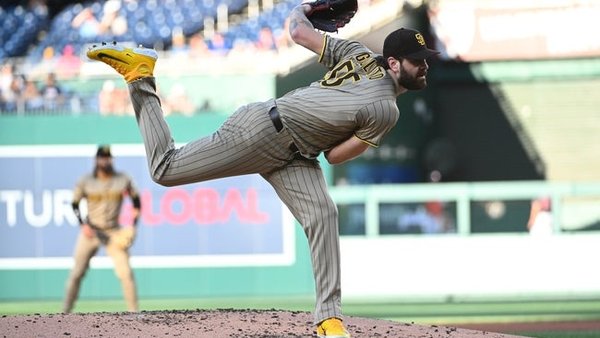
Eovaldi’s 1.17 WHIP and a Padres lineup posting a .657 team OPS point clearly toward a low-scoring afternoon — yet the total sits at 7.5 with the under priced at flat money. The market is anchoring on a 16-run series opener that bears no resemblance to Sunday’s pitching slate.
Lucas Giolito vs Nathan Eovaldi: San Diego Padres at Texas Rangers Betting Preview
After yesterday’s 6-4 Padres comeback on Manny Machado’s 10th-inning blast, the series heads to a Sunday matinee with a dramatically different pitching complexion. The total sits at 7.5, and the under is available at flat money — +100. That’s the bet. The market is pricing this game like the offenses from Friday’s 16-run opener are going to show up again. They won’t. Not with this pitching slate.
The market has set this total at a number that already reflects some pitcher respect for Eovaldi, but not nearly enough when you layer in the Padres’ offensive ceiling. San Diego is posting a team OPS of .657 — one of the weakest offensive profiles in baseball. Against a competent starter, that number translates directly into suppressed run output. The under at +100 is flat money on what should be a low-scoring, pitching-driven afternoon.
The Rangers moneyline at -154 is simply not a playable number. By the rules of value betting, -154 blows past any reasonable juice ceiling regardless of the starter edge. That’s not a close call — it’s a hard stop. The cleanest expression of the Texas advantage is the total, not the side.
Game Info & Betting Lines
- Date/Time: Sunday, June 21, 2026 | 2:35 PM ET
- Venue: Globe Life Field, Arlington, TX (Dome | Park Factor: 1.05 — marginally hitter-friendly)
- TV: MLB.TV, Padres.TV, Rangers Sports Network
- Probable Starters: Lucas Giolito (SD, 2-2, 4.56 ERA) vs. Nathan Eovaldi (TEX, 6-7, 4.23 ERA)
- Moneyline: San Diego Padres +130 / Texas Rangers -154
- Run Line: Texas Rangers -1.5 (+146) / San Diego Padres +1.5 (-176)
- Total: 7.5 (Over -122 / Under +100)
Why This Number Is Off
The market’s case for setting the total at 7.5 is reasonable on the surface. Globe Life Field’s dome neutralizes weather as an under driver, both teams have shown some offensive upside this series — Friday’s opener went 16 combined, Saturday came in at 10 — and Giolito’s ERA at 4.56 isn’t alarming enough to scare anyone toward the under on its own.
But the market is anchoring on ERA when it should be anchoring on WHIP and K-rate. Giolito’s ERA of 4.56 is almost charitable compared to what his peripheral numbers suggest. A 1.79 WHIP in 25.2 innings means constant traffic, but his 5.61 K/9 means that traffic rarely escalates into multi-run crooked numbers. Hitters get on base against Giolito — they just don’t blow the game open against him.
That’s actually an argument for the under, not the over. A pitcher who walks batters but doesn’t get hit hard keeps run totals suppressed more than a pitcher who gets shelled in three-pitch sequences. Meanwhile, Eovaldi’s 1.17 WHIP over 87.1 innings is a legitimate suppression floor. Both sides of this run environment point lower — and flat money on the under at +100 is the cleanest way to play it.
What Separates the Pitching
The distance between these two starters is wider than their ERAs suggest, and the Statcast data makes the gap visible.
Nathan Eovaldi is built around a split-finger that he throws 35.9% of the time at 88.4 mph, generating a 29.7% whiff rate and holding hitters to a .292 xwOBA. His curveball is arguably sharper — used 21.0% of the time at 76.4 mph with a 35.6% whiff rate and just .228 xwOBA against. Together those two pitches account for more than half his arsenal and represent genuine swing-and-miss weapons. His 8.55 K/9 over 87.1 innings isn’t a small-sample mirage — it’s a legitimate workload confirmation of a pitcher who misses bats consistently.
The concern on Eovaldi is his cutter, which is getting hit to a .399 xwOBA — and his four-seamer at .430 xwOBA is genuinely hittable. Fernando Tatis Jr. carries a .396 xwOBA vs. right-handed pitchers, and Samad Taylor sits at .426 xwOBA against RHP — those are real threats at the top of the Padres order against the pitches Eovaldi goes to when ahead in counts.
Lucas Giolito is a different animal. His 5.61 K/9 is alarming for a starter — that’s barely better than league-average contact management. His -0.07 WAR in just 25.2 innings isn’t a rounding error. He’s issued 21 walks in fewer than 26 innings. Brandon Nimmo carries a .476 xwOBA vs. right-handers — he’s the Rangers’ most dangerous bat in this matchup, and Giolito’s inability to put hitters away consistently means Nimmo will see deep counts. The key separation: Eovaldi creates weak contact with put-away pitches; Giolito creates traffic without the strikeouts to escape it.
The Pushback
The honest concern here is Giolito’s walk rate triggering bullpen chaos. At 21 walks in 25.2 innings — a pace that would translate to roughly 12 walks per nine — there’s a real scenario where he’s yanked in the third inning and the Rangers bullpen inherits a bases-loaded mess. Texas’s relief corps is already operating short-handed with Jalen Beeks (back), Chris Martin (shoulder), Carter Baumler (ribs), and Robert Garcia (shoulder) all on the IL. A short Giolito outing doesn’t just hurt San Diego — it stresses the Rangers’ backend and opens the door to crooked innings from either side.
The series run context also cuts against the under. This matchup has already produced 26 combined runs across two games. Friday was a 16-run circus; Saturday finished at 10. The market isn’t blind to that momentum — the total opened lower and got pushed up by public over money. Fading series run trends is a legitimate contrarian lean, but it requires discipline when the recent evidence is this loud.
And the Rangers themselves aren’t inspiring confidence as a host. Texas has lost five of six heading into Sunday, just got swept by Minnesota, and is 0-15 when allowing multiple runs in the first inning. Their offense went cold against Mason Miller in the 10th last night and fanned a season-high 17 times. The Rangers are the better team in this matchup, but they’re not playing like it right now.
The Structural Case for Under 7.5
Strip away the series noise and the structural case for the under is straightforward: Eovaldi is a legitimate ground-ball and weak-contact generator who limits damage even when his cutter gets squared up, and he’s facing a Padres lineup that’s posting a .657 OPS as a team — among the worst offensive profiles in the league. That’s not a unit that strings together multi-run innings against a competent arm. Giolito, for all his walk-rate ugliness, is not a pitcher who gets hammered — his traffic tends to strand rather than score. Two pitchers who suppress quality of contact, one of whom faces an offense that’s been genuinely anemic all season, is a recipe for a game that stays in the 6-7 range regardless of what the recent series totals suggest.
Yes, the numbers project a higher combined total if you let the raw run-environment math run unchecked — Globe Life Field’s 1.05 park factor and two leaky bullpens will do that. But the under thesis isn’t built on projections. It’s built on Eovaldi’s split-finger (.292 xwOBA, 29.7% whiff) neutralizing a .657 OPS offense, Giolito’s strand-not-score profile keeping the Rangers from a crooked-number inning early, and flat money at +100 providing structural value that the juice on the over (-122) simply doesn’t offer. With Eovaldi on the mound suppressing the Padres’ already-anemic offense, and Giolito creating traffic without the contact damage to blow innings open, the run environment here points firmly under the number — and the market is giving you even money to say so.
The Pick
Under 7.5 (+100) — 2 units, moderate confidence.
The juice ceiling kills the Rangers moneyline, but the total is where the structural value lives. Eovaldi’s arsenal suppresses the Padres’ weak offense, Giolito’s strand-rate keeps Texas from a big inning, and flat money on the under is the cleanest number on the board. Play it for 2 units.