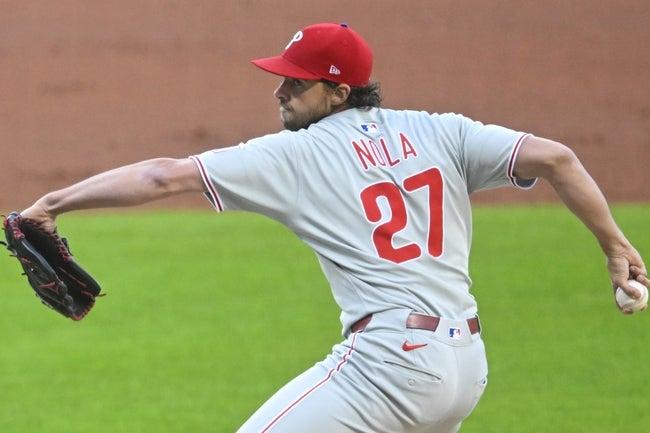
Chris Sale’s 2.10 ERA and 1.01 WHIP represent a suppression profile the market has only partially priced — the total sits at 7.5 with the under at -108, a number that hedges against Nola’s 32 home runs allowed without fully extracting what Sale does to a .712-OPS lineup that leans into left-handed pitching trouble. The gap between these two starters is not subtle, and the price hasn’t closed it.
Aaron Nola vs. Chris Sale: Philadelphia Phillies at Atlanta Braves Betting Preview
The Phillies arrive in Atlanta four games back in the NL East, fresh off a dispiriting 2-1 loss to Houston where they were retired in order over the final four innings. The Braves just bounced back from a brutal three-game beatdown at the hands of Tampa Bay with a 3-1 win Thursday, getting seven scoreless innings from Martín Pérez and going into this series with a pulse. Game 1 of this three-game set is September baseball with real stakes — and the pitching matchup is the entire ballgame.
The core thesis here is simple: Chris Sale is the best starting pitcher either of these teams will face all season, and the total of 7.5 is begging to be attacked from the under side. Philadelphia’s offense carries a team OPS of .712 — functional, not fearsome — and is walking into one of the most dominant strikeout-to-walk ratios in baseball. Nola on the other side is a liability the Braves can exploit, but the question is whether Atlanta can push past 4-5 runs before Sale hands it to a depleted bullpen situation.
The market has set this at -108 on the under. That’s not a steep price. It reflects some uncertainty — Nola’s home-run rate, Atlanta’s power bats, bullpen volatility on both sides — but it’s also a price point where the Sale edge isn’t fully extracted. That gap is where this bet lives.
Game Info & Betting Lines
- Date/Time: Friday, September 11, 2026 — 7:15 PM ET
- Venue: Truist Park, Atlanta | Park Factor: 1.01 (essentially neutral)
- TV: MLB.TV, BravesVision, NBC Sports Philadelphia
- Probable Starters: Aaron Nola (PHI) vs. Chris Sale (ATL)
- Moneyline: Philadelphia Phillies +157 / Atlanta Braves -191
- Run Line: Atlanta Braves -1.5 (+119) / Philadelphia Phillies +1.5 (-144)
- Total: 7.5 (Over -112 / Under -108)
Why This Number Is Close — But Still Off
The market isn’t wrong to post this at 7.5. There’s a legitimate argument that 7.5 is already a low total and that the oddsmakers have priced in Sale’s dominance. Philadelphia scores 4.48 runs per game on the season. Atlanta scores 4.56. Split the difference, add a small park bump from Truist’s 1.01 factor — barely rounding up from neutral — and you’re already looking at a theoretical combined output near 9 runs before accounting for the pitching quality on either side.
That’s the case for the market being right. A 7.5 total in a neutral park with two legitimate starting pitchers isn’t an accident.
But here’s where the market undershoots: it hasn’t fully weighted what Sale does to traffic suppression. His 1.74 BB/9 means he almost never puts runners on base without a hit. His 11.04 K/9 means those hits are rarer than his ERA suggests. The season-average offensive inputs — Philadelphia scoring 4.48 per game — are a reasonable baseline, but they don’t capture what happens when Sale’s specific arsenal meets this lineup. His 36.7% whiff slider and elite fastball tunnel materially compress what Philadelphia is actually going to score against him. That suppression is the mechanism that pushes the combined total below the 7.5 line, and -108 is the market hedging against Nola’s vulnerability without fully extracting the Sale edge. That hedge is reasonable, but it’s not enough to push me off the suppression side.
What Separates the Pitching
The gap between these two starters is not subtle. Chris Sale has put together one of the best seasons in baseball: 2.10 ERA, 1.01 WHIP, 184 strikeouts in 150 innings, just 9 home runs allowed all year. His arsenal is a two-pitch hammer — a 96.0 mph four-seamer at 40.7% usage that generates a 22.6% whiff rate and a .303 xwOBA against, paired with a 79.6 mph slider at 39.6% usage that is genuinely filthy: 36.7% whiff rate, .221 xwOBA, 26.0% put-away rate. That slider is the pitch that ends at-bats. When Sale works his fastball-slider combination, he creates a tunnel that even elite hitters struggle to solve.
The BvP data against Schwarber (24 PA, .227, 2 HR, 8K) and Harper (18 PA, .111, 0 HR, 9K) is telling — Sale has historically owned both Philadelphia’s biggest power threats. Schwarber carries a massive .507 xwOBA with 44 home runs, but his 32.3% strikeout rate is exactly what Sale’s slider preys on. Harper is the one that really jumps out: he actually struggles against left-handed pitching this season, posting just a .372 xwOBA versus LHP — Sale is a lefty, so that’s the relevant split, not his .482 mark against right-handers. His .111 average against Sale in 18 plate appearances with nine strikeouts isn’t a fluke at all — it’s completely consistent with that split. If anything, the BvP history confirms the matchup disadvantage rather than overstating it, and it’s another weight on the under side of the scale.
Aaron Nola presents a very different profile. His knuckle curve is genuinely elite — 40.8% whiff rate, .222 xwOBA, 27.3% put-away rate at 32.8% usage — and his 9.41 K/9 gives him the ceiling to navigate a tough lineup. But the problem is his 32 home runs allowed this season. Olson (51 PA vs. Nola, .244, 4 HR), Harris II (40 PA, .216, 3 HR), and Acuña Jr. (43 PA, .375, 2 HR) all have meaningful history against Nola. The gap isn’t just ERA (2.10 vs. 4.76) — it’s the entire risk profile.
Run Environment & Game Shape
Truist Park’s 1.01 park factor is as close to neutral as it gets — this venue isn’t going to juice the total in either direction. The run environment lives or dies on the starting pitchers, and that asymmetry is stark. Sale’s 9 home runs allowed in 150 innings against Nola’s 32 in 155 innings tells you everything about which side of this game carries the risk. Atlanta’s bullpen has some volatility with Robert Suarez and Joey Wentz on the IL, but the Braves don’t need the pen to carry much load if Sale is operating at his season-average level of 6-plus innings per start.
Philadelphia’s lineup at a .712 team OPS is capable of scoring runs in bunches — the 11-7 win over Houston earlier this week proves that ceiling exists. But that was against a different pitcher profile. Sale’s 1.01 WHIP and 29 walks in 150 innings mean Philadelphia has to earn everything the hard way: no free passes, no traffic without contact, and contact rates suppressed by that slider. The realistic shape of this game is Sale keeping it at 1-2 runs through 6-7 innings while Nola gives up 3-4 to Atlanta’s power-heavy lineup — a final score in the 3-2 or 4-2 neighborhood lands comfortably under 7.5.
The Pick: Under 7.5 (-108), 2 units, moderate confidence. Sale’s suppression profile against a Philadelphia offense that struggles versus left-handed pitching is the engine here, and -108 is a fair price to extract that edge without overcommitting. Lay the two units and let Sale do the work.