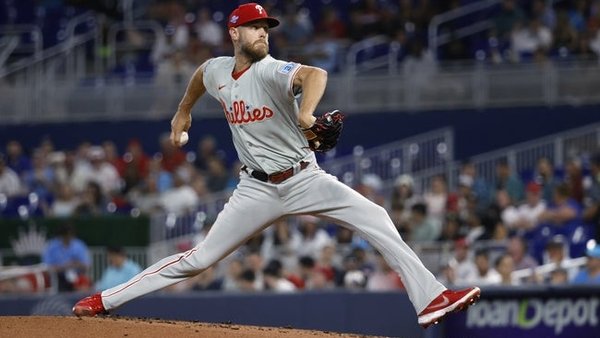
Wheeler’s four-pitch arsenal faces a TBD starter scenario that signals bullpen games or emergency decisions — the price gap doesn’t match the pitching reality.
Zack Wheeler vs TBD Starter: Philadelphia Phillies at Boston Red Sox Betting Preview
The Red Sox are sitting at +124 on the moneyline despite not naming their starting pitcher, while the Phillies counter with Zack Wheeler, who carries a 3.12 ERA and has been dominant through his first three starts. Boston’s rotation uncertainty isn’t just a lineup card mystery — Garrett Crochet is on the IL with a shoulder issue, and Johan Oviedo is out long-term with elbow problems.
Philadelphia has improved significantly under interim manager Don Mattingly, posting a 7-3 record in their last 10 games and winning their last series against Colorado. Kyle Schwarber continues his power surge with 16 home runs this season, tying Aaron Judge for the MLB lead, while Brandon Marsh leads the team with a .353 average that ranks among the best in baseball.
The line reflects home field advantage and recent struggles from a Phillies team that started poorly, but it’s not accounting for the clear pitching gap that should drive this outcome.
Game Info & Betting Lines
- Date/Time: Tuesday, May 12, 2026 | 6:45 PM ET
- Venue: Fenway Park (Park Factor: 1.08)
- Probable Starters: Zack Wheeler (PHI) vs TBD (BOS)
- Moneyline: Philadelphia Phillies -146 / Boston Red Sox +124
- Run Line: Boston Red Sox +1.5 (-137) / Philadelphia Phillies -1.5 (+114)
- Total: 8.5 (Over +100 / Under -122)
Why This Number Is Close
The market is balancing legitimate factors here. Boston gets the standard home field bump worth roughly 20-25 cents, and Fenway’s 1.08 park factor creates a slight offensive environment that favors the home lineup. The Red Sox have been respectable at home this season, and their 17-23 record isn’t dramatically worse than Philadelphia’s 19-22 mark.
But the line is treating this as a relatively even pitching matchup, which it clearly isn’t. A TBD starter typically signals either a bullpen game, a spot starter, or someone being rushed back from injury concerns. Boston’s rotation has been decimated by injuries, forcing them into uncomfortable decisions.
The market is also likely hesitant to fully embrace Philadelphia’s recent improvement, viewing their 7-3 record over the last 10 games with skepticism given their poor overall record. However, my model shows Boston with a slight 51.3% win probability — this isn’t about chasing the Phillies’ hot streak, but rather recognizing that Boston’s home edge and Philadelphia’s TBD starter matchup creates a contrarian opportunity where the public perception differs from the underlying value.
What Separates the Pitching
Wheeler brings a complete four-pitch arsenal that’s been effective from the jump this season. His 94.5 mph four-seam fastball generates a 29.2% whiff rate and holds hitters to a .171 xwOBA, while his split-finger pitch has been devastating at 55.0% whiffs. The arsenal diversity gives Wheeler multiple ways to attack Boston’s lineup, and his 0.98 WHIP through 17.1 innings shows command has been sharp.
The Statcast data reveals troubling matchups for Boston’s top hitters against Wheeler’s profile. Jarren Duran has faced Wheeler nine times previously, managing a .375 average but with a home run and strikeout in that small sample. Wilyer Abreu and Carlos Narváez have struggled in their limited exposure, going hitless with multiple strikeouts in five combined plate appearances.
Without knowing Boston’s starter, we’re left projecting against their likely alternatives — either a bullpen opener scenario or an emergency starter with limited big league experience. Neither option provides the same stability Wheeler offers, and the Red Sox bullpen has already been taxed with rotation injuries forcing longer relief appearances throughout the season.
The Pushback
Here’s the problem with this thesis: Philadelphia’s offensive numbers remain concerning despite the recent hot streak. Their .237 team average ranks near the bottom of MLB, and while Schwarber and Marsh have been productive, the lineup still struggles with consistency beyond those two bats. Alec Bohm just returned from a two-game benching due to poor performance, and the middle of the order lacks reliable production.
Boston’s TBD starter could also be a positive surprise. The Red Sox might be saving a healthy arm for this spot, or the uncertainty could be strategic rather than injury-related. Fenway Park’s dimensions favor contact hitters, and Philadelphia’s recent offensive surge might not translate against a pitcher they haven’t scouted.
The bigger concern is Philadelphia’s overall inconsistency. Despite the recent wins, they’re still a sub-.500 team with legitimate questions about roster construction and long-term viability. Banking on their continued improvement when they’ve shown such volatility feels like chasing recency bias rather than identifying true value.
Run Environment & Game Shape
Fenway’s 1.08 park factor creates a slight offensive boost, but both lineups have struggled to score consistently this season. Philadelphia averages 4.15 runs per game while Boston sits at 3.9, suggesting a total environment that favors the under despite the park’s reputation.
Wheeler’s presence points toward a controlled game from Philadelphia’s side, likely keeping the score in single digits. The uncertainty around Boston’s starter makes run projection difficult, but emergency starters often struggle with command and pitch efficiency, potentially creating scoring opportunities for a Phillies lineup that’s shown recent life.
The model projects a close game with Boston edging 4.8-4.7, but that narrow margin on the run line creates significant value. Recent games between these teams have been decided by multiple runs, and Philadelphia’s offensive improvement under Mattingly suggests they can manufacture runs even in tighter contests.
The Bet
I’m taking the Boston Red Sox +1.5 (-137) based on the model’s projection showing Boston with a slight edge and the home field advantage in what should be a competitive game. While Philadelphia has improved under Mattingly, the underlying metrics suggest this is closer than the recent hot streak indicates.
The run line offers better value than the moneyline in a projected close game, especially with Wheeler’s presence likely keeping this from becoming a blowout. Boston’s home environment and the uncertainty around game flow with a TBD starter creates the right setup for a cover, even in a potential loss.
I’m passing on the Philadelphia -1.5 at +114 despite the pitching advantage — too many recent games have been decided by one run, making the run line a dangerous play for the road favorite.
Best Bet: Boston Red Sox +1.5 (-137)