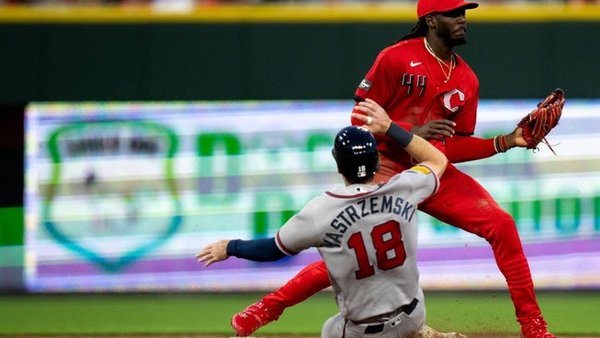
Brady Singer has surrendered 16 home runs in 51 innings — one of the worst HR rates in baseball — yet the Cardinals are priced at just -142, a number that reflects the market already agreeing on the pitching gap. The friction here isn’t which team is better; it’s whether the juice has already swallowed the edge.
Brady Singer vs Kyle Leahy: Cincinnati Reds at St. Louis Cardinals Betting Preview
The Cardinals open this NL Central home series as -142 favorites, a number that feels intuitive on the surface given the pitching edge. Kyle Leahy has been the more functional starter by every measurable angle, and Brady Singer has been one of the worst arms in baseball this season. The market clearly sees the gap. The problem is that -142 is the price you pay when the market already agrees with you — and that’s exactly what creates the friction in this spot.
St. Louis is the right side. The Cardinals’ superior team-wide pitching infrastructure (ERA of 4.14, WHIP of 1.356) versus Cincinnati’s staff (ERA of 4.76, WHIP of 1.453) extends the edge well beyond just the starter matchup. Jordan Walker is hitting .291 with a 0.892 OPS and 15 home runs; Alec Burleson is driving in runs at a steady clip. The lineup has real weapons against a leaky Singer.
But here’s the honest framing: I like the Cardinals in this game. I’m not sure I like them at -142. That ceiling matters, and everything that follows is about understanding whether the edge still bleeds through the juice.
Game Info & Betting Lines
- Date/Time: Friday, June 5, 2026 | 8:15 PM ET
- Venue: Busch Stadium | Park Factor: 1.00 (neutral run environment)
- TV: MLB.TV, Reds.TV, Cardinals.TV
- Probable Starters: Brady Singer (CIN) vs Kyle Leahy (STL)
- Moneyline: Cincinnati Reds +120 / St. Louis Cardinals -142
- Run Line: St. Louis Cardinals -1.5 (+138) / Cincinnati Reds +1.5 (-166)
- Total: 9.5 (Over +100 / Under -122)
Why This Number Is Close
The market is doing something reasonable here. Singer has been genuinely bad — a 6.18 ERA, 1.69 WHIP, and 16 home runs allowed in just 51 innings is a disastrous HR/9 rate by any standard — but Busch Stadium is a perfectly neutral park (factor of 1.00), and the Cardinals have dropped seven of their last ten games. The market isn’t ignoring the pitching edge; it’s discounting the Cardinals’ recent slide and pricing Cincinnati’s lineup, which carries genuine threats at the top even without Elly De La Cruz (hamstring, IL).
The legitimate case for the Reds is that Singer’s ERA is real but his secondary numbers aren’t a total disaster across the board, and a Cardinals team in a cold stretch at home is a different proposition than one riding momentum. JJ Bleday carries a 1.003 OPS and Sal Stewart has 12 home runs — this Cincinnati lineup can still do damage against a starter whose sinker is being punished to the tune of a 0.594 xwOBA against.
Where I think the market is slightly wrong is in underweighting how pronounced the pitching gap actually is. Leahy’s curveball and slider create a different kind of innings than Singer can. The Cardinals’ run prevention edge is real enough that -142 isn’t as inflated as it feels — but it’s right at the boundary where I start getting uncomfortable recommending it as a standalone play.
What Separates the Pitching
The gap between these two starters is measurable and significant. Singer sits at a -0.29 WAR on the season while Leahy has posted a +0.43 WAR — a swing of roughly 0.72 wins — and that differential tells you something concrete about how the season has actually gone for each arm.
Start with the arsenals. Singer leans heavily on his sinker (29.7% usage, 94.1 mph), but that pitch is being absolutely punished — an xwOBA of 0.594 against it, with a whiff rate of just 10.1%. That’s a pitch hitters are squaring up, and with the Cardinals posting a .240 team batting average and genuine power threats like Jordan Walker (.471 xwOBA, 7.4% barrel rate, 31.6% hard-hit rate) sitting in the middle of the lineup, that sinker is a liability. Singer’s curveball is his best offering (40.8% whiff, .265 xwOBA), but he only deploys it 26.4% of the time — not enough to compensate for the sinker getting hammered. His four-seam fastball, used 22.2% of the time, carries a 0.286 xwOBA against — better than the sinker, but the pitch still generates only a 24.6% whiff rate and limited put-away ability at 23.1%.
Leahy operates with more depth. His slider (23.3% usage, 86.5 mph) generates a 36.4% whiff rate and .292 xwOBA against, and his curveball (15.1%) goes even further — .215 xwOBA and 34.5% whiff, a true swing-and-miss weapon. The concern with Leahy is his four-seam fastball, which leads his arsenal at 32.0% usage but carries a .445 xwOBA against and only an 11.1% whiff rate. That’s a pitch being hit hard when contact is made. Nelson Velázquez sits at a .573 xwOBA overall and a .735 xwOBA versus left-handed pitching — Leahy is right-handed, so the splits don’t directly apply, but Velázquez’s barrel rate (8.9%) and hard-hit rate (35.7%) make him a threat regardless.
The type of innings each pitcher creates matters here. Singer generates hard contact and home run risk. Leahy generates swing-and-miss opportunities but carries fastball vulnerability. In a neutral park, that difference in home run suppression — Singer’s 16 allowed versus Leahy’s 8 in roughly comparable innings pitched — is the clearest edge in the entire matchup.
The Pushback
Here’s where I have to pump the brakes. Both offenses are closer to league average than their top hitters suggest. The Cardinals post a .240/.317/.384 slash line as a team — solid but not dominant. Cincinnati’s .229 average is modest, but their 77 home runs as a team (versus St. Louis’s 65) tell you they can still do damage in bunches. With De La Cruz on the IL, that power threat is reduced, but Bleday (1.003 OPS, 10 home runs), Sal Stewart (.818 OPS, 12 home runs), and Spencer Steer (.817 OPS) give the Reds enough to hang around against Leahy’s vulnerable fastball.
St. Louis’s 3-7 run over the last ten games is a real concern. Teams in cold stretches don’t always right the ship immediately, and a home crowd that has watched seven losses in ten chances isn’t going to provide the kind of lift this lineup might need against a team that, even with Singer’s struggles, still has legitimate hitters at the top.
The Cardinals’ bullpen neutrality (component breakdown showing even bullpen split) means the starting pitching edge doesn’t get amplified in the late innings the way you’d want it to at -142. If Singer exits early and Cincinnati turns it over to their relievers, Leahy’s advantage narrows considerably once both teams are operating out of the pen.
Run Environment & Game Shape
The total is set at 9.5, and that feels right for this matchup. Busch Stadium plays neutral (park factor of 1.00), so there’s no environmental inflation to worry about. Singer’s profile — heavy sinker usage, elevated HR rate, below-average whiff numbers — points toward a game where St. Louis can generate scoring opportunities in clusters. Leahy’s swing-and-miss secondary pitches (slider and curve combining for 36.4% and 34.5% whiff rates respectively) give him the ability to limit damage in stretches, even if his fastball is hittable.
The numbers project this as a 5-4 or 4-3 Cardinals win — a one-run or two-run margin that reflects the pitching edge without overstating it. That game shape is exactly why the run line at +138 for St. Louis -1.5 is an interesting footnote, but the juice on the Cardinals moneyline is already the central tension here, and layering in run line risk compounds it rather than resolves it.
The Pick
The Cardinals are the right side. The pitching edge is real, the home run suppression gap is real, and Singer facing a lineup with Walker, Velázquez, and Burleson in the middle is a bad matchup for Cincinnati’s starter. I’m not going to pretend the case for St. Louis isn’t compelling — it is.
But -142 does not clear my juice threshold for a standalone play. At that price, you need to win this bet roughly 59% of the time just to break even, and a Cardinals team that has gone 3-7 over their last ten games, facing a lineup that still carries power threats even without De La Cruz, is not a 59%-win proposition I’m comfortable locking in as a primary bet. The edge is there. The price is just a touch too fat for me to put real money on it in isolation.
Cardinals ML at -142 is a lean only — parlay leg or beer money action. If you’re building a multi-game ticket and need a side you feel good about, St. Louis belongs on it. If you’re looking for a standalone bet you can size up, this isn’t that spot. The -130 range would change the calculus; at -142, I’m keeping the units at zero and flagging this as the kind of side-I-like-but-can’t-fully-endorse that the juice creates far too often in the early-week lines.
Bet: Cardinals ML — lean only (parlay leg or beer money) | 0 units