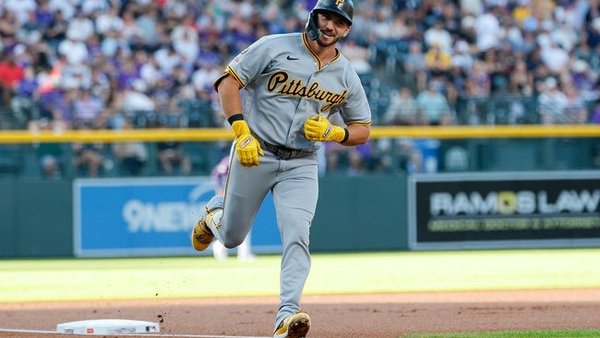
Saturday’s 9-7 chaos has the market treating Sunday like a rerun — but both teams send legitimate starters with full rest while Pittsburgh trots out a lineup missing Horwitz and Cruz. The total sits at 8.5 with the over juiced to -124, yet the underlying conditions point in a different direction than yesterday’s box score does.
Brady Singer vs. Mitch Keller: Cincinnati Reds at Pittsburgh Pirates Betting Preview
Saturday’s brawl — a 9-7 slugfest driven by bullpen meltdowns on both sides — burned through relievers on each roster. Now the market has repriced today’s total upward to 8.5, likely anchored to that chaos. The problem is that Sunday series finales almost never mirror the game that preceded them. Both teams send legitimate starters to the mound with full rest, and two of Pittsburgh’s most dangerous bats — Spencer Horwitz and Oneil Cruz — are watching from the IL.
The thesis here isn’t complicated: a pitcher-friendly park, depleted lineups, mediocre-but-consistent starters, and plus money on the low side of a number the market inflated on recency. The numbers project 9.1 combined runs, which is technically over 8.5 — I’ll address that tension directly. But the under at +102 in a 0.96-factor park with that lineup downgrade is the kind of value spot that doesn’t announce itself loudly. It just sits there, waiting.
Game Info & Betting Lines
- Date/Time: Sunday, June 28, 2026 | 1:35 PM ET
- Venue: PNC Park (Park Factor: 0.96 — pitcher-friendly)
- TV: MLB.TV, Reds.TV
- Probable Starters: Brady Singer (CIN) vs. Mitch Keller (PIT)
- Moneyline: Cincinnati Reds +112 / Pittsburgh Pirates -132
- Run Line: Pittsburgh Pirates -1.5 (+158) / Cincinnati Reds +1.5 (-192)
- Total: 8.5 (Over -124 / Under +102)
Why This Number Is Off
The market’s logic is sound on the surface: two starters with ERAs hovering near 4.89, a ballpark that doesn’t suppress runs dramatically, and fresh memory of a 16-run combined output the day before. Setting 8.5 is defensible. The over at -124 reflects where the sharp and square money has gravitated — leaning into the offensive environment while respecting that both starters carry bloated WHIPs.
But here’s the problem: the market is conflating a bullpen game with a starter game. Saturday’s total was built on late-inning meltdowns — Gregory Soto surrendering a three-run walk-off, Caleb Ferguson giving up a pinch-hit homer in the eighth. Those aren’t indicators of starter run environment; they’re indicators of overtaxed relievers. Today, both bullpens step back in with reduced availability, and both teams will want length from their starters after burning through arms Saturday.
The under at +102 signals the market sees this as genuinely close to a coin flip — the juice difference between over (-124) and under (+102) is a significant gap suggesting bettors have piled onto the over. That creates the value. When the crowd chases yesterday’s number, the under is where the price gets left behind. PNC’s 0.96 park factor suppresses run totals modestly but consistently, and the Pittsburgh lineup without Horwitz and Cruz is meaningfully weaker than the one that hung seven runs on Saturday.
What Separates the Pitching
At first glance, Brady Singer (4.81 ERA, 1.51 WHIP, 73 IP) and Mitch Keller (4.89 ERA, 1.32 WHIP, 88.1 IP) look nearly identical — two mid-rotation arms generating traffic without imploding. But the Statcast profiles reveal meaningful differences in how they generate outs and where they’re vulnerable.
Singer leans heavily on his sinker — 48.0% usage at 91.3 mph — a pitch that holds hitters to a .357 xwOBA. That’s not dominant, but the sinker’s ground-ball orientation limits the big-inning risk that Singer’s WHIP might otherwise suggest. His slider (32.4% usage, 28.8% whiff rate, .311 xwOBA) is his true put-away weapon. The concern is his cutter (.468 xwOBA) and four-seamer (.577 xwOBA) — he throws these sparingly, but when he misses with them, damage follows. His 17 HR allowed in 73 IP is the loudest red flag in his profile.
Keller operates differently. His four-seamer (32.6% usage, 93.4 mph) isn’t a strikeout pitch — 15.1% whiff rate, .364 xwOBA — but he complements it with a curveball that generates an elite 36.4% whiff rate and .285 xwOBA, and a sweeper sitting at .283 xwOBA. His cutter (.253 xwOBA) is arguably his most efficient offering. Worth noting on the other side of the ledger: Keller’s sinker carries a .430 xwOBA, his weakest offering, so left-handed power hitters who can stay on the inner half have a path to damage. The critical number, though, is that Keller has allowed only 9 HR in 88.1 IP. In a park that already suppresses power, that low home run rate dramatically limits multi-run innings.
The matchup signals worth noting: Bryan Reynolds carries a .420 xwOBA and a .375 batting average across 19 career PA against Singer with 2 HR — Singer’s sinker profile doesn’t neutralize Reynolds. On the Pittsburgh side, Brandon Lowe is 0-for-20 in 20 career PA against Singer with 4 strikeouts — a genuine Singer mismatch that could suppress Pittsburgh’s most dangerous power bat on the day.
The Pushback
The honest case against the under starts with the projection: the edge engine projects 9.1 combined runs, which clears the 8.5 total by 0.6 runs. That’s not a screaming over signal, but it’s technically on the wrong side of the number I’m playing. I’m not ignoring it — I’m discounting it for three reasons. First, the 9.1 projection doesn’t fully account for the IL-depleted Pittsburgh lineup; losing Horwitz and Cruz strips out two of their top five bats by OPS. Second, Singer’s sinker-heavy approach plays better in daylight Sunday starts than his ERA suggests — the ground-ball profile generates double plays, not strikeouts, but it limits crooked numbers. Third, the bullpen depletion cuts both ways: neither team can afford to let a starter implode and go to the pen early, which creates incentive for both managers to let their starters work through contact rather than yank them at the first sign of trouble.
The other angles I looked at and rejected: the Pirates ML at -132 has real juice for a team I think wins this game, but paying -132 in a series finale with two mediocre starters and a depleted roster doesn’t offer enough cushion. The run line at +158 for Pittsburgh is attractive on paper, but the IL situation makes the -1.5 cover a coin flip — Cruz and Horwitz are exactly the run-support bats you need when you’re trying to win by two. The over at -124 is simply too expensive to chase a 0.6-run projected edge when the underlying context argues for regression from Saturday’s chaos.
The Bottom Line
Sunday afternoon, PNC Park, both bullpens taxed, two starters with nearly identical surface stats but meaningful Statcast separation, and a lineup missing its two most dangerous IL-sidelined bats against a pitcher who has held Pittsburgh’s best power hitter hitless across 20 career plate appearances. The market priced this game off Saturday’s energy. The actual game-day conditions argue for fewer runs, not more. Singer’s sinker keeps the ball in the yard, Keller’s curveball generates elite whiff rates in the zone, and PNC does the rest. This isn’t a screaming edge — it’s a disciplined lean into plus money in a pitcher-friendly environment.
The play is the under 8.5 at +102 for 1 unit.