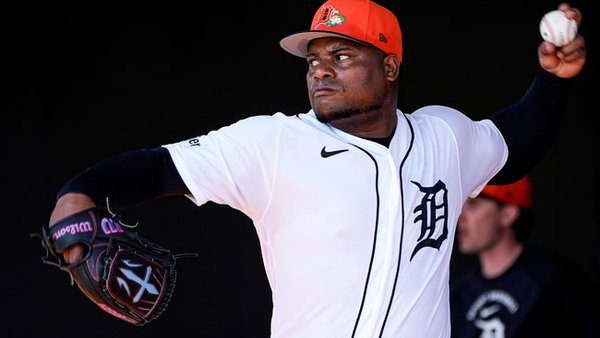
Framber Valdez’s ground-ball sinker and Mason Adams’ 11.2 K/9 strikeout rate point toward a suppressed early-inning run environment — yet the market is pricing the over at -114 as if both starters don’t exist. Detroit’s .709 team OPS and Colorado’s recently cold lineup create a run environment the posted total of 8.0 hasn’t fully accounted for.
Mason Adams vs Framber Valdez: Colorado Rockies at Detroit Tigers Betting Preview
The market has this total set at 8.0 and is leaning toward the over at -114, with the under available at -105. That nine-cent gap isn’t enormous, but it matters — it means the books expect a slightly higher-scoring game, and we’re fading that assumption at a discount.
The surface-level case for the over writes itself: Colorado’s bullpen carries a 5.50 ERA, Detroit’s offense has genuine power threats, and the numbers project 9.3 combined runs. If you stop there, you bet the over and move on. But the starting pitchers are where this game actually gets shaped, and both starters create a run environment that the raw season numbers for these teams don’t capture. Comerica Park runs at a 0.99 park factor — essentially neutral, no inflation to bail out sloppy pitching or reward overmatched hitters.
The structural lean here is toward suppressed early-inning scoring. Framber Valdez has a ground-ball identity that limits crooked numbers, and Mason Adams is generating strikeouts at an elite rate in his limited sample. Detroit’s offense sits at a .709 OPS — below league average — and Colorado’s lineup has gone cold recently after being swept in New York. This is a game that wants to stay under if the starters hold their shape.
Game Info & Betting Lines
- Date/Time: Friday, September 11, 2026 | 6:40 PM ET
- Venue: Comerica Park | Park Factor: 0.99 (neutral)
- TV: MLB.TV, Rockies.TV, Tigers.TV
- Probable Starters: Mason Adams (Colorado) vs Framber Valdez (Detroit)
- Moneyline: Colorado Rockies +154 / Detroit Tigers -187
- Run Line: Detroit Tigers -1.5 (+118) / Colorado Rockies +1.5 (-143)
- Total: 8.0 (Over -114 / Under -105)
Why This Number Is Slightly Off
The market is setting 8.0 and pricing the over at -114 for defensible reasons. Colorado’s pitching staff is genuinely bad — a 5.50 ERA and 1.52 WHIP tell you that once Adams exits, the Rockies’ bullpen is a liability. Detroit has legitimate power in its lineup with Dillon Dingler (26 HR), Riley Greene (19 HR), and Hunter Goodman on the other side at 37 HR. The books aren’t wrong to acknowledge the over-side argument.
But here’s the problem: the total is priced as if the starters don’t exist. Adams and Valdez are on the mound today, not the respective bullpens. The books are pricing in regression toward each team’s season-long numbers, which includes a lot of bad pitching on Colorado’s part. Adams’ 11.2 K/9 over 13.2 innings is a real signal that he can suppress Detroit’s lineup in the early frames, even accounting for sample size concerns.
The legitimate edge is simple: under at -105 is nine cents cheaper than over at -114. When the projected gap is 1.3 runs over the total — not 3, not 4, but 1.3 — you’re not getting a slam-dunk read from the numbers. That marginal gap combined with the structural case for suppressed scoring makes the under the better-priced side, not necessarily the mathematically dominant one.
What Separates the Pitching
Valdez and Adams create very different types of innings, and the contrast matters for how you think about run scoring.
Framber Valdez is the workhorse here — 157.2 innings pitched, a 1.36 WHIP, and a sinker that he throws 44.9% of the time at 93.8 mph. That sinker generates weak contact rather than strikeouts, holding hitters to a .373 xwOBA but producing ground balls that keep the ball in the park. His curveball (28.8% usage, 78.4 mph) is the true weapon — a 29.8% whiff rate and .271 xwOBA against, tunneling beautifully off the sinker. His slider sees only 4.5% usage but is devastating when deployed, holding hitters to a .159 xwOBA. Valdez’s profile isn’t strikeout-heavy (6.79 K/9), but it’s contact-management: he allows runs, yes — a 4.17 ERA and 9-10 record confirm it — but he creates consistent, manageable innings rather than big explosions. Against Colorado’s top order, Hunter Goodman (.440 xwOBA overall, 37 HR) is the legitimate threat, and his .457 xwOBA vs. left-handed pitching makes him the name to watch in every at-bat against the southpaw Valdez.
Mason Adams works the opposite profile. His curveball is the headline: 58.3% whiff rate, .318 xwOBA against, deployed 16.3% of the time. His four-seam fastball sits at 93.3 mph and generates a 22.2% whiff rate. Together with a cutter showing a .229 xwOBA against, Adams has genuine swing-and-miss stuff — hence the 11.2 K/9. The matchup concern is Riley Greene (.468 xwOBA overall, .487 xwOBA vs. right-handed pitching), who is Detroit’s most dangerous hitter against a right-hander like Adams. Greene’s 7.1% barrel rate and 28.4% hard-hit rate make him a legitimate home-run threat against Adams’ four-seam, which surrenders a .375 xwOBA. The gap between the two arms: Valdez is the proven commodity across a full season, while Adams is flashing elite metrics in 13.2 innings. When they’re both on, this game stays quiet. The question is which one cracks first.
The Pushback
The honest version of this analysis has to start with Colorado’s bullpen problem. Adams has thrown 13.2 innings this season. He’s not pitching a complete game. The moment he exits, the Rockies’ 5.50 ERA relief corps takes over, and Detroit’s power bats — Greene, Dingler, Eduardo Valencia — have the kind of exit velocity profiles that punish middle-relievers in a hurry. That’s the real over argument, and it’s not trivial.
On the Colorado side, Hunter Goodman’s .457 xwOBA against left-handed pitching is a genuine threat against Valdez. That’s an elite number, and Goodman has 37 home runs — he doesn’t need many pitches to change a game. But Zac Veen, batting fifth for Colorado, tells a very different story against lefties: his vsLHP xwOBA sits at just .090, meaning Valdez neutralizes him almost entirely. That’s the kind of split that actually reinforces the under case — Colorado’s middle of the order has a massive hole once you get past Goodman, and Valdez is exactly the pitcher to exploit it.
The counter to the over case is structural: the bullpen problem is real but priced in. The total is 8.0, not 6.5. There’s already an acknowledgment baked into the line that Colorado’s pitching will leak runs at some point. What isn’t fully priced in is the probability that both starters go five-plus effective innings before the bullpens take over, keeping the early-inning run environment quiet enough that the back-end leakage doesn’t push the total over the number.
Run Environment & Game Shape
Detroit and Colorado have both struggled to score consistently in their last few series. The Tigers went 4-6 over their last ten games and only recently snapped a seven-series losing streak. Colorado just got swept in New York, scoring three or fewer runs in two of those three games. Neither lineup is in a hot streak heading into this matchup.
Comerica Park’s 0.99 park factor gives us nothing in either direction — this is a pure pitcher-vs-hitter matchup with no environmental thumb on the scale. Detroit’s team OPS of .709 is below league average, and while Colorado’s .737 OPS looks slightly better on paper, their lineup has been trending cold. The park won’t bail anyone out, and neither offense enters this game riding momentum.
The shape of this game points toward a 4-5 run first half followed by moderate bullpen exposure in the late innings. If Valdez and Adams both hold form through five-plus innings — which their respective arsenals suggest is plausible — the total stays manageable. The under at -105 gives you a nine-cent discount over the over, and in a spot where the scoring projection only marginally favors the over, that pricing edge is meaningful.
Bet: Under 8.0 (-105) for 2 units. The structural case is clear — two starters with genuine suppression profiles, a neutral park, and two offenses that aren’t running hot. The -105 price is exactly where you want to be when the over-under argument is this close on the numbers.