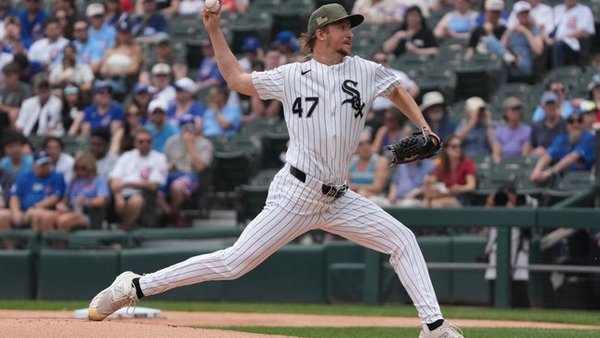
The Giants carry a -57 run differential, a 20-31 record, and two injured outfielders — yet the market is still pricing them as a -124 home favorite. Chicago’s win probability at 54.4% implies a fair number near -118, but the White Sox are sitting at +106. The home-field narrative is doing a lot of heavy lifting that the talent on the field does not support.
Erick Fedde vs. Adrian Houser: Chicago White Sox at San Francisco Giants Betting Preview
After last night’s 9-run fourth inning turned Oracle Park into a White Sox showcase, the market has barely moved. Chicago is still sitting at +106 on the moneyline — plus money on a team with a 26-24 record against a Giants squad that is 20-31 and owns one of the worst run differentials in baseball at -57. That’s the core inefficiency here. The bookmakers are leaning on home-field optics, but the Giants’ lineup is missing Jung Hoo Lee (10-Day IL, back) and Heliot Ramos (10-Day IL, quad) — two of their top three listed outfielders — and their last 10 games read 3-7. The market is pricing the Giants’ zip code. Chicago’s win probability at 54.4% implies a fair moneyline around -118. Getting the White Sox at +106 is a 9.8% implied probability edge, and those don’t show up clean very often.
Neither starter will inspire confidence, and I want to be direct about that: this is not a game you back because of elite pitching. It’s a game you back because one lineup is meaningfully better than the other, the price is wrong, and the value is sitting right in front of you at +106.
Game Info & Betting Lines
- Date/Time: Saturday, May 23, 2026 — 4:05 PM ET
- Venue: Oracle Park (Park Factor: 0.92 — run-suppressing)
- TV: MLB.TV, NBC Sports BA, CHSN
- Probable Starters: Erick Fedde (Chicago, 0-4, 4.30 ERA) vs. Adrian Houser (San Francisco, 2-4, 5.25 ERA)
- Moneyline: Chicago White Sox +106 / San Francisco Giants -124
- Run Line: Chicago White Sox +1.5 (-210) / San Francisco Giants -1.5 (+172)
- Total: 8.5 (Over -105 / Under -115)
Why This Number Is Off
The market’s case for SF at -124 rests on two pillars: home field and the assumption that both starters are roughly equal disasters. The Giants do get a real edge from playing at Oracle Park — the crowd knows it, the quirks of right-center field matter, and there’s something legitimate about familiar surroundings. And yes, the books are right that both starters are bad. Fedde’s 4.30 ERA with 11 home runs allowed in 46 innings is alarming. The market is not wrong to acknowledge the pitching gap is minimal.
But here’s the problem: the market is treating two injured outfield spots as a footnote and ignoring the Giants’ .666 team OPS — the weakest offensive profile in this matchup by a meaningful margin. The White Sox carry a .724 OPS with genuine power threats who don’t need a perfect pitching performance to manufacture runs. When you strip out the injured players and look at what the Giants are actually rolling out in that lineup, the -124 price is carrying a level of home-bias that isn’t supported by the talent on the field tonight. The numbers put Chicago’s win probability at 54.4%, implying a fair moneyline around -118. Getting Chicago at +106 is a 9.8% implied probability edge — and those don’t show up clean very often.
What Separates the Pitching
Let’s be honest about what we have here: Erick Fedde (0-4, 4.30 ERA, 1.30 WHIP) against Adrian Houser (2-4, 5.25 ERA, 1.48 WHIP). This isn’t a pitcher’s duel — it’s a question of which vulnerable arm faces a better opposing lineup.
Fedde’s arsenal is built around a four-seam fastball at 91.9 mph that he throws 62.3% of the time, generating a solid 27.0% whiff rate and a suppressed .268 xwOBA against. That’s actually a competent pitch. His sweeper at 80.7 mph adds a secondary option (21.8% whiff), and his cutter produces the best xwOBA-against in his arsenal at .193 — though he deploys it only 4.3% of the time. The real concern with Fedde is his sinker: 8.9% usage, .368 xwOBA against, suggesting hitters do damage when he goes to it. His 11 HR allowed in 46 IP is not a park artifact — it’s a profile that gets hit hard when he misses.
Houser is structurally more dangerous to his own team. His bread-and-butter is a sinker at 94.7 mph — thrown nearly 46.5% of the time — but that pitch generates a .415 xwOBA against with only a 7.3% whiff rate. That is a contact-heavy, damage-inviting profile against a White Sox lineup that includes Munetaka Murakami at a .535 xwOBA with an 11.1% barrel rate and 37.8% hard-hit rate. Murakami has been feasting on right-handed pitching all season (.546 xwOBA vs. RHP), and Houser throws him the kind of heavy sinker that Murakami punishes. Vargas (.421 xwOBA, 7.2% barrel) and Montgomery (.422 xwOBA) round out a top-four that represents a legitimate problem for a groundball pitcher who can’t miss bats. Houser’s -0.62 WAR isn’t just a bad number — it’s a negative-value pitcher the market is asking you to bet on.
The gap between these two arms, while narrow on ERA, is real when you look at the contact profiles and the lineups each one is facing. Fedde is bad, but Houser is walking into a worse matchup.
The Pushback
I don’t want to oversell this. There are real reasons to hesitate at +106, and ignoring them would be dishonest handicapping.
Fedde’s homer rate is genuinely scary. Eleven home runs in 46 innings is not a slump — it’s a profile, and Oracle Park’s 0.92 park factor only mutes it slightly. The Giants have legitimate power threats in Casey Schmitt (.866 OPS, 9 HR) and Rafael Devers, and while Devers has been quiet (.694 OPS), he’s the kind of hitter who can go deep against a fastball-heavy pitcher in any given at-bat. Fedde’s .368 xwOBA on his sinker is the exact vulnerability Schmitt and Devers are built to exploit.
Chicago’s injury list also deserves acknowledgment. Austin Hays (10-Day IL, calf), Everson Pereira (10-Day IL, pectoral), and Kyle Teel (60-Day IL) create real depth concerns. The White Sox are running out a lineup that has been reshuffled multiple times, and the players filling those spots are unproven. That’s not nothing.
And the projected score is essentially a coin flip: 4.4 to 4.3. That’s not a comfortable margin to hang a bet on. Anyone who tells you this is a lock is lying to you.
What keeps me on Chicago is the compounding nature of the Giants’ disadvantages. The injury-depleted outfield isn’t one missing piece — it’s two of their best outfielders gone at the same time. The .666 team OPS was already the weaker profile in this matchup before those losses. The last-10 record of 3-7 is not a sample size accident; it reflects a team that has been losing the close games all month. And Houser’s sinker-heavy approach is the wrong pitch mix to be throwing at a White Sox lineup that hits the ball hard on the ground and in the air.
The Run Line: Hard Pass
Chicago +1.5 at -210 is gross value destruction. You’re laying more than two-to-one juice to win a single run of cushion against a team that scored 9 runs last night. The moneyline at +106 gives you the same directional bet without the crippling price tag. If you believe in Chicago here, you take the plus-money moneyline and walk away from the run line entirely. There is no version of this math where -210 makes sense when +106 is sitting right next to it.
Run Environment & Game Shape
Oracle Park’s 0.92 park factor is meaningful context here, but it doesn’t change the fundamental shape of this game. Both starters carry WHIPs north of 1.30, neither misses many bats, and the total is set at 8.5. The over is juiced to -105, which tells you the books expect scoring. The run environment is suppressed by the park, not by the pitching — and that’s an important distinction. A suppressed run environment driven by pitcher dominance is a reason to fade offense. A suppressed run environment driven by park factors while both starters are contact-heavy flyball-and-groundball disasters just means the final score might be 5-4 instead of 7-5. It doesn’t protect the Giants’ lineup from Houser’s .415 xwOBA sinker problem, and it doesn’t help Fedde avoid the deep counts and hard contact that have defined his season.
The game shape I’m expecting: both starters get through five or six innings with moderate damage, the bullpens take over in the middle frames, and the White Sox’s offensive edge — anchored by Murakami, Vargas, and Montgomery — does enough to win a game that probably lands somewhere in the 5-4 to 6-5 range. That’s not a blowout. It doesn’t need to be. At +106, I just need Chicago to win the game.
Bet: Chicago White Sox Moneyline +106 — 2 units — Moderate confidence. The price is wrong, the lineup edge is real, and the Giants are asking you to lay -124 on a 20-31 team missing two starting outfielders. I’ll take the plus money.