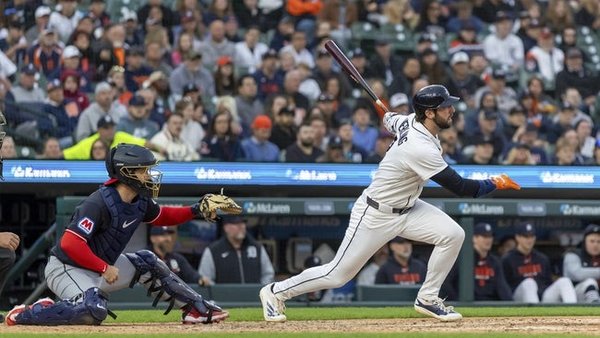
Trevor Rogers carries a 6.87 ERA and -0.7 WAR into Sunday’s start, yet Baltimore is priced at -118 — implying 54% win probability against a team the model gives a 39% chance. That 15-point gap in implied probability, compounded by a depleted Orioles bullpen missing three arms, puts real strain on a price leaning too hard on home field and Detroit’s recent skid.
TBD vs Trevor Rogers: Detroit Tigers at Baltimore Orioles Betting Preview
The market has installed Baltimore as a -118 favorite at home, a number that looks reasonable on the surface. But scratch beneath it and you find a starting pitcher with a 6.87 ERA and -0.7 WAR — one of the worst starters in baseball this season — being backed as if he’s a reliable arm. Detroit, meanwhile, is sitting at +100, meaning the market is essentially pricing this as a coin flip. The numbers disagree. Detroit projects to outscore Baltimore 4.8 to 4.6, with a 61% win probability. Getting plus money on the projected winner in a near-neutral park is the argument in one sentence.
The complication — and it’s a real one — is that Detroit’s starter is TBD. That’s not a footnote, it’s the central risk of this play. But the Rogers problem is so significant that even an unannounced arm has a path to making this work. When you combine a struggling starter on one side with a depleted Baltimore bullpen on the other, the structural case for Detroit money shifts from interesting to actionable.
Yesterday’s game in this series was rained out, which means both teams carry their recent form into today without the rhythm reset a full game might provide. The previous bet in this series targeted the under — that result is still pending — but today’s number asks a different question entirely.
Game Info & Betting Lines
- Date/Time: Sunday, May 24, 2026 — 6:05 PM ET
- Venue: Oriole Park at Camden Yards (Park Factor: 1.01 — essentially neutral)
- Probable Starters: Detroit Tigers — TBD (WARNING: no confirmed starter) vs. Baltimore Orioles — Trevor Rogers (2-5, 6.87 ERA)
- Moneyline: Detroit Tigers +100 / Baltimore Orioles -118
- Run Line: Detroit Tigers -1.5 (+168) / Baltimore Orioles +1.5 (-205)
- Total: 8.5 (Over -105 / Under -115)
Why This Number Is Off
Baltimore at -118 implies roughly 54% win probability. The numbers give them 39%. That’s a 15-point gap in implied probability — not a rounding error, a genuine market inefficiency. The market is leaning on home-field advantage and Detroit’s 1-9 last-10 record to justify the price. Both of those are legitimate inputs. Camden Yards is a familiar environment for the Orioles, and a team on a seven-game losing streak carries real psychological weight.
But here’s the problem: the Orioles’ own numbers undercut their pricing. Baltimore’s run differential on the season sits at -56, compared to Detroit’s -26. The Orioles are being priced like a .500-ish team with upside when their actual production profile says otherwise. Their pitching staff ERA of 4.95 is nearly a full run worse than Detroit’s 3.97. The market is anchoring on home field and Detroit’s recent skid while ignoring that Baltimore is sending out a starter the rest of the league has been teeing off on all season.
The legitimate case for Baltimore is real — home environment, Pete Alonso locked in with 10 home runs and a .433 xwOBA, and an opponent who can’t name its starter. I understand why the market has the Orioles as a mild favorite. I just don’t think that case is worth -118 when Rogers is the arm getting the ball.
What Separates the Pitching
Trevor Rogers has been functionally unplayable this season. His 6.87 ERA and 1.66 WHIP across 38 innings tell the story, but the Statcast data tells it louder. His four-seam fastball — thrown 42.9% of the time at 94.2 mph — generates a .325 xwOBA against with only a 10.9% put-away rate. That’s a pitch being hit hard, not missed. His split-finger, used 19.2% of the time, is actively getting punished at a .445 xwOBA against. His sinker isn’t much better at .398 xwOBA. The slider is the one weapon that plays — 36.8% whiff rate and .257 xwOBA — but at 15.8% usage, it can’t carry the arsenal.
Detroit’s lineup is built to hurt Rogers. Riley Greene (.324 AVG, .889 OPS, .487 xwOBA season-long) and Dillon Dingler (9 HR, .464 xwOBA) represent serious damage potential. Dingler specifically sits at a .376 xwOBA versus left-handed pitching and a .504 xwOBA versus right-handers — Rogers throws from the left side, which is the slightly more favorable side for Dingler, but the production profile still reads as dangerous. Greene’s .465 xwOBA versus lefties makes him the primary matchup threat.
On the Detroit side, the TBD caveat is unavoidable and significant. The Statcast data in the system reflects a sinker-heavy profile (46.4% usage, 93.9 mph) with a curveball at 32.7% whiff rate and a slider generating 42.1% whiff. If that arsenal belongs to whoever Detroit sends out, it’s a competent profile. But without a confirmed name, projecting performance is guesswork. What we can say is that Detroit’s team ERA of 3.97 suggests their pitching infrastructure — starters and bullpen combined — is meaningfully stronger than Baltimore’s 4.95 mark. That gap doesn’t evaporate just because the name on today’s lineup card is blank.
Baltimore’s bullpen is also compromised. Ryan Helsley (IL, elbow), Grant Wolfram (IL, back), and Yaramil Hiraldo (IL, shoulder) are all unavailable. If Rogers exits early — and his history suggests he will — Baltimore is leaning on a thinned-out relief corps to hold whatever lead they may or may not have built. That’s a structural edge for Detroit that doesn’t show up cleanly in any single stat line, but it’s real.
The Pushback
The case against this play isn’t hard to construct. Detroit is on a seven-game losing streak and has lost 14 of their last 16. The psyche of a team in freefall is a genuine factor, even if it doesn’t show up in xwOBA splits. Kerry Carpenter and Gleyber Torres — two lineup contributors — are both on the IL, which thins Detroit’s offensive depth past the top of the order. The team batting .234 with an OPS of .688 isn’t exactly a lineup that punishes bad pitching with consistency.
On the Baltimore side, Pete Alonso is genuinely dangerous. His 10 home runs, .433 xwOBA, 35.2% hard-hit rate, and 7.3% barrel rate make him a one-swing threat in any count. He homered in Friday’s game and has been one of the more productive bats in the league over the last few weeks. Samuel Basallo adds another layer at an 8.7% barrel rate and .441 xwOBA — this is not a lineup that rolls over.
And the unknown starter is a real problem for this play, not a dismissible one. If Detroit sends out a replacement-level arm, the 61% win probability attached to this game evaporates fast. That’s not a hypothetical risk — it’s the central uncertainty. I’m not dismissing it. I’m weighing it against a 6.87 ERA on the other side and concluding that Rogers is the more predictable liability of the two.
Run Environment & Game Shape
The combined run total is posted at 8.5. The underlying numbers project 9.4 combined runs — marginally over the line, but not by a margin that screams action. That 0.9-run edge is real, and if forced to pick a direction on the total, the over is the secondary lean. The Rogers ERA alone could inflate scoring enough to push past 8.5, and Camden Yards at a 1.01 park factor isn’t suppressing anything.
But the TBD starter introduces too much variance to make the total the primary play. An unknown Detroit arm could be a run-prevention asset or a five-inning disaster — there’s no way to price that cleanly. If the TBD arm comes in soft and gets shelled early, the over cashes easily. If Detroit sends out someone capable of keeping Baltimore’s lineup quiet through five or six, the under has a path. The total edge is narrow and the variance is wide, which is exactly the combination that makes it a lower-confidence play.
The run line at +168 for Detroit -1.5 is similarly off the table as a primary vehicle. The implied win-by-two-or-more requirement asks too much from an unidentified starter on a team in a seven-game skid. Even if Detroit wins this game — and the numbers suggest they should more often than not — asking them to cover a run line with that much lineup and rotation uncertainty isn’t a price worth chasing when the moneyline is sitting at even money.
The Pick
Detroit Tigers moneyline, +100, 2 units, moderate confidence. This is plus money on the team the numbers say should win more than 60% of the time, against a starter with a 6.87 ERA who has been one of the worst arms in baseball this season. The TBD starter is a real risk and the seven-game losing streak is a real headwind — moderate confidence is the right framing, not a strong lean. But getting paid even money on the projected winner in a near-neutral park is the kind of structural edge worth taking. Rogers is the known liability here, and the market is underpricing what that liability actually means for Baltimore’s chances of winning this game.
Bet: Detroit Tigers Moneyline +100 — 2 Units