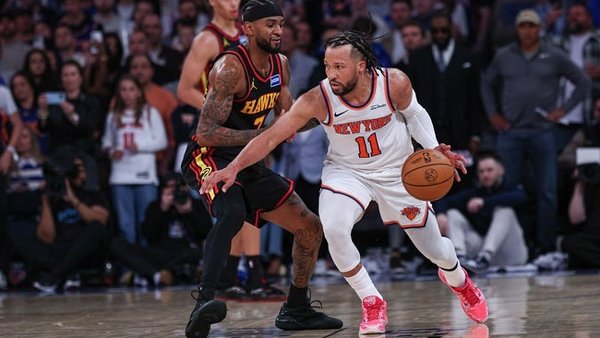
Bash sees a Game 2 matchup where the market may be underpricing New York’s ability to control tempo and dominate the glass in a playoff setting that favors their identity.
The Setup: Hawks at Knicks
New York is laying 5.5 at home in Game 2 after handling Atlanta 113-102 on Saturday night, and the total sits at 217.5. The Knicks controlled that opener from the second half on, with Karl-Anthony Towns scoring 19 of his 25 after halftime and the defense tightening up when it mattered. Atlanta showed life—CJ McCollum and Jalen Johnson combined for 49—but couldn’t sustain it against a deeper, more physical rotation.
Here’s the tension: New York is the better team, no question. They finished seven games ahead in the standings, they’re 30-10 at home, and they just won Game 1 by double digits. But 5.5 is a playoff number that asks the Knicks to win by six or more in a series where Atlanta went 20-6 after the All-Star break and has real offensive firepower. The projection suggests this line might actually be a touch high, but the matchup dynamics tell a different story.
Game Info & Betting Lines
When: Monday, April 20, 2026 | 7:30 PM ET
Where: TBD
Watch: NBC, Peacock
Records: Atlanta Hawks 46-36 (road: 22-19) | New York Knicks 53-29 (home: 30-10)
Current Betting Lines (Bovada):
- Spread: New York Knicks -5.5 (-115) | Atlanta Hawks +5.5 (-105)
- Total: 217.5 (Over -110 / Under -110)
- Moneyline: New York Knicks -235 | Atlanta Hawks +195
Why This Line Exists
The market is giving New York respect for the Game 1 performance and the home-court edge, but it’s also accounting for Atlanta’s ability to score in bunches. The Hawks average 118.5 points per game and play at a 102.5 pace—significantly faster than New York’s 97.7. That pace differential creates natural variance, and the market knows it.
What’s interesting is the total. At 217.5, the market is pricing a slower, grindier Game 2 than what we saw Saturday. Game 1 finished at 215 combined points, and that was with the Knicks controlling tempo for long stretches. The expectation here is that Atlanta will struggle even more to generate clean looks, and New York will continue to muck this up defensively.
The 5.5 spread reflects New York’s efficiency advantage—they posted a +6.4 net rating during the season compared to Atlanta’s +2.2—but it also leaves room for a competitive Hawks team that can shoot and push pace. The question is whether that offensive firepower can actually materialize against a Knicks defense that held them to 102 in the opener and forced them into tough shots late.
Hawks Breakdown
Atlanta’s offense runs through Jalen Johnson, who averaged 22.5 points, 10.3 rebounds, and 7.9 assists during the regular season. He’s a legitimate triple-double threat every night, and he had 23 points in Game 1. Nickeil Alexander-Walker (20.8 PPG, 39.9% from three) and CJ McCollum (18.7 PPG) provide perimeter scoring, and both can get hot in a hurry.
The concern is Onyeka Okongwu, who’s questionable with a right knee injury after logging 19 points and seven rebounds in the opener. If he can’t go, Atlanta loses a key interior presence, and that’s a problem against Towns and Josh Hart on the glass. The Hawks are already at a 5.0 percentage-point disadvantage in offensive rebounding rate, and losing Okongwu would make that gap even wider.
Defensively, Atlanta posted a 112.9 rating during the season, which is respectable but not elite. They gave up 113 in Game 1 and couldn’t get stops when they needed them in the fourth quarter. The defensive versatility just isn’t there to match up with New York’s multiple scoring options.
Knicks Breakdown
Jalen Brunson is the engine—26.0 points and 6.8 assists per game, and he had 28 in the opener. He’s calm, he’s efficient, and he’s comfortable in these moments. Towns gives them a true two-way anchor at 20.1 points and 11.9 rebounds per game, and his second-half takeover in Game 1 was a reminder of what he can do when he’s locked in.
OG Anunoby is probable with a left ankle sprain, but he logged 38 minutes and 18 points in Game 1, so there’s no real concern about his availability. Mikal Bridges and Josh Hart round out a rotation that’s deep, versatile, and built for playoff basketball. Hart’s 11 points and 14 rebounds in the opener were huge, and his energy on the glass is a key reason New York holds a 29.4% offensive rebounding rate compared to Atlanta’s 24.4%.
New York’s 118.7 offensive rating and 112.3 defensive rating give them a meaningful edge on both ends. They’re more efficient, they’re better defensively, and they control the boards. In a playoff setting, those advantages compound.
The Matchup
This is where the separation happens. The projection has New York winning by 4.2 points, which would suggest the 5.5 spread offers slight value on Atlanta. But the matchup dynamics point the other way.
Start with the glass. New York’s 5.0 percentage-point edge in offensive rebounding rate is a strong advantage, and it showed up in Game 1. Hart, Towns, and Anunoby combined for 33 rebounds, and those second-chance opportunities kept Atlanta’s defense on its heels. If Okongwu sits, that gap widens even further, and the Hawks will struggle to limit possessions.
Then there’s pace. Atlanta wants to play at 102.5 possessions per game, but New York wants to slow it down to 97.7. In Game 1, the Knicks dictated tempo, and that’s the blueprint for Game 2. The expected pace blend sits around 100.1 possessions, which favors New York’s halfcourt execution and limits Atlanta’s transition opportunities.
The offensive matchup also tilts toward the Knicks. New York’s offense against Atlanta’s defense creates a 5.8 per 100 possessions advantage, while Atlanta’s offense against New York’s defense is only a 2.7 edge. That’s a meaningful gap, and it suggests the Knicks can score more efficiently in this setting.
Clutch performance is another factor. New York went 21-13 in clutch situations during the season with a +1.4 plus/minus, while Atlanta was 17-18 with a -0.3 mark. The Knicks are better late, and they proved it in Game 1 when they pulled away in the fourth quarter.
Bash’s Best Bet & The Play
The total at 217.5 is too low. My model projects 229.7 combined points, and while that’s a significant gap, the pace blend and second-chance scoring opportunity support a higher-scoring environment than the market is pricing. New York’s offensive rebounding edge creates extra possessions, and both teams have enough firepower to push this number over in a playoff game where rotations tighten and stars get more touches.
The spread is trickier. The projection suggests Atlanta +5.5 has slight value, but the matchup edges—rebounding, pace control, clutch execution—all favor New York. If Okongwu sits, the Knicks’ ability to dominate the glass becomes even more pronounced, and that could push this into a double-digit win.
The Play: Over 217.5 (-110)
This is a Game 2 in a playoff series where both teams will adjust and look to impose their identity. New York will attack the glass and generate second-chance points. Atlanta will try to push pace and create transition looks. The expected pace blend supports more possessions than the market is accounting for, and the offensive talent on both sides is real. The risk is a defensive slugfest, but the matchup dynamics and rebounding edge suggest this one goes over the number.