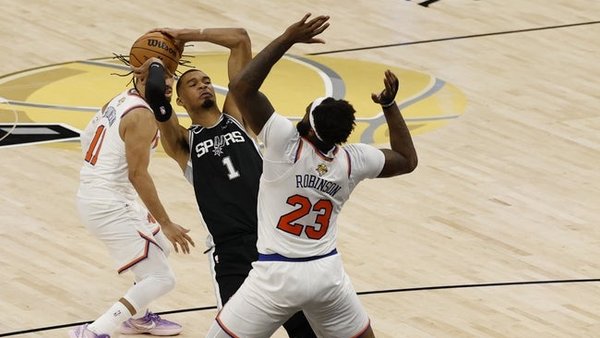
Bash sees a Finals rematch shaped by pace pressure and a total that may not reflect the defensive intensity both teams showed in Game 1. The market’s number feels light given how this series is setting up.
The Setup: Knicks at Spurs
The Knicks head back to San Antonio for Game 2 of the NBA Finals on Friday night, and the market has the Spurs installed as 6.5-point favorites with a total sitting at 216. That total feels like the story here. New York just erased a 14-point second-half deficit in Game 1, riding Jalen Brunson’s 30 points and a suffocating fourth-quarter defensive effort that held San Antonio to just 19 points in the final frame. The Knicks closed on an 11-0 run, and that finish wasn’t about offensive fireworks — it was about grinding possessions and getting stops when it mattered.
The projection here lands at 228.2 points, which creates a strong edge against a 216 total. That’s a 12.2-point gap, and it’s rooted in how these teams actually play over a full 48 minutes. Both offenses run efficient systems — identical 118.7 offensive ratings — and the expected pace blend of 99.2 possessions sets up more scoring chances than this number accounts for. The Spurs push tempo at 100.7 possessions per game, the Knicks operate at 97.7, and when you blend those styles in a Finals environment where both teams can score, 216 feels too conservative.
Game Info & Betting Lines
Game Time: 7:30 PM ET, Friday, June 5, 2026
Location: TBD
TV: ABC
Current Betting Lines (Bovada):
- Spread: Spurs -6.5 (-110) | Knicks +6.5 (-110)
- Total: Over 216.0 (-110) | Under 216.0 (-110)
- Moneyline: Spurs -235 | Knicks +195
Why This Line Exists
The market is pricing San Antonio’s home-court dominance and superior season-long profile. The Spurs went 62-20 overall and 32-8 at home, while the Knicks finished 53-29 with a 22-19 road mark. San Antonio’s net rating of +8.4 edges New York’s +6.4, and that 2.0-point gap in efficiency forms the foundation of the spread. The Spurs also posted a slightly better defensive rating at 110.4 compared to the Knicks’ 112.3, which gives them an edge in controlling game flow.
But the 6.5-point spread feels inflated when you consider the projected margin sits at just 2.9 points. That’s a 3.6-point edge toward the Knicks covering, and it’s rooted in how evenly matched these offenses actually are. Both teams shoot the ball at nearly identical efficiency levels — true shooting percentages within half a point, effective field goal percentages separated by just 0.1 percentage points. The shooting quality is basically priced correctly here, and turnover rates are within noise as well. What separates these teams isn’t offensive firepower — it’s how they generate second chances and control the glass.
The total at 216 is where the market seems to be overreacting to Game 1’s final score of 105-95. That game featured a 19-point fourth quarter from San Antonio and a defensive slugfest down the stretch, but that’s not the full picture of how these teams operate over a season. The Knicks averaged 116.5 points per game, the Spurs 119.8, and both offenses are built to score in volume when the pace allows it. The expected 99.2 possessions creates enough opportunities for both sides to push past 216, especially if the Spurs respond at home and the Knicks continue riding their 12-game playoff winning streak.
Knicks Breakdown
New York’s offense runs through Jalen Brunson, and he delivered exactly what you’d expect in Game 1 — 30 points on efficient shooting, including 13 in the fourth quarter when the Spurs couldn’t generate any separation. Brunson’s season averages of 26.0 points and 6.8 assists per game tell the story of a lead guard who controls tempo and makes plays in crunch time. His clutch field goal percentage of 47.0% and three-point shooting at 41.4% in close games give the Knicks a reliable closer, and that matters in a Finals series where every possession magnifies.
Karl-Anthony Towns posted 18 points and 12 rebounds in Game 1, and his ability to stretch the floor while also dominating the glass creates matchup problems for San Antonio. Towns averaged 20.1 points and 11.9 rebounds during the regular season, shooting 50.1% from the field and 36.8% from three. That versatility forces Victor Wembanyama to defend in space, which opens driving lanes for Brunson and OG Anunoby. Anunoby added 17 points in Game 1, and his 16.7 points per game on 48.4% shooting gives New York a third scoring option who can also defend multiple positions.
The Knicks’ offensive rebounding rate of 29.4% creates a 3.2-percentage-point edge over San Antonio’s 26.2% mark, and that’s a medium-sized gap that translates to extra possessions. Josh Hart’s 7.4 rebounds per game from the guard spot and Towns’ interior presence give New York legitimate second-chance opportunities, which matters in a game where both defenses will tighten up. Mitchell Robinson is probable with a fractured right finger, but he played through it in Game 1 and averaged 5.1 points and 5.5 rebounds in 14.1 minutes per game during the playoffs. His presence gives the Knicks another body to throw at Wembanyama in short bursts.
Spurs Breakdown
Victor Wembanyama is the engine here, and his 25.0 points, 11.5 rebounds, and 3.1 blocks per game make him the most impactful two-way player in this series. Wembanyama’s ability to protect the rim and also stretch the floor with 34.9% three-point shooting creates a unique challenge for New York’s defense. He can alter shots inside, switch onto perimeter players, and punish smaller defenders in the post. The Spurs’ defensive rating of 110.4 is built around his rim protection, and his 5.5 blocks per game as a team average shows how much he influences shot selection.
De’Aaron Fox and Stephon Castle form a dynamic backcourt that pushes pace and creates transition opportunities. Fox averaged 18.6 points and 6.2 assists during the season, while Castle posted 16.7 points and 7.4 assists. That dual-threat setup allows San Antonio to attack in waves, and their 100.7 pace per game is designed to create more possessions and wear down opponents. Devin Vassell’s 13.9 points per game and 38.4% three-point shooting give the Spurs another floor spacer, and Keldon Johnson’s 13.2 points and 5.4 rebounds add physicality on the wing.
The Spurs’ offense runs at an identical 118.7 rating to the Knicks, and their assist-to-turnover ratio is slightly better at 64.6% assist rate compared to New York’s 64.3%. Ball movement is basically even here, and turnover rates are within noise. What San Antonio does well is convert in transition and capitalize on live-ball turnovers, which is why their pace matters so much. If they can push the tempo and force New York into contested shots, they’ll generate the extra possessions needed to cover a 6.5-point spread. But Game 1 showed that the Knicks can slow the game down and execute in the half-court when they need to.
The Matchup
The off-defense mismatch numbers tell a clear story here. New York’s offense against San Antonio’s defense creates an 8.3 per 100 possessions advantage for the Knicks, which is a strong edge that suggests they’ll score efficiently even in a road Finals environment. San Antonio’s offense against New York’s defense produces a 6.4 per 100 possessions edge for the Spurs, which is also strong but not quite as dominant. Both teams can score, and both defenses will give up points when the pace picks up.
The rebounding battle tilts slightly toward New York with that 3.2-percentage-point offensive rebounding edge. Towns, Hart, and Robinson give the Knicks multiple bodies who can crash the glass, and that creates extra possessions that the total doesn’t fully account for. San Antonio’s overall rebounding edge is negligible at just 0.1 percentage points, so the glass isn’t a major separator outside of offensive boards.
Clutch performance is basically even between these teams. The Knicks went 21-13 in clutch situations with a +1.4 plus-minus, while the Spurs posted a 24-12 record with the same +1.4 mark. Both teams execute in close games, and both have reliable closers. That parity matters when you’re evaluating a 6.5-point spread — neither team has a significant edge in tight moments, which suggests this game stays competitive deeper into the fourth quarter.
My model projects a 2.9-point margin in favor of San Antonio, which includes the standard home-court adjustment. That’s a small edge, and it’s rooted in the Spurs’ slightly better net rating and defensive efficiency. But 2.9 points is a long way from 6.5, and that gap creates real value on the Knicks’ side. New York has won 12 straight playoff games, they just beat San Antonio in Game 1 on this same floor, and they’ve shown they can execute in hostile environments. The spread feels like an overreaction to San Antonio’s home dominance during the regular season, but this is a Finals series where the gap between these teams is much smaller than six or seven points.
Bash’s Best Bet & The Play
The play here is Over 216. The projection sits at 228.2 points, and that 12.2-point edge is too strong to ignore. Both offenses are efficient, the pace blend of 99.2 possessions creates enough scoring chances, and the offensive rebounding edge for New York adds extra opportunities that push the total higher. Game 1’s 200-point total was shaped by a defensive fourth quarter, but over a full series, these teams are built to score. San Antonio will respond at home, the Knicks will continue leaning on Brunson and Towns, and the expected game flow points to a faster, more open contest than 216 accounts for.
The risk here is that both coaches tighten rotations and the game turns into another defensive grind, but the underlying numbers suggest that’s not the most likely outcome. Both teams shoot the ball well, both can create in transition, and the offensive rebounding battle tilts toward New York in a way that generates second-chance points. The total feels like it’s priced for a Game 1 repeat, but the matchup dynamics point to more scoring volume.
The Bet: Over 216 (-110)