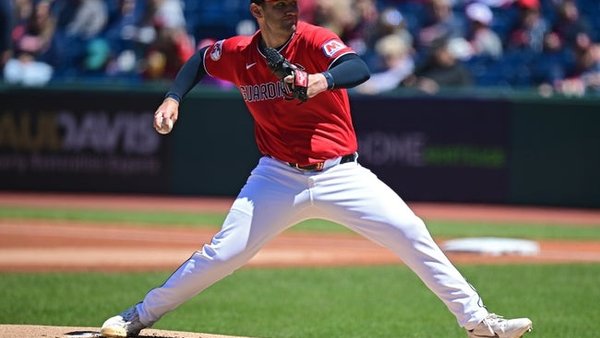
Williams’ strikeout dominance says one thing — the 8.5 total is still pricing this like both starters are comparable. The pitching gap between a 10.73 K/9 rate and Singer’s 11 homers allowed across 42 innings creates a run environment the number hasn’t absorbed.
Brady Singer vs Gavin Williams: Cincinnati Reds at Cleveland Guardians Betting Preview
After yesterday’s 7-4 Cleveland win pushed this series into Sunday’s rubber match, the pitching dynamics have shifted dramatically. Where Saturday featured competitive arms, today presents one of the season’s clearest starter disparities. Gavin Williams brings elite strikeout rates and run prevention to face Brady Singer, who’s surrendered 11 home runs across just 42 innings. The market acknowledges this gap with Cleveland favored at -162, but that price exceeds reasonable juice thresholds for a pure moneyline play.
The more telling number sits at 8.5 for the total, where Progressive Field’s slight pitcher bias and Williams’ dominance create legitimate under value. Cincinnati’s offensive inconsistency — they scored 15 runs Thursday before managing just 4 yesterday — suggests this isn’t the reliable run-producing unit needed to overcome Cleveland’s staff advantage.
Game Info & Betting Lines
- Date/Time: Sunday, 2026-05-17, 1:40 PM ET
- Venue: Progressive Field (Park Factor: 0.98)
- Probable Starters: Brady Singer (5.79 ERA) vs Gavin Williams (3.74 ERA)
- Moneyline: Cincinnati Reds +136 / Cleveland Guardians -162
- Run Line: Cleveland Guardians -1.5 (+130) / Cincinnati Reds +1.5 (-160)
- Total: 8.5 (O -106 / U -114)
Why This Number Is Too High
The 8.5 total reflects recent offensive eruptions more than sustainable scoring patterns. Cincinnati’s 15-run explosion Thursday created recency bias, but that performance came against Washington’s Foster Griffin, who entered with a 2.12 ERA before surrendering 9 runs in 4.1 innings. Yesterday’s 11-run affair featured more realistic scoring levels when facing legitimate pitching.
The market’s balancing Williams’ strikeout dominance against Cincinnati’s demonstrated upside, but the pitcher quality gap should suppress this number below 8.5. Line shopping this one is worth the extra minute — Bovada is still sitting on the opener while the rest of the market has moved. Cleveland’s 3.88 team ERA versus Cincinnati’s 4.64 creates nearly a full run of prevention value that the total hasn’t fully absorbed.
What Separates the Pitching
The stark contrast begins with strikeout rates: Williams’ 10.73 K/9 against Singer’s 6.0 K/9 represents the kind of differential that creates extended scoreless stretches. Williams’ arsenal features a 96.2 mph four-seam generating 25.3% whiffs and a devastating sweeper at 86.6 mph with a 47.5% whiff rate. That sweeper alone holds hitters to .272 xwOBA and serves as his primary put-away pitch.
Singer’s approach runs completely counter — his 48.1% sinker usage at 91.2 mph creates contact but allows hard contact, reflected in his .388 xwOBA against. His 11 home runs allowed across 42 innings stem from this contact-heavy profile against lineups like Cleveland’s that feature patient hitters such as José Ramírez (.379 xwOBA) and Chase DeLauter (.360 xwOBA).
The bullpen context amplifies this advantage. Cleveland’s relief corps has supported their 1.277 WHIP throughout the season, while Cincinnati’s pen carries a bloated 1.468 WHIP that’s created late-innings stress. When Williams hands a lead to Cleveland’s relief unit, they’ve proven capable of preservation.
The Pushback
The primary concern centers on Cincinnati’s demonstrated offensive ceiling. Thursday’s 15-run outburst wasn’t entirely fluky — JJ Bleday’s two-homer performance showcased legitimate power (.487 xwOBA this season), and Elly De La Cruz continues generating quality contact (.491 xwOBA) despite his strikeout tendencies. Williams’ limited 55.1 innings this season provide a smaller sample than ideal for such confident projections.
Cleveland’s own offensive limitations create risk for the under. Their .689 team OPS ranks below Cincinnati’s .703, and yesterday’s 7-run output represented their highest total in this series. If Singer locates his sinker effectively and Cleveland’s patient approach works against them, we could see extended scoreless stretches that favor a different total range.
But the strikeout differential remains the decisive factor. Williams’ ability to miss bats creates innings where Cincinnati simply cannot generate the multi-hit rallies needed to overcome his stuff.
Run Environment & Game Shape
Progressive Field’s 0.98 park factor provides subtle pitcher assistance without dramatically altering run expectation. The market’s 8.5 total anticipates a game in the 4-4, 5-3 range, but the pitching quality suggests something closer to 3-2, 4-1 scoring patterns.
Williams’ strikeout rate creates extended at-bats that drain Cincinnati’s lineup, while Singer’s contact-heavy approach against Cleveland’s patient hitters should generate efficient innings. The combination favors a lower-scoring environment than the total suggests.
Joe Jensen’s Pick
JENSEN’S PICK: TOTAL UNDER 8.5 (-114) — 2 Units
I considered the Cleveland moneyline given the clear pitching advantage, but -162 exceeds reasonable juice thresholds despite the edge. The pick is Under 8.5 (-114), meaning the combined score must stay under 8.5. Williams’ elite strikeout rate and Cleveland’s superior staff should create the low-scoring environment this price doesn’t reflect.
The under provides clean exposure to the pitching quality gap without paying Cleveland’s steep moneyline price. I’m projecting something in the 5-3 Cleveland range, where the under cashes comfortably even if both offenses contribute. The confidence level sits at moderate — Williams’ smaller sample and Cincinnati’s offensive upside create enough uncertainty to limit the investment, but the strikeout differential and staff advantages make this the cleanest play on the board.