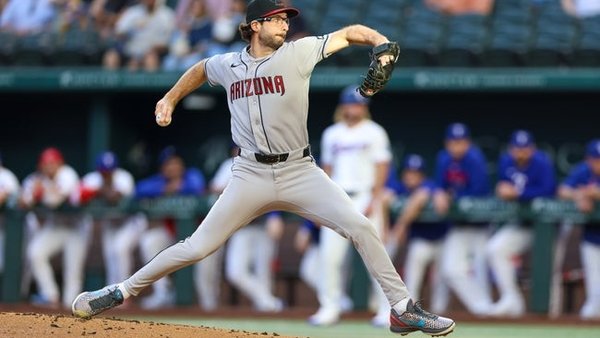
The matchup points clearly to Ray’s advantage over Gallen — the +116 price hasn’t moved with what the underlying metrics reveal about this pitching gap.
Robbie Ray vs Zac Gallen: San Francisco Giants at Arizona Diamondbacks Betting Preview
The Giants arrive in the desert coming off a 10-1 demolition of Oakland, while Arizona limped home with an 8-6 slugfest win over Colorado that required late-inning heroics. But strip away the recent results and this matchup comes down to a fundamental pitching disparity that the market isn’t fully pricing.
Robbie Ray brings a 3.04 ERA and proven peripherals to Chase Field, facing Zac Gallen who’s struggling through a 5.02 ERA start to the season with replacement-level production. At +116 on the Giants moneyline, you’re getting paid to back the superior arm in what projects as a tight game.
Game Info & Betting Lines
- Date/Time: Monday, May 18, 2026, 9:40 PM ET
- Venue: Chase Field (Park Factor: 0.97 — slightly pitcher-friendly)
- Probable Starters: Robbie Ray (3-5, 3.04) vs Zac Gallen (1-4, 5.02)
- Moneyline: San Francisco Giants +116 / Arizona Diamondbacks -136
- Run Line: Arizona Diamondbacks -1.5 (+146) / San Francisco Giants +1.5 (-176)
- Total: 9 (O -110 / U -110)
Why This Number Is Too Wide
The market is balancing Arizona’s home field advantage and slightly better record (22-23 vs 20-27) against the obvious pitching gap. That’s legitimate — Chase Field does provide value for the home team, and the Diamondbacks have outscored opponents by 20 runs compared to San Francisco’s -37 differential.
But the -136 price on Arizona suggests the market views this as nearly a coin flip with home field as the tiebreaker. That undervalues what should be a significant starting pitcher advantage. Ray’s 0.97 WAR compared to Gallen’s -0.44 represents a 1.4-win gap over a full season — that’s not a marginal difference.
The line is essentially asking: is Ray’s edge worth more than 16 cents of value? When you’re comparing a pitcher with a 1.17 WHIP and 8.76 K/9 against one posting a 1.51 WHIP and 6.07 K/9, I think it is.
What Separates the Pitching
This isn’t a subtle pitching gap — it’s a chasm. Ray’s sinker sits at 93.3 mph with 38% usage, holding hitters to a .308 xwOBA, while his curveball generates a massive 36.2% whiff rate and .221 xwOBA. The combination creates different at-bat shapes than what Gallen offers.
Gallen has become overly reliant on his four-seam fastball, throwing it 59.4% of the time at 96.1 mph — but hitters are teeing off with a .349 xwOBA against it. His slider generates decent whiffs at 31.8%, but the .338 xwOBA against shows hitters aren’t missing by much when they make contact.
The park factor works in Ray’s favor here. Chase Field’s 0.97 run environment slightly suppresses offense, which amplifies the value of superior command. Ray’s 20 walks in 50.1 innings compared to Gallen’s 14 walks in just 43 innings shows who’s more likely to pitch around trouble.
The Pushback
The concern is obvious: San Francisco’s offense. The Giants are hitting .244 with a .668 OPS — that’s not exactly a lineup built to capitalize on pitcher advantages. Even with Gallen struggling, Arizona’s bats have shown more pop with 40 home runs compared to San Francisco’s 37, and a better .699 OPS.
There’s also the home field reality. Arizona has won 5 of their last 10 at Chase Field, and Corbin Carroll is swinging a hot bat with a .933 OPS and 7 home runs. If Gallen can find his slider command early, the Diamondbacks lineup has enough thump to make Ray work.
But here’s why I keep coming back to the Giants: Ray has been consistently good, not just lucky. His 49 strikeouts in 50.1 innings with only 10 home runs allowed shows sustainable performance. Meanwhile, Gallen’s struggles aren’t just bad luck — the Statcast data confirms hitters are making quality contact.
Run Environment & Game Shape
The total at 9 suggests the market expects a moderate-scoring affair, which makes sense given Chase Field’s neutral-to-pitcher-friendly profile. This run environment actually enhances Ray’s value — in games where every run matters, you want the pitcher more likely to keep crooked numbers off the board.
The projected scoring range of 4-5 runs per team means margin for error is limited. Gallen’s tendency to allow hard contact in hitter’s counts could be the difference between a 5-4 game and a 7-4 game, and at these run levels, that gap decides the outcome.
Joe Jensen’s Pick
JENSEN’S PICK: Giants Moneyline +116 — 2 Units
I considered San Francisco Giants +1.5 at -176, but the juice on the cushion is steep — I’d rather take the moneyline. The run line forces you to lay -176 for what amounts to a push insurance policy, and in a game where I think the Giants can win outright, that price eats too much of the edge.
This is moderate confidence at 2 units because while the pitching edge is clear, the Giants offense creates uncertainty. Ray gives San Francisco the better chance to win, but the lineup needs to show up against a struggling Gallen to cash the ticket. The +116 price provides enough cushion to make it worthwhile, but I’m not going heavier given the offensive concerns.