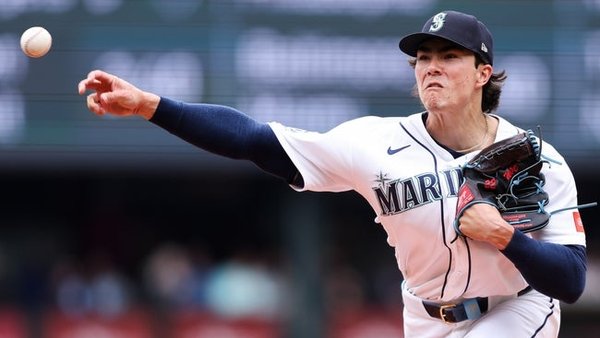
Bryan Woo’s elite command sits opposite Noah Schultz’s control breakdown — the market has priced this like two struggling offenses when the pitching disparity tells a different story.
Noah Schultz vs Bryan Woo: Chicago White Sox at Seattle Mariners Betting Preview
The market has set this total at 7, pricing in the offensive struggles both clubs have shown this season. Chicago sits at .236 as a team while Seattle checks in at .228 — two lineups grinding through contact issues in what should be a pitcher-driven environment. But the real story here isn’t just the weak batting averages. It’s the control gap between Noah Schultz and Bryan Woo, and how that disparity plays out in T-Mobile Park’s run-suppressing dimensions.
The White Sox arrive hot with a 7-3 record in their last 10 games, coming off a dramatic 9-8 walk-off win over the Cubs where Edgar Quero hit his first homer of the season — a clutch 10th-inning, two-run shot that capped an impressive homestand. Seattle, meanwhile, just got swept by San Diego, allowing 8 runs in Sunday’s finale despite George Kirby’s usual reliability.
Game Info & Betting Lines
- Date/Time: Monday, May 18, 2026, 9:40 PM ET
- Venue: T-Mobile Park (Park Factor: 0.92 — pitcher-friendly)
- Probable Starters: Noah Schultz (CHW) vs Bryan Woo (SEA)
- Moneyline: Chicago White Sox +146 / Seattle Mariners -174
- Run Line: Seattle Mariners -1.5 (+128) / Chicago White Sox +1.5 (-154)
- Total: 7 (Over -120 / Under -102)
Why This Number Is Close
The market is essentially pricing two struggling offenses in a run-suppressing environment — and on paper, that makes sense. Chicago’s .738 OPS ranks near the bottom of the league, while Seattle’s .694 OPS is even worse. Both teams have struck out more than 400 times already, with Chicago showing 420 strikeouts against just 176 walks — textbook poor plate discipline.
But the total also reflects some uncertainty around Noah Schultz’s control issues. His 21 walks in just 29.1 innings pitched creates the kind of baserunner volume that can inflate run totals quickly, especially against a Seattle lineup that does work counts when healthy. The market sees Schultz’s 4.91 ERA and factors in enough volatility to push this number up from what would otherwise be a sub-7 total in this park.
Where I think the line gets it slightly wrong is undervaluing how Bryan Woo’s precision changes the entire game flow.
What Separates the Pitching
The control gap between these starters is massive. Woo enters with a pristine 1.0 WHIP and has walked just 10 batters in 53 innings — that’s elite-level command that creates short at-bats and quick innings. His 95.6 mph four-seam sits at 27.9% usage and holds hitters to a .467 xwOBA, while his changeup at 15.0% usage generates a devastating .248 xwOBA with 30.3% whiffs.
Schultz, by contrast, has issued 21 walks in 29.1 innings — a 6.45 BB/9 rate that puts constant traffic on the bases. His sweeper is his best weapon at 29.5% whiffs and .330 xwOBA, but he’s throwing it just 18.6% of the time. The rest of his arsenal sits above .375 xwOBA, with his four-seamer getting hammered at .467 xwOBA despite 95.6 mph velocity.
The matchup dynamics favor Woo heavily. Chicago’s top threats — Munetaka Murakami (.555 xwOBA) and Miguel Vargas (.431 xwOBA) — both profile as aggressive hitters who can capitalize on mistakes, but Woo simply doesn’t make many. Seattle’s patient approach, led by hitters who’ve worked 188 walks as a team, should exploit Schultz’s zone issues and create the kind of deep counts that lead to walks and elevated pitch counts.
The Pushback
Here’s my real hesitation with the under at 7: Schultz’s variance could blow this game wide open in a hurry. Twenty-one walks in 29.1 innings isn’t just poor control — it’s the kind of command breakdown that can turn a 2-1 game into a 6-3 laugher in one bad inning. Seattle’s been patient enough to work 188 walks as a team, and if they get deep counts against Schultz early, we could see his pitch count spike and force Chicago into a bullpen that’s already been taxed during this homestand.
The other factor nagging at me is Seattle’s recent offensive futility creating a false sense of security. Yes, they’re hitting .228 with a pathetic .694 OPS, but they just faced three quality Padres starters who can execute. Schultz isn’t in that tier. When Seattle gets walks and baserunners — which they will against this kind of control — their .239 RISP average suddenly becomes more relevant than their overall team batting line.
There’s also the T-Mobile Park factor cutting both ways. While the 0.92 run factor suppresses offense, it also means any crooked number becomes magnified in the final total. If Schultz walks three guys in the third inning and Julio Rodriguez finds a gap, we could be looking at a 4-run frame that makes 7 feel very reachable.
The Rejected Angle
I spent serious time considering the run line here, and Seattle -1.5 at +128 has obvious appeal on paper. Woo’s control advantage suggests he should dominate this Chicago lineup, while their bullpen edge (3.75 ERA vs 4.35 ERA) could extend a lead late. The matchup data supports it — Seattle’s patient approach against Schultz’s walks should create multiple scoring opportunities, and T-Mobile Park’s dimensions favor the home team’s pitching style.
But here’s why I’m staying away from the run line despite the attractive price: Chicago’s offensive variance makes them dangerous in small samples. Murakami’s .555 xwOBA and Montgomery’s .432 xwOBA represent legitimate power threats, and Schultz, for all his control issues, has allowed just 2 home runs in 29.1 innings. If the White Sox get one swing right against Woo’s occasional mistake — particularly his four-seamer that’s yielding a .467 xwOBA — they can steal a game they probably shouldn’t win. In a projected 4-3 type game, that one swing is the difference between covering and losing the run line entirely.
Run Environment & Game Shape
T-Mobile Park’s dimensions and marine air suppress offense consistently, creating the kind of environment where pitching edges get amplified. With a 0.92 run factor, this venue typically shaves about half a run off the total compared to a neutral park. That matters significantly when you’re dealing with two offenses already struggling to generate consistent contact.
The market is essentially pricing a 3-4 or 4-3 type game, and that feels right given the personnel involved. Woo’s precision should keep Chicago’s aggressive hitters off balance, while Schultz’s wildness could create just enough scoring chances for Seattle to push across 3-4 runs without requiring a breakout offensive performance.
My models project this finishing around 4-3 Seattle, making the under 7 the primary target despite the concerns about Schultz’s variance.
The Pick
Under 7 (-102) for 2 units
The pitching gap is too substantial to ignore, even accounting for Schultz’s control issues. Woo’s elite command profile (10 walks in 53 innings) creates the kind of shutdown performance that defines low-scoring games, while T-Mobile Park’s run-suppressing environment provides enough margin for error to weather a mediocre Schultz outing. Chicago’s .236 average and Seattle’s .228 mark aren’t fluke numbers — they represent two lineups genuinely struggling to make consistent contact, and that profile shouldn’t change dramatically in a pitcher-friendly environment.
The total feels inflated by about half a run based on the venue and starter quality gap. Take the under and expect a classic American League pitchers’ duel to close out the Monday night slate.