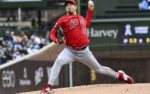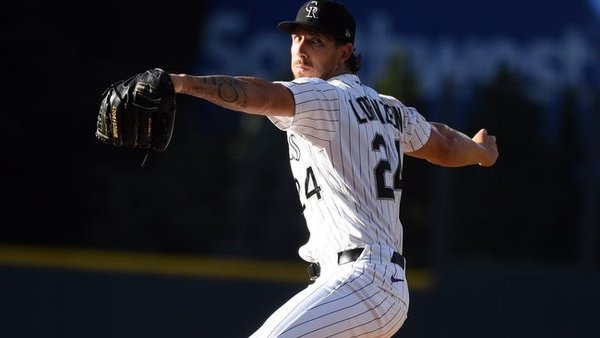
Jared Jones (6.23 ERA) and Michael Lorenzen (7.13 ERA over 70.2 innings) are taking the ball at the highest park factor in baseball, and the model projects 13.2 combined runs — nearly two full runs clear of the posted 11.5. The first two games of this series stayed low because competent arms held the park at bay; Sunday’s starters are a different problem entirely.
Jared Jones vs. Michael Lorenzen: Pittsburgh Pirates at Colorado Rockies Betting Preview
After the first two games of this series went well under — 4-3 and 2-1 — Sunday’s pitching matchup is a fundamentally different equation. Kyle Freeland and Tomoyuki Sugano are not taking the ball today. Jared Jones and Michael Lorenzen are, and that distinction is everything when you’re trying to handicap a run total at the most offense-friendly venue in baseball.
The market has already priced in some Coors inflation — 11.5 is an elevated number by any standard. But the convergence of two genuinely struggling starters, a park factor of 1.38, and bullpens that have been leaned on hard in back-to-back high-leverage finishes creates a run environment the posted total still underestimates. The numbers project 13.2 combined runs. That’s not a rounding error — it’s nearly two full runs of separation from the number.
The over at -118 carries a slight juice premium, and I’ll address that honestly. But the structural case for this bet is built on three pillars that don’t disappear because the market charges a little extra to get there: two legitimately bad starting pitchers, the highest park factor in the sport, and depleted bullpens unlikely to bail either team out early.
Game Info & Betting Lines
- Date/Time: Sunday, June 21, 2026 | 3:10 PM ET
- Venue: Coors Field | Park Factor: 1.38 (highest in MLB)
- TV: MLB.TV, Rockies.TV
- Probable Starters: Jared Jones (PIT) vs. Michael Lorenzen (COL)
- Moneyline: Pittsburgh Pirates -138 / Colorado Rockies +118
- Run Line: Pittsburgh Pirates -1.5 (+106) / Colorado Rockies +1.5 (-128)
- Total: 11.5 — Over -118 / Under -104
Why This Number Is Off
The market is being careful here, and I understand why. Coors totals are among the most sharply adjusted in baseball — books have decades of data on altitude-inflated scoring, and they don’t leave obvious value sitting on the board. The -104 price on the under signals that sharp money hasn’t piled onto the over; there’s genuine disagreement about where this game lands.
The legitimate case for staying under 11.5 is real: the two previous games in this series went 4-3 and 2-1. Paul Skenes nearly no-hit Colorado at Coors last month — he took a no-hitter into the seventh inning on May 12. Pitching can hold even in Denver when the arms are good enough. And both offenses are dealing with notable absences — Oneil Cruz is on the IL with a hand injury for Pittsburgh, while Colorado is missing Mickey Moniak (ankle) and Brenton Doyle (oblique), two of their better lineup contributors.
But here’s where the market is slightly wrong: those prior games featured Freeland and Sugano on the mound — arms with some track record of competence, even if inconsistent. Today’s starters are different animals entirely. Lorenzen’s 7.13 ERA over 70.2 innings is not a cold stretch — it’s a season-long indictment. Jones’s 6.23 ERA comes in a small sample, but four home runs surrendered in 17.1 innings at altitude is a terrifying signal. The under is priced for a pitcher-driven game; neither of these arms creates that environment.
What Separates the Pitching
The gap between these two starters isn’t wide — it’s a race to see who gets shelled first. But they’re bad in different ways, and understanding how matters for projecting the game shape.
Jones brings elite velocity — his four-seam fastball sits at 98.8 mph — but the pitch generates an xwOBA of .404 against, which is genuinely alarming for a heater thrown 40.2% of the time. His slider (90.2 mph, 29.2% whiff) and changeup (93.5 mph, 36.4% whiff, .245 xwOBA) are legitimate weapons, but hitters are laying off the fastball and sitting on the secondary stuff. His curveball leads all his pitches in whiff rate at 46.7%, yet he allows a .368 xwOBA on it — a pitch that misses bats but still gives up hard contact when it catches the zone. At Coors, where the ball carries and the altitude steals break from breaking balls, Hunter Goodman’s .449 xwOBA and 7.3% barrel rate represent exactly the kind of contact profile that turns Jones’s leaky fastball into extra bases. Goodman has also shown he can hit right-handed pitching, posting a .442 xwOBA versus RHP this season.
Lorenzen is worse by ERA but faces a different challenge: Pittsburgh’s lineup is legitimately constructed. His four-seam fastball sits 94.2 mph but generates only a 10.2% whiff rate and an xwOBA of .427 — hitters square it up routinely. His cutter (.421 xwOBA against) is equally hittable. The only pitches generating real swing-and-miss are his changeup (31.4% whiff) and sweeper (33.3% whiff), but he can’t hide behind those all afternoon. Brandon Lowe’s .431 xwOBA and 6.4% barrel rate against right-handed pitching (.447 xwOBA vs. RHP) makes him the Pirates’ most dangerous weapon here — and in 12 plate appearances against Lorenzen, Lowe is hitting .300 with a home run.
The meaningful pitching gap isn’t between these two starters — it’s between both of them and what a functional MLB starting pitcher looks like. Lorenzen’s 1.85 WHIP over 70+ innings means runners are a near-constant presence. Jones’s 1.62 WHIP in his small sample suggests the same pattern is developing fast.
The Pushback
I’m not going to pretend the first two games of this series don’t matter. They do. Colorado won 4-3 on Friday and 2-1 on Saturday — both well under 11.5 — and those results came at Coors Field, not some neutral dome. The natural question is: if the park factor is so overwhelming, why did the totals stay this low all weekend?
The answer is the starting pitching. Freeland and Sugano on the mound produced genuinely pitcher-friendly games — Freeland went deep into Friday’s contest, Sugano went six innings Saturday and took a no-hitter into the seventh before things unraveled. These were functional starts. The games stayed low because the arms were good enough to suppress the park. Today’s arms are not.
The other pushback is the injury situation. Moniak is out — and his .942 OPS this season (in 150 at-bats, so treat that number with appropriate sample-size caution) made him Colorado’s most dangerous bat. Cruz being out hurts Pittsburgh’s middle-of-the-order depth. These are real subtractions. But the remaining hitters on both sides — Goodman, Rumfield, Johnston for Colorado; Lowe, Reynolds, Horwitz for Pittsburgh — are more than capable of doing damage against two starters posting 6+ ERAs.
The final pushback is the juice. -118 on the over means the breakeven sits around 54.1%. That’s not a bargain. I need this game to go over 11.5 more than half the time just to break even, and I’m asking that to happen against two starting pitchers who haven’t exactly proven incapable of throwing a bad game that stays low. I get it. But the 1.7-run projected edge over the number is wide enough that paying the slight premium is justified.
Run Environment & Game Shape
Coors Field’s 1.38 park factor isn’t just a theoretical multiplier — it shows up in the run-scoring environment in concrete ways. The ball carries differently at altitude, breaking balls flatten out, and outfield dimensions that look manageable at sea level become launching pads. Both of today’s starters rely heavily on pitches that suffer at elevation: Jones’s fastball is already getting squared up at .404 xwOBA at sea level, and Lorenzen’s entire arsenal — his four-seamer (.427 xwOBA), his cutter (.421 xwOBA), his sinker (.359 xwOBA) — is the kind of pitch mix that gets punished when hitters can sit on contact.
The game shape here strongly favors early chaos. Both starters project to work into trouble in the first three innings, which means both bullpens — already taxed by consecutive close finishes Friday and Saturday — will be asked to work significant innings on short rest. Pittsburgh’s relief corps is already shorthanded with Wilber Dotel (lat) and Chris Devenski (illness) both on the IL. Colorado is missing Tanner Gordon (hip) and Welinton Herrera (elbow) from their pen as well. These are not fresh bullpens walking into a fireman role — they’re depleted groups being handed a lit match.
The Statcast contact quality on both sides reinforces this. Pittsburgh’s Lowe (.431 xwOBA, 29.0% hard-hit rate), Reynolds (.871 OPS), and Horwitz (.853 OPS) are all capable of multi-hit games against a pitcher posting Lorenzen’s numbers. Colorado’s Goodman (.449 xwOBA, 7.3% barrel rate), Rumfield (.835 OPS), and Johnston (.309 average, .394 xwOBA vs. RHP) give Jones no easy at-bats in the middle of the order. With both starting pitchers projecting to allow baserunners at a near-constant rate, and both bullpens stretched thin, the runway to 11.5 combined runs is shorter than the market is pricing in. The over doesn’t need a blowout — it needs two mediocre starters to do exactly what their season-long numbers say they do, in the one park in baseball most likely to amplify every mistake.
The Pick
Over 11.5 — -118 — 2 Units — Moderate Confidence.
The core thesis is straightforward: Jared Jones (6.23 ERA, 1.62 WHIP) and Michael Lorenzen (7.13 ERA, 1.85 WHIP) are two of the worst starters in baseball, pitching at a park with a 1.38 run factor, backed by bullpens that have worked back-to-back close games. The prior two games in this series stayed low because Freeland and Sugano are legitimate arms who managed Coors. Today’s starters are not those pitchers. The numbers project 13.2 combined runs — nearly a two-run edge over the posted total. I’m paying -118, acknowledging the ~54% breakeven, and taking the over. The structural case is too clean to talk myself out of it.