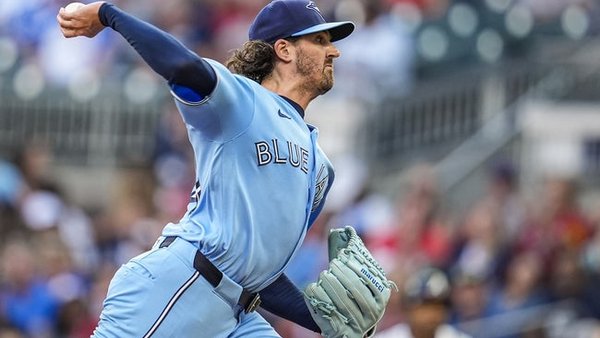
Two of the coldest offenses in baseball meet at Rogers Centre’s perfectly neutral dome — a 1.00 park factor that strips away any external inflation and leaves the math entirely to the hitters. The Cardinals posted a .693 OPS and went 3-7 in their last 10, while Toronto sits at .684 on the season; a combined 8.9-run projection clears 8.5 by just 0.4, and that razor-thin margin is exactly where the tension lives.
Quinn Mathews vs. Kevin Gausman: St. Louis Cardinals at Toronto Blue Jays Betting Preview
The total sitting at 8.5 asks a legitimate question: can two below-average offenses, one of which went 10-18 in July and the other averaging fewer than 4 runs per game, combine for nine or more in a neutral dome? The market has set a fair number here — there’s no obvious misprice — but “fair” and “value” aren’t the same thing. The numbers project a combined 8.9 runs, which technically points over, but by a margin thin enough that the surrounding context matters more than the raw output.
The Cardinals are an offensive mess right now. A team-wide .693 OPS ranks near the bottom of the league, and their recent form makes it worse — they went 10-18 in July, are 3-7 in their last 10 games, and just scored one run against a Blue Jays team that wasn’t exactly shutting everyone down. Toronto isn’t much better, posting a .684 OPS on the season and running at roughly 3.9 runs per game. This is a game between two struggling offenses in a park with a perfectly neutral run factor of 1.00.
After the series opener finished 3-1, today’s pitching matchup shifts to Kevin Gausman for Toronto against Quinn Mathews for St. Louis. Gausman brings a legitimate swing-and-miss profile that complicates the Cardinals’ cold lineup. The lean here is under 8.5 — not a hammer, but a defensible number when the context lines up.
Game Info & Betting Lines
- Date/Time: Saturday, August 1, 2026 | 3:07 PM ET
- Venue: Rogers Centre, Toronto (Park Factor: 1.00 — neutral dome, no weather or altitude inflation)
- Probable Starters: Quinn Mathews (STL) vs. Kevin Gausman (TOR)
- Moneyline: Cardinals +126 / Blue Jays -136
- Run Line: Toronto Blue Jays -1.5 (+146) / St. Louis Cardinals +1.5 (-176)
- Total: 8.5 (Over -110 / Under -110)
Why This Number Is Close
The honest answer to why 8.5 exists here is that the market is doing its job. Two teams with middling rotations, depleted bullpens, and no dominant offensive identity should project to something in the 8-9 range. The market has landed on a number that reflects all of that. I’m not going to pretend there’s some egregious mistake in the line.
The legitimate over case: Gausman’s 4.51 ERA and 1.27 WHIP are not the profile of a pitcher who locks games down. He’s allowed 15 home runs in 121.2 innings this season — a rate that makes him vulnerable to any lineup with a power threat at the top. Jordan Walker (.838 OPS, 22 HR) and Alec Burleson (.805 OPS, 15 HR) are real hitters, not lineup fillers. If either gets to a fastball early, Gausman can give up a crooked number fast.
Where the market may be slightly off: it may be underweighting how cold the Cardinals actually are as a unit right now and how little the Blue Jays’ lineup has delivered against this rotation. The combined 8.9-run projection barely clears the line by 0.4, offering almost no cushion. At -110 on both sides, you’re not being asked to overcome heavy juice — and the under catches any game that plays out the way yesterday’s did. A 0.4-run edge toward the over is not a bet. It’s a coin flip with a slight breeze behind it.
What Separates the Pitching
The gap between these two starters isn’t enormous, but it favors the under in different ways on each side of the matchup.
Gausman works with a two-pitch core: a four-seamer sitting 51.6% of the time at 93.9 mph and a splitter thrown 37.7% of the time at 83.9 mph. The splitter is his best weapon — it generates a 38.1% whiff rate and holds hitters to an xwOBA of .241. That’s a genuine put-away pitch, and against a Cardinals lineup that is ice cold, it’s well-suited to produce soft contact and punchouts. His four-seamer, however, is a liability — hitters have posted a .336 xwOBA against it, and that’s where Walker (.451 xwOBA overall) and Burleson (.426 xwOBA) can do damage. Gausman’s slider is a distant third option at 10.3% usage, and hitters have hit it to a .421 xwOBA — not a weapon he can lean on.
Mathews is the bigger unknown. His arsenal features a 94.4 mph four-seamer (36.5% usage) with a 29.4% whiff rate, a changeup at 83.2 mph generating a 50.0% whiff rate, and a slider sitting at 37.5% whiff. Those are impressive whiff numbers in a small sample, but the Blue Jays’ top hitters — Vladimir Guerrero Jr. (xwOBA .356), Kazuma Okamoto (.413 xwOBA, 6.8% barrel rate) — make hard contact consistently. Okamoto in particular has a 30.3% strikeout rate, which means he either punches out or squares something up. Against a right-hander like Mathews, his .417 xwOBA versus righties is a real concern.
Neither starter profiles as a shutdown arm who creates six innings of nothing. Both create game shapes with baserunners, occasional hard contact, and reasonable whiff rates. That combination points toward a game that stays in the 4-5 run range per team rather than blowing past the total in either direction.
The Pushback
The honest pushback against the under is real, and I’m not going to wave it away. The raw numbers edge toward the over, and the reasons aren’t superficial. Gausman’s home run rate — 15 in 121.2 innings — means Walker and Burleson represent genuine threat. Walker carries a .451 xwOBA overall and a .432 xwOBA versus right-handers. Burleson is even more dangerous against same-side pitching, posting a .455 xwOBA versus righties. Those aren’t fringe hitters; they’re legitimately dangerous against a pitcher with Gausman’s fastball vulnerability.
On the other side, Okamoto’s .413 xwOBA and 6.8% barrel rate against Mathews represent a real enough risk that one bad inning from the Cardinals’ starter could swing the game shape entirely. The Blue Jays’ bullpen, while not elite, did just strand the bases loaded in the seventh last night with a walk-off double play — they’re capable of managing situations. And Toronto has won seven straight against St. Louis. Familiarity and recent dominance aren’t nothing.
I hear all of that. But the question isn’t whether the over case exists — it clearly does. The question is whether a 0.4-run projection edge is enough to justify taking -110 on the over when the Cardinals just scored one run in this exact park against this exact team. It isn’t.
Run Environment & Game Shape
Rogers Centre is as neutral a venue as you’ll find — a 1.00 park factor means the dome adds nothing to the run environment. No wind, no altitude, no short porch doing the math for either offense. Whatever happens in this game comes from the hitters and pitchers alone, with no external thumb on the scale.
Both offenses have real limitations. The Cardinals (.693 OPS, 3-7 in their last 10) are one of the coldest lineups in baseball right now. The Blue Jays (.684 OPS, -58 run differential on the season) aren’t far behind. Yesterday’s 3-1 final wasn’t an anomaly — it was consistent with what both these teams have been producing all month. The Cardinals averaged fewer than 3.5 runs per game in July. Toronto is sitting at roughly 3.9. The arithmetic doesn’t get you to nine without something going wrong for a pitcher.
Could it happen? Sure. One Gausman fastball left over the plate to Walker, one Mathews changeup that doesn’t miss, and the game shape changes. But betting the over at -110 means you’re laying even money that these two depleted offenses, in a neutral dome, against two starters with genuine swing-and-miss stuff, combine for nine or more. Given everything above — the cold Cardinals, the low Blue Jays run rate, the park context, and the thin projection edge — the under at -110 is the cleaner side.
The Play: Under 8.5 (-110), 1 unit, lean.