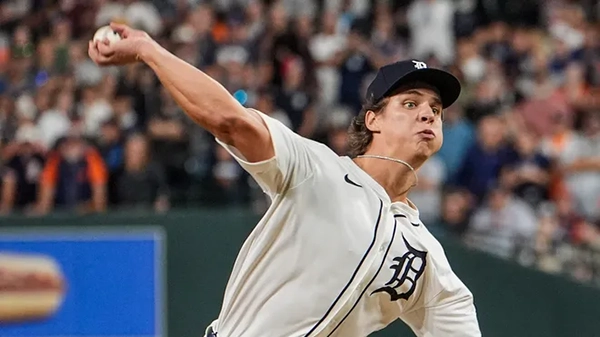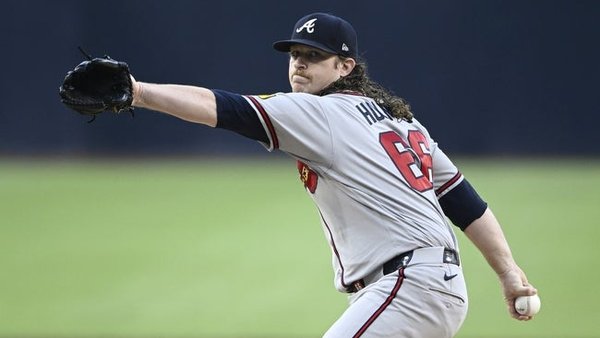
Grant Holmes carries a 3.46 ERA and a dominant slider-curve pairing into a matchup against a Phillies lineup built on soft contact — while Andrew Painter’s 5.71 ERA and 19 home runs allowed raise legitimate questions about Atlanta’s run ceiling. The total is sitting at 9.0, but yesterday’s 12-run blowout came in a bullpen game, not this one.
Andrew Painter vs Grant Holmes: Philadelphia Phillies at Atlanta Braves Betting Preview
Yesterday’s 12-2 demolition naturally has bettors eyeing the over in game three. That’s the market noise you have to cut through. Atlanta’s offense unloaded on a Phillies bullpen game — Luzardo scratched, Brooks Raley absorbing his second straight loss — and the box score tells a story about roster circumstances more than offensive capability. Today’s pitching matchup looks nothing like Saturday’s.
The real story is a genuine quality gap at the mound. Grant Holmes takes the ball with a 3.46 ERA and 1.29 WHIP across 137.2 innings of work — that’s a full-season sample, not a hot stretch. On the other side, Andrew Painter has posted a 5.71 ERA and 1.41 WHIP in just 110.1 innings, allowing 19 home runs, and the Phillies are 3-7 in their last ten games. That pitching gap is the engine driving the under lean here.
Atlanta’s moneyline at -131 clears any reasonable ceiling, so the moneyline isn’t the play regardless of the starter edge. The total at 9.0 is where the market is slightly miscalibrated, and a projected combined score of 9.4 runs only barely clears the posted number — meaning the under at -114 offers a credible suppression lean without asking you to price in a shutdown performance from a struggling arm.
Game Info & Betting Lines
- Date/Time: Sunday, September 13, 2026 | 1:35 PM ET
- Venue: Truist Park | Park Factor: 1.01 (essentially neutral)
- Probable Starters: Andrew Painter (PHI) vs Grant Holmes (ATL)
- Moneyline: Philadelphia Phillies +109 / Atlanta Braves -131
- Run Line: Atlanta Braves -1.5 (+155) / Philadelphia Phillies +1.5 (-189)
- Total: 9.0 (Over -105 / Under -114)
Why This Number Is Close
The books set this total at 9.0 for legitimate reasons. Atlanta’s lineup is power-oriented — 187 home runs as a team — and Painter’s 19 home runs allowed in 110.1 innings is a profile that invites exactly the kind of multi-run crooked numbers we saw yesterday. The over is priced at -105, practically a pick’em against the run-suppression thesis. The market is essentially saying: we acknowledge Holmes is solid, but Painter is a liability and this could get ugly quickly.
That’s not a wrong reading. But the market is slightly overweighting yesterday’s result. Saturday’s blowout came against a bullpen-constructed game; today Painter actually takes the ball. When a starter goes out there, the game shape changes — five or six innings of average-to-bad pitching still anchors the run environment more than an open bullpen. And on the Atlanta side, Holmes has been suppressing run environments all season long. The books have priced both of those factors in, but the -105 on the over suggests they’re giving the under less credit than it deserves.
The numbers project a combined 9.4 runs — sitting only 0.4 over the posted total. That margin favors the under side when you account for Holmes’ demonstrated ability to keep the ball in the park and limit damage. The -114 juice on the under is manageable without requiring a pristine performance from either staff.
What Separates the Pitching
This is not a close pitching matchup. Holmes enters with a full-year résumé: nine wins, 137.2 innings, a WHIP that reflects genuine contact management. His primary weapon is a slider sitting 36.5% of the time at 85.2 mph, generating a 39.5% whiff rate and .293 xwOBA against — that’s a legitimate out pitch. He backs it with a 94.1 mph four-seam that holds hitters to a .384 xwOBA, and his curveball at 37.9% whiff rate with a .249 xwOBA against gives him a second swing-and-miss option when he needs strikeouts. Against a Phillies lineup with a .710 OPS, Holmes’ combination of strike-throwing and a dominant slider-curve pairing creates exactly the kind of quiet middle innings that keep scores grounded.
The concern with Holmes is a walk rate that has climbed — 57 walks in 137.2 innings is slightly elevated, and that matters against a team that can manufacture runs even without big hits. Kyle Schwarber carries a .504 xwOBA and a 13.1% walk rate; he’ll grind counts and could work around even solid sequencing. But here’s the difference: Schwarber’s BvP against Holmes sits at just 12 plate appearances, and the small sample doesn’t establish a clear exploit.
Painter operates with more pure velocity — his four-seam sits at 96.5 mph — but his arsenal’s effectiveness is undercut by a sinker posting a .411 xwOBA against and a four-seam that surrenders a .400 xwOBA. Atlanta’s best contact hitters are legitimate threats: Matt Olson at a 7.2% barrel rate, Drake Baldwin at 6.5%, and Ronald Acuña Jr. at 6.0% — all capable of doing damage against Painter’s contact-friendly offerings. Painter’s split-finger at .234 xwOBA against and his changeup at .160 xwOBA are legitimate weapons, but those elite hard-contact profiles from Olson, Acuña, and Baldwin mean the Braves can inflict damage even when Painter reaches back for his better secondary stuff. The gap between these two arms is real, and it shows up in innings pitched, ERA, and contact quality allowed.
The Pushback
The honest case for the over lives in Painter’s track record against power lineups and the volatility baked into his .411 sinker xwOBA. Atlanta’s projected order today does feature some genuine threats — Drake Baldwin (.430 xwOBA) leads off and can make hard contact, and Brewer Hicklen at fifth in the order shows a .443 xwOBA with 29.2% hard-hit rate. One crooked inning from Painter could flip this game sideways in a hurry.
But consider who else populates that projected Atlanta order: Dominic Smith at .316 xwOBA batting third, Ozzie Albies at .293 xwOBA batting fourth, Mauricio Dubón, Kyle Farmer, and Ha-Seong Kim filling out the bottom. This is not a murderers’ row. Yes, Olson, Acuña, and Harris are Atlanta’s best contact-quality hitters — but none of them appear in today’s projected lineup at all. The Braves are running out a patchwork order, and Painter can steal innings against weaker contact profiles even when he’s not at his best.
Meanwhile, the Phillies lineup facing Holmes isn’t built for big innings either. Positions three through nine lean heavily on Rafael Marchán (.215 xwOBA), Luis Arraez (.299 xwOBA), Alec Bohm (.341), and Bryson Stott — a group that generates soft contact and rarely barrels balls up. Even with Schwarber’s upside at the top, Philadelphia’s lineup structure limits ceiling scoring.
Run Environment & Game Shape
Truist Park plays at a 1.01 park factor — essentially neutral, offering no significant inflation or suppression of the run environment. This game’s shape is determined almost entirely by the pitching split. Holmes has the stuff and the track record to work six-plus quality innings and hand a lead to Atlanta’s bullpen. Painter’s likely game script is messier — think five innings, elevated pitch count, a crooked inning or two — but even an imperfect Painter start anchors the scoring more than a wide-open bullpen game.
The projected scoring range centers around 9.4 combined runs — Atlanta contributing roughly 5.0, Philadelphia 4.5. That margin creates the under’s best-case scenario: Holmes does his job and keeps Philadelphia under four, while Painter’s struggles are contained to one bad inning rather than two. You don’t need a dominant outing from either arm. You just need the game to play out like the pitching matchup suggests — a competitive, mildly sloppy contest that lands right around the total rather than blowing past it. Philadelphia is also 3-7 in their last ten games, an offense in a cold stretch that makes Holmes’ assignment more manageable than the ERA-neutral park factor implies.
This is a two-unit lean on the under, not a max-bet situation. The 0.4-run projected overage is a thin edge, and Painter’s volatility is real. But at -114, the under offers fair value on a pitching-gap thesis that the books have slightly underpriced in the wake of Saturday’s blowout. Back the suppression side.
Bet: Under 9.0 (-114) — 2 Units