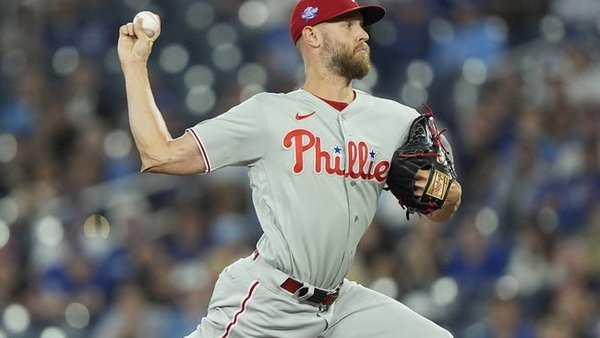
Zack Wheeler’s 3.14 ERA and 44.5% split-finger whiff rate walk into a game totaled at 8.5 — a number the raw projection barely clears at 9.2. The half-run gap looks thin on the surface, but Wheeler’s pitch-level suppression profile compresses Washington’s side of the equation in ways a flat run model doesn’t capture.
Zack Wheeler vs. Jared Simpson: Philadelphia Phillies at Washington Nationals Betting Preview
Washington took last night’s series opener 6-3, with Daylen Lile’s pinch-hit three-run homer doing the damage in the seventh inning. After yesterday’s collapse, the pitching matchup shifts significantly — from Cristopher Sánchez, who is cratering in September, to Zack Wheeler, who is arguably the most reliable arm in the National League. That’s not a minor rotation difference. That’s the entire argument.
The Phillies’ moneyline is priced at -196, and that’s a hard stop before anything else gets considered. The juice ceiling exists for a reason — overpaying for favorites in baseball is a long-term bleed, and -196 violates it regardless of how dominant Wheeler looks. So the question becomes where else the pitching edge surfaces. The answer is the total.
The posted total is 8.5 with the under at -110. The numbers project 9.2 combined runs — only 0.7 above the line — but Wheeler alone can compress Washington’s side of that equation by a run or more over league-average. A pitcher-friendly Nationals Park and a Philadelphia offense that has cooled in recent weeks complete the under picture. The number isn’t wildly off, but it’s slightly wrong on Wheeler’s side of the ledger, and that’s enough.
Game Info & Betting Lines
- Date/Time: Wednesday, September 16, 2026 | 6:45 PM ET
- Venue: Nationals Park | Park Factor: 0.98 (modest pitcher-friendly tilt)
- TV: MLB.TV, NBC Sports Philadelphia, Nationals.TV
- Probable Starters: Zack Wheeler (PHI) vs. Jared Simpson (WSH)
- Moneyline: Philadelphia Phillies -196 / Washington Nationals +161
- Run Line: Washington Nationals +1.5 (-107) / Philadelphia Phillies -1.5 (-113)
- Total: 8.5 (Over -110 / Under -110)
Why This Number Is Close — But Slightly Off
The market is doing its job here. An 8.5 total with Wheeler on the mound is not careless pricing. The books know what Wheeler is — a 12-win, 3.14 ERA starter with a 1.07 WHIP and 10.8 K/9 across 143.1 innings. They’ve priced that in. The legitimate case for the over rests almost entirely on Jared Simpson’s 4-inning sample and the Nationals’ legitimate offensive upside. Washington carries a .751 OPS and 200 home runs on the season — real firepower that can erupt quickly if a starter loses command early.
But here’s the problem: the market is balancing two unequal variables. Wheeler’s suppression is one of the most bankable commodities in baseball this season — 143 innings of consistent, elite-level run prevention. Simpson’s contribution to the total is essentially unknowable. And when one half of the equation is anchored by Wheeler holding Washington’s dangerous lineup to minimal production, 8.5 starts to look like a number that bakes in too much uncertainty from the Simpson side without adequately discounting what Wheeler does on the other.
Now, the raw numbers do project 9.2 total runs — technically a 0.7-run edge toward the over. I’m not ignoring that. But a flat run projection doesn’t account for Wheeler’s elite suppression profile the way a structured handicap does. Once you apply what his split-finger, curveball, and four-seamer actually do to expected contact quality against a lineup like Washington’s, the effective projected total for Wheeler’s half of this game drops by more than 0.7 runs on its own — enough to push the real number below 8.5. The raw figure favors the over by a sliver. The pitch-level data pushes it back under.
The Phillies are also not a run-producing machine right now. Their .711 OPS and .311 OBP are mid-tier, and they’ve gone 4-6 over their last ten games. You’re not banking on Philadelphia’s offense to inflate this total — and that works in the under’s favor.
What Separates the Pitching
The gap between these two starters is substantial, and it matters for how each half-inning flows. Wheeler’s four-seamer sits at 95.2 mph with a 25.2% whiff rate and holds hitters to a .282 xwOBA. His split-finger is the out pitch — deployed 15.4% of the time, generating a 44.5% whiff rate and just a .229 xwOBA against. His curveball is even more devastating in pure expected-quality terms, sitting at a .179 xwOBA with a 42.9% whiff rate. These aren’t just good numbers — they describe a pitcher who creates weak contact, limits walks (45 BB in 143.1 IP), and doesn’t give hitters anything comfortable to attack.
Against the Nationals’ lineup, the matchup data reinforces the ceiling. James Wood is the most dangerous bat Washington has — .546 xwOBA, a 10.4% barrel rate, and 35.4% hard-hit rate. But in 15 plate appearances against Wheeler, Wood is hitting .083 with 7 strikeouts. That’s a small sample, but it’s directionally consistent with what Wheeler’s split-finger does to power hitters who like to attack up in the zone.
Simpson is a different story — and not a simple one. His 6.75 ERA in 4.0 innings screams trouble, but his 0.75 WHIP is wildly contradictory for that run total. His four-seamer generates a 33.3% whiff rate at 94.3 mph — legitimate stuff — but his sinker carries a .466 xwOBA against and his split-finger has produced a 0.0% whiff rate in this sample. The arsenal shows flashes, but the secondary offerings are unreliable in four innings of data. For the Phillies’ power hitters — Schwarber at a .501 xwOBA, Harper at .442 — Simpson’s lack of a consistent secondary could become expensive quickly. The pitching gap is real, and it tilts the run environment firmly toward the under.
Pushback: The Case Against the Under
The honest friction here is that the under requires two things to go right simultaneously: Wheeler needs to be efficient and deep into the game, and the Phillies’ offense needs to stay quiet enough against Simpson that the combined total stays below 8.5. If Wheeler exits early due to pitch count or command issues, or if the Phillies string together a crooked number in the third or fourth, the under is in trouble before Washington even gets its full shot at the board.
Washington’s offense is also not to be dismissed. The Nationals posted a .751 OPS as a team and have 200 home runs on the season — and last night’s game proved they can manufacture runs in bunches when a Phillies starter loses the zone. Daylen Lile’s pinch homer was against a fatigued bullpen, not a fresh starter, but the offensive capability is real. If Simpson implodes early and hands the Phillies a big number in the first few innings, Washington has the lineup to respond and keep this game over 8.5 on their own.
The bet is not a lock. It’s a moderate-confidence lean that rests almost entirely on Wheeler’s shoulder. That’s the risk you’re accepting.
Run Environment & Game Shape
Nationals Park plays at a 0.98 park factor — a modest but genuine pitcher-friendly lean. It’s not a dramatic suppression environment, but in a game where the total is already sitting at 8.5, a sub-1.0 park factor is another thumb on the scale for the under rather than against it.
The expected game shape here is a Wheeler-dominant first five or six innings where Washington’s lineup is held to one or two runs, followed by a middle-relief phase where the Phillies’ bullpen — solid but not elite — manages the back end. Philadelphia’s offense against Simpson is the wild card, but a .311 OBP and a lineup that has cooled significantly since August doesn’t project as an outfit that’s going to hang a seven-spot on a starter, even a shaky one. Wheeler’s presence alone can carve 1-2 runs off Washington’s expected offensive output against a league-average arm, and when you combine that with a neutral-to-favorable park and a Phillies offense that isn’t running hot, 8.5 is a number that’s been set slightly too high for what this pitching matchup actually delivers.
The Pick
Wheeler’s elite suppression profile — a .229 xwOBA against on his split-finger, a .179 xwOBA on his curveball, and 143.1 innings of proven run prevention — drives Washington’s expected run contribution down far enough that 8.5 is a number the market has priced one pitcher short.
Bet: Under 8.5 Runs — 2 Units — Moderate Confidence