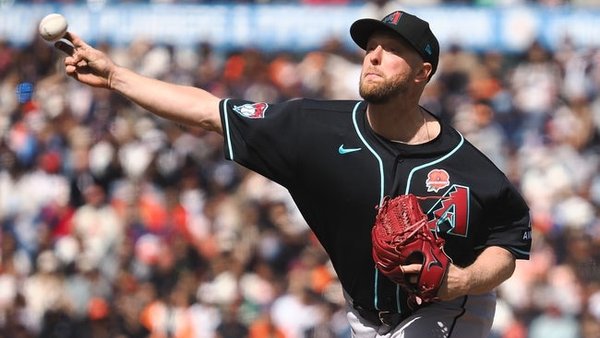
Merrill Kelly’s 4.97 ERA walks into a Marlins lineup carrying three hitters with xwOBA north of .435 — while Chase Field’s 0.97 park factor quietly suppresses any home-field run bonus. The Diamondbacks are posted at -136 despite a near-coin-flip projected run differential, and that gap between price and probability is where this analysis lives.
Ryan Gusto vs. Merrill Kelly: Miami Marlins at Arizona Diamondbacks Betting Preview
After Miami’s 4-2 extra-innings win Tuesday — where Esteury Ruiz’s three-run double off Taylor Clarke in the 11th did the damage — the pitching matchup shifts significantly tonight. Arizona sends out Merrill Kelly (9-13, 4.97 ERA) while Miami counters with Ryan Gusto (1-5, 4.14 ERA). That 0.83-run ERA gap is the anchor of this entire thesis.
The market has priced Arizona at -136, a meaningful favorite designation that implies roughly 57.6% win probability. The Edge Engine projects this game as a near-dead-heat — Miami 4.5, Arizona 4.4 — which means the Marlins at +113 represent a significant value gap between what the numbers say should happen and what the book is charging you to back each side. This is a pure price play, not a dominance argument.
Arizona’s playoff urgency is real. The Diamondbacks sit 2.5 games back of the final NL wild card with 10 games remaining, and last night’s loss was a genuine wound. Crowd energy and desperation at Chase Field are legitimate factors. But market noise around a team’s postseason stakes often inflates the favorite price beyond what the numbers actually support — and tonight that inflation benefits the Marlins bettor at +113.
Game Info & Betting Lines
- Date/Time: Wednesday, September 16, 2026 | 9:40 PM ET
- Venue: Chase Field (Park Factor: 0.97 — slightly pitcher-friendly, dome)
- Probable Starters: Ryan Gusto (MIA, 4.14 ERA) vs. Merrill Kelly (ARI, 4.97 ERA)
- Moneyline: Miami Marlins +113 / Arizona Diamondbacks -136
- Run Line: Arizona Diamondbacks -1.5 (+153) / Miami Marlins +1.5 (-186)
- Total: 9.0 (Over -105 / Under -115)
Why This Number Is Off
The -136 on Arizona makes intuitive sense. Home team, playoff urgency, more experienced pitcher by win total, and a fan base that will be loud after Tuesday’s gut-punch loss. The books are pricing in the environmental edges — home field, crowd, desperation — that quantitative models sometimes underweight.
But here’s the problem: when you strip away the narrative and look at the component breakdown, the numbers show away advantages in starter quality, offense, run prevention, and splits. None of those edges are enormous individually, but they all point the same direction. The cumulative signal produces a 52.2% win probability for Miami — and yet Miami is priced as if they win roughly 47% of the time. That’s a 9.9-percentage-point implied probability gap, which is not a marginal inefficiency.
The legitimate case for Arizona is mostly situational: a desperate team at home, a pitcher who likely performs better at Chase Field than his raw 4.97 ERA suggests, and a Miami bullpen that is badly shredded. The market is aware of all of that, and it’s reflected in the -136 price. My argument isn’t that Arizona can’t win — it almost certainly will roughly half the time. My argument is that +113 on Miami is the correct side of the value equation in a coin-flip game.
What Separates the Pitching
This matchup comes down to one concrete, measurable gap: Gusto’s 4.14 ERA versus Kelly’s 4.97 ERA — a difference of 0.83 runs that constitutes the most reliable edge in tonight’s game. Both are mid-rotation arms with real vulnerabilities, but they are not equivalent, and the market is pricing them closer to equivalent than the data warrants.
Kelly, at 9-13 on the season, has been a serviceable innings-eater but not a stopper. A 4.97 ERA at Chase Field — a slight pitcher’s park — means he’s been genuinely hittable. Miami’s top hitters present real problems for a pitcher in his profile. Griffin Conine carries an xwOBA of 0.476 — elite contact quality — paired with a 7.4% barrel rate. Kyle Stowers sits at 0.438 xwOBA with 19 home runs and a 32.0% hard-hit rate. Heriberto Hernández adds a third legitimate power threat at 0.437 xwOBA with 24 long balls. Three hitters in the same lineup with xwOBA north of .435 against a pitcher posting nearly a 5.00 ERA is a recipe for the Marlins generating real run-scoring opportunities.
Gusto, meanwhile, is the less-heralded arm in the matchup but the better one by ERA. His 4.14 ERA creates a different type of inning than Kelly — tighter margins, fewer free bases. Arizona’s lineup is functional: Gabriel Moreno (.303 AVG, .856 OPS) and Corbin Carroll (.400 xwOBA, 21 HR) headline a group that can score. But Arizona’s team OPS sits at .712 compared to Miami’s .728, and the Diamondbacks left 15 runners on base Tuesday night — a suppressed offensive execution rate that may not immediately correct. Gusto doesn’t have to dominate; he just needs to be the better pitcher in this specific game, and on paper, he is.
The Pushback
Let me slow down here, because there are genuine reasons to hesitate on this play.
First, Miami’s bullpen is in rough shape. Andrew Nardi, Anthony Bender, Pete Fairbanks — all on the IL. That’s three legitimate relievers unavailable tonight, and Fairbanks left Monday’s game with an apparent injury after walking the leadoff hitter. A depleted bullpen in a close game that heads to the sixth or seventh inning could unravel the starter’s work fast, and close games in September at Chase Field with playoff implications on the line tend to get interesting late.
Second, Kelly likely has better splits at home than his raw ERA shows. A 4.97 ERA is the season-long number — his Chase Field performance against a right-handed-heavy lineup may shade more favorable, and that’s a real variable that isn’t fully captured in the top-line figures.
Third, Arizona’s desperation factor isn’t just crowd noise. A team that’s 2.5 games back with 10 to play and just took a gut-punch loss the night before is going to compete differently. The Diamondbacks’ backs are against the wall, and that kind of focused urgency can manufacture runs in ways that don’t show up in season averages.
I keep coming back to the price. All of those counterarguments are legitimate, and they’re baked into the -136. The question is whether those factors close a 9.9-percentage-point gap. They don’t — not fully, not at this price.
Run Environment & Game Shape
The projected total of 8.9 runs sits right against the posted 9.0, giving no actionable edge on the total in either direction. Chase Field’s park factor of 0.97 makes it a slight run suppressor — particularly relevant in a dome environment where surface conditions are consistent and there’s no wind variable. The under at -115 is a mild lean if you need a second bet, but there’s no compelling edge to force it. Laying -186 on the run line in a game projected as essentially a coin flip is precisely the kind of price you shouldn’t pay just to feel more comfortable about your position — the moneyline at +113 is the play, and adding the run line requirement for -186 juice turns value into a liability.
The Pick
Miami Marlins ML +113, 1 unit — lean. This is a pure price play in a near-even game. The starter gap is real, the component signals all tilt away, and the market has overpriced the home side’s situational advantages. Bet: Miami Marlins ML +113, 1 unit, lean.