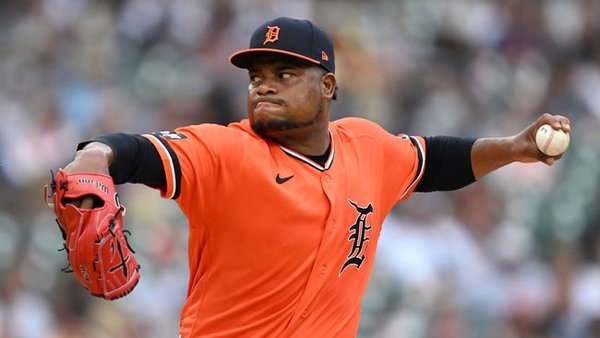
Two sub-4.00 starters square off at a park playing slightly below neutral, while both offenses rank below average in OPS and carry little offensive momentum into a late-September pressure game. The projection sits at 9.2 combined runs — 0.7 above the posted total of 8.5 — but power-dependent lineups that fail to go deep tend to go quiet in a hurry against competent starting pitching.
Framber Valdez vs Erick Fedde: Detroit Tigers at Chicago White Sox Betting Preview
The surface read on this game is two mediocre offenses, two competent starters, and a total that looks reasonable at 8.5. That’s partially right. But the market is pricing in a run environment that neither of these lineups is currently capable of sustaining. Detroit’s team OPS sits at .716, Chicago’s at .722 — both comfortably below average. Neither offense manufactures runs with volume or efficiency against quality starting pitching, and tonight they’re each facing arms that have earned sub-4.00 ERAs.
The projection spits out 9.2 combined runs, which technically points toward the over. I’m going the other direction. The 0.98 park factor at Guaranteed Rate Field shades scoring down slightly, and when you account for the quality of contact these lineups typically generate — not their seasonal run totals, but their underlying Statcast profiles — the 8.5 feels like a ceiling that’s genuinely reachable, not a floor to clear.
Both teams arrive from losing efforts: Detroit dropped its series finale to Toronto, and Chicago just dropped two of three in Cleveland, falling out of first place in the AL Central. The pressure context of a late-September game matters here, and neither team is rolling into this one with offensive momentum.
Game Info & Betting Lines
- Date/Time: Thursday, September 17, 2026 | 7:40 PM ET
- Venue: Guaranteed Rate Field | Park Factor: 0.98 (slight pitcher lean)
- TV: MLB.TV, Tigers.TV, CHSN
- Probable Starters: Framber Valdez (DET, 10-10, 4.01 ERA) vs Erick Fedde (CHW, 8-9, 3.97 ERA)
- Moneyline: Detroit Tigers +105 / Chicago White Sox -126
- Run Line: Chicago White Sox -1.5 (+160) / Detroit Tigers +1.5 (-194)
- Total: 8.5 (Over -105 / Under -115)
Why This Number Is Close But Slightly Off
The market has landed on 8.5 for a reason. Both starters carry ERA numbers in the 3.97-4.01 range. The lineups aren’t built for suppression, they’re built for mediocrity — and mediocrity at scale can still produce runs. The legitimate case for the over runs through Fedde’s alarming home run rate (23 HR in 133.2 IP, roughly 1.55 HR/9) and the White Sox’s genuine power threats in Miguel Vargas (31 HR) and Munetaka Murakami (31 HR). One multi-run inning from Fedde, and you’re looking at a 5-4 game that cashes the over.
But here’s the problem — the market has also already priced the over at -105, meaning books are essentially collecting even juice on both sides with a slight lean toward the over being taken. That’s not a book signaling a confident number; it’s a book holding middle ground. And the under at -115 is almost flat. When the posted total sits 0.7 runs below the underlying projection, the natural lean is over — but park suppression, cold offense from both clubs, and the quality of Detroit’s bullpen (3.64 staff ERA) all push the expected output back toward the line. The under isn’t a value scream; it’s a disciplined play on the right side of a close number in a pitcher-leaning environment.
What Separates the Pitching
Framber Valdez is a sinker-first arm — his sinker accounts for 44.6% of his pitches at 93.8 mph, but it’s a contact-generator, not a swing-and-miss weapon, holding a 9.1% whiff rate and an xwOBA against of .375. His real strikeout weapon is the curveball (29.0% usage, 29.2% whiff rate, .269 xwOBA), and when he pairs it with the occasional slider — used only 4.5% of the time but generating a 39.0% whiff rate and .151 xwOBA — he’s capable of punching through a lineup. The concern is his 6.65 K/9, which is below average. Contact will happen. The question is whether it’s loud contact, and for most of the White Sox lineup, the Statcast profile suggests it won’t be. Chase Meidroth carries just a 2.2% barrel rate, Randal Grichuk sits at 5.9%, and even Vargas at 6.7% is a manageable threat for a sinker-heavy pitcher who generates weak grounders.
The genuine mismatch against Valdez is Munetaka Murakami. His .475 xwOBA and 9.5% barrel rate make him a legitimate hard-contact threat, and a sinker-heavy arm is not the ideal profile to face him. Murakami’s 34.2% hard-hit rate against that type of pitch mix is worth watching. But Murakami’s 35.0% strikeout rate — the highest of any White Sox regular — creates a natural ceiling on his damage output per plate appearance.
Erick Fedde operates differently. His primary weapon is the sweeper (37.5% usage, 82.1 mph, .288 xwOBA against) which generates a 23.3% whiff rate and should give Detroit right-handed hitters fits — particularly Riley Greene, who carries an .486 xwOBA versus right-handed pitching but whiffs at a 27.4% clip. Greene’s BvP sample is small (11 PA), but the .500 batting average and one HR in that sample is a data point that can’t be ignored. Dillon Dingler has also gone 2-for-4 with a HR against Fedde in limited exposure, and his .409 xwOBA with a 5.0% barrel rate makes him a real threat in the middle of that Detroit order.
The piece of the Detroit lineup I can’t overlook, though, is Eduardo Valencia. The DH is hitting .320 with a .946 OPS in 100 AB, but the underlying numbers are what jump out: a .437 xwOBA — higher than Dingler’s .409 — and a 9.1% barrel rate that actually leads this Detroit roster in barrels per plate appearance. Valencia represents a legitimate HR risk for Fedde that doesn’t announce itself in the counting stats. He’s not generating headlines with 27 home runs, but his quality-of-contact profile says he’s more dangerous on a per-swing basis than his modest HR total implies. Against a pitcher surrendering 1.55 HR/9, that barrel rate matters.
The Pushback I’m Taking Seriously
I want to be honest about where I’m fading the numbers here, because the disagreement is real. The aggregate projection lands at 9.2 — that’s not a trivial gap above 8.5. The over-friendly case isn’t just theoretical: Fedde’s HR rate is one of the worst in the league among starters with this many innings, and Detroit has multiple legitimate power threats in Greene, Dingler, and Valencia who have the barrel profiles to capitalize. The BvP data on Greene (1 HR in 11 PA) and Dingler (1 HR in 4 PA) against Fedde specifically adds a layer of concern that isn’t noise, even at small sample sizes.
Add in Chicago’s power — Vargas and Murakami each have 31 home runs — and Valdez’s sinker-heavy profile that generates contact rather than strikeouts, and a 9+ run game is absolutely within range. I’m not pretending it isn’t. I’m fading my own projection here, and I’m doing it with eyes open.
Run Environment & Game Shape
The park factor at Guaranteed Rate Field comes in at 0.98 — a modest but directionally meaningful pitcher’s lean. It’s not Petco Park, but in a game where the total is already sitting close to the projected output, every decimal point matters. The real structural argument for the under is game shape: both offenses are built around power rather than contact volume, and power-dependent lineups are feast-or-famine. When the home run doesn’t happen, the scoring dries up fast against starters posting sub-4.00 ERAs.
Combined with two pitchers who generate substantial contact rather than strikeouts — Valdez at 6.65 K/9, Fedde at 6.13 K/9 — you might expect a high-contact, high-run environment. But contact quality tells a different story. The middle portions of both lineups are the only zones where barrel rates get truly dangerous, and Detroit’s bullpen (3.64 ERA) functions as a genuine insurance policy if Valdez struggles. Chicago’s pen has been more exploitable at 4.12 ERA, but Detroit’s lineup, despite the Valencia and Greene threats, isn’t a unit that piles on against relief pitching at high volume — their 1,316 strikeouts on the season rank among the more swing-and-miss offenses in the AL. When runs have to be manufactured rather than hit over the fence, this Detroit lineup frequently goes quiet.
The game shape I’m expecting: both starters work into the sixth, limiting damage, with one or two solo shots sprinkled in — enough to make the final count feel competitive, not enough to breach 8.5. The under doesn’t need a dominant pitching performance from either arm. It just needs the power-dependent offenses to stay power-dependent, the park factor to do its small job, and the Detroit bullpen to clean up any mess Valdez leaves behind.
The Pick
I’m not going to pretend this is a slam dunk. The projection says over, and I respect what that number is telling me. But I’ve looked at the actual components — two below-average offenses, a pitcher’s park, cold recent form from both clubs, and a Detroit bullpen that’s earned the right to be called an asset — and the under is where I land. The market juice is nearly flat, which means the books aren’t confident either, and that’s fine by me. I don’t need the books to agree. I just need the game to stay quiet, and everything I see suggests it will.
Bet: Under 8.5 | 2 Units | Moderate Confidence