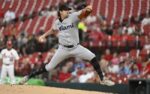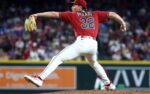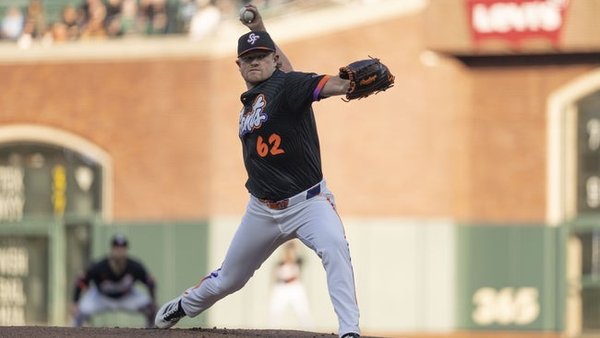
Logan Webb’s 1.11 WHIP and 2.3 BB/9 give the Giants a genuine run-suppression anchor — the kind the posted total of 8 may not be fully accounting for. Grayson Rodriguez’s 8.23 ERA and 4.4 BB/9 justify some of that number, but Oracle Park’s 0.92 park factor and the Angels’ .702 team OPS point toward a run environment the market is pricing a tick too generously.
Grayson Rodriguez vs Logan Webb: Los Angeles Angels at San Francisco Giants Betting Preview
The posted total of 8 is doing a lot of work here. It’s pricing in Grayson Rodriguez’s combustibility, acknowledging Oracle Park’s pitcher-friendly 0.92 park factor, and still landing at a number that feels just a tick too generous when you put Logan Webb on one side of the ledger. This isn’t a neutral pitching environment with two average starters — it’s a cavernous, fog-draped ballpark with one of the better contact-management arms in the league squaring off against a pitcher who’s posting an 8.23 ERA through 35 innings.
The under at 8 (-110) is the cleanest expression of what this game actually looks like on paper. Webb’s elite command profile suppresses one full side of the run total, and the Angels’ .702 team OPS — one of the worst offensive outputs in baseball — walks directly into the worst matchup it could draw. Rodriguez’s blowup risk is real and worth acknowledging, but the total is already priced to absorb some of that chaos. The question is whether it’s priced to absorb enough of it. My lean says no.
The market isn’t wrong to respect Rodriguez’s upside for blowing this game open — that’s exactly why the number sits at 8 rather than 7. But the numbers project 8.9 combined runs, meaning the edge here is modest, not a slam dunk. This is a moderate lean toward under, not a hammer.
Game Info & Betting Lines
- Date/Time: Friday, July 24, 2026 — 10:15 PM ET
- Venue: Oracle Park (Park Factor: 0.92 — pitcher-friendly)
- TV: ESPN Unlmtd, MLB.TV, NBC Sports BA, KNTV, Angels.TV
- Away Starter: Grayson Rodriguez (3-3, 8.23 ERA, 1.77 WHIP, 35 IP)
- Home Starter: Logan Webb (5-7, 3.87 ERA, 1.11 WHIP, 107 IP)
- Moneyline: Los Angeles Angels +146 / San Francisco Giants -174
- Run Line: San Francisco Giants -1.5 (+126) / Los Angeles Angels +1.5 (-152)
- Total: 8 (Over -110 / Under -110)
Why This Number Is Close
The market set 8 because it understands the tension in this matchup. On one hand, Webb is the kind of pitcher who genuinely caps a run total — he’s thrown 107 innings with a 1.11 WHIP and only 27 walks all season, which translates to a microscopic 2.3 BB/9. Clean counts, weak contact, minimal traffic. Against an Angels lineup hitting .240 with a .702 OPS, that’s a recipe for three-up-three-down innings across five or six frames. Webb’s side of the ledger could realistically land at 3 runs or fewer.
The legitimate case for the over rests entirely on Rodriguez. His 8.23 ERA is not bad luck — it’s a reflection of a pitcher who walks 17 batters in 35 innings, gives up hard contact, and has shown he can turn a game into a bullpen emergency by the third inning. If he implodes and the Giants stack a five-run first, you’re chasing the under from behind before Webb even throws a pitch. The market baked that scenario into the number, which is exactly why 8 feels right rather than obviously wrong.
Where I think the market is slightly off is in how it weights Oracle Park. A 0.92 park factor is one of the most meaningful run-suppression environments in baseball — it’s not a marginal adjustment. Pair that with Webb’s command profile and the Angels’ recently cold offense — held to one run or fewer in two of their last three games, including a shutout loss to the Cardinals on 7/22 — and the under has a structural foundation the 8-run total doesn’t fully price.
What Separates the Pitching
The gap between these two starters is one of the wider mismatches you’ll find on any given Friday. Logan Webb carries a 1.44 WAR through 107 innings — durable, consistent, and built around a pitch mix that generates early-count contact and avoids crooked numbers. His slider is his primary swing-and-miss weapon by usage, deployed 26.3% of the time with a 33.2% whiff rate and .343 xwOBA against. His knuckle curve gets even more whiffs at 37.6% but sees far less deployment at just 9.8% usage — it’s a weapon he deploys situationally rather than as a staple. His changeup holds hitters to a .251 xwOBA with a 23.7% whiff rate. Webb doesn’t overpower lineups — he sequences them to death, and against an Angels offense that strikes out 977 times on the season and makes mostly weak contact, that approach is surgical.
The Angels’ best threats against Webb are limited. Mike Trout carries an .847 OPS and an xwOBA of .486 — he’s the one name in this lineup who can do damage regardless of the matchup. But his BvP history against Webb is a thin 8 plate appearances, and Webb’s 4-seam fastball at 93.4 mph pairs well with that slider (85.9 mph, 33.2% whiff rate) to keep right-handed power hitters off-balance.
Grayson Rodriguez is a completely different story — and a more complicated one than his ERA alone suggests. His sinker carries a .509 xwOBA against, one of the most punishable primary pitches in the league. He throws it 28% of the time. His cutter (30.4% usage) generates a 29.6% whiff rate and .265 xwOBA, which is a functional weapon. But the pitch that doesn’t get enough attention is his split-finger, which he throws 24.5% of the time — nearly as often as the sinker — and it’s genuinely his best offering: 35.7% whiff rate and an elite .174 xwOBA against. That’s a legitimate swing-and-miss pitch. The problem is that one plus pitch hasn’t been enough to offset the damage the sinker invites, and the -1.08 WAR on the season reflects that reality. Rodriguez has a weapon; he just doesn’t have enough of them, and the one he leans on most is the one that’s killing him.
The Giants’ top-of-order threats against Rodriguez are significant. Bryce Eldridge sits with a .452 xwOBA and a 29.1% hard-hit rate. Heliot Ramos checks in at .451 xwOBA with a 27.2% hard-hit rate. Willy Adames brings legitimate power from the bottom third of the order and has shown he can do damage in key spots — his ninth-inning homer against Kansas City on 7/20 is a recent reminder. Jung Hoo Lee hit an RBI triple in the Giants’ most recent game and provides another contact threat in the six-hole. Worth noting that Victor Bericoto, who has posted strong numbers against right-handed pitching this season, is on the 10-Day IL with an oblique injury and will not factor into this lineup. The Giants don’t need him to make Rodriguez uncomfortable — this order has enough artillery without him.
Pushback: Why the Under Isn’t a Lock
I’m not going to pretend this is a layup. There are three real structural concerns with the under here.
First, Rodriguez’s blowup ceiling is legitimate. He’s walked 17 batters in 35 innings, which means he’s one bad inning away from loading the bases with nobody out in the third. If the Giants score five or six before Webb makes his first adjustment, the under is cooked before the fourth inning. A pitcher with a 4.4 BB/9 in a ballpark full of hitters with elevated xwOBAs is a time bomb, not just a weak starter.
Second, the Giants’ bullpen is depleted. Joel Peguero, Jose Butto, and Matt Gage are all on the IL. If Webb exits early or gets into trouble, San Francisco is burning through a thin relief corps — and thin bullpens give up runs at inconvenient times. That’s a structural over risk that doesn’t show up in starter analysis.
Third, the projected total of 8.9 runs puts us only 0.9 runs above the posted number. That’s a real edge, but it’s not a blowout margin. Half a pitcher’s bad inning erases it. This is a lean, not a conviction play, and anyone pressing multiple units here is getting ahead of what the numbers actually support.
Angles I Considered and Rejected
The Giants moneyline at -174 is the obvious alternative. The home win probability is strong — around 75% — and Webb is a genuine quality start candidate. The problem is the juice. Paying -174 for a team with a -64 run differential on the season, on a night where their starter could be pulled by the fifth inning, puts too much of your return at risk. The implied probability at -174 requires the Giants to win roughly 63.5% of the time just to break even. That’s reasonable on paper, but it’s a steep price when the game has meaningful volatility on both sides.
The run line at Giants -1.5 (+126) is tempting on paper — plus money on a team that should win by multiple runs sounds clean. But Rodriguez’s implosion risk cuts both ways. A blowout loss for the Angels means the run line cashes, but a 5-4 Giants win — very much in play if Rodriguez gives up a crooked early number and Webb then cruises — leaves run line bettors empty. The run line requires a specific game shape, and this matchup has too many paths to a single-digit Giants win to justify the commitment.
The under survives both of those scenarios more cleanly. It doesn’t care about the margin of victory — just the combined run total. And when one pitcher is Webb and the other is Rodriguez in Oracle Park, the structural pressure on run-scoring is real regardless of which direction the game tilts.
Run Environment & Game Shape
Oracle Park does real work in this spot. The 0.92 park factor isn’t a rounding error — it’s one of the most consistent run-suppression environments in baseball, and it matters most in games where at least one starter is capable of keeping the ball in the yard. Webb is exactly that starter. His 9 home runs allowed in 107 innings is a clean profile, and the park makes that number even more sustainable.
The game shape most likely to emerge here is a lopsided start from Rodriguez — meaning the Giants score early, Webb then pitches with a lead, and the back half of the game compresses into quiet innings. Webb pitching with a cushion is one of his best modes: he works ahead in counts, gets weak contact, and doesn’t give the Angels’ lineup anything to sit on. A 5-2 or 4-2 final is very much in the range of outcomes, and both of those cash the under with room to spare.
The scenario that breaks this ticket is Rodriguez getting through four or five innings while surrendering a steady trickle of runs rather than one massive blowup — and then a depleted Giants bullpen tacking on additional traffic in the later innings. That’s the path to 9 or 10 combined runs, and it’s not a fantasy. But it requires things to go wrong in a specific, sequential way. The more probable game shape — Rodriguez implodes early, Webb cruises — tends to compress the total, not expand it.
At flat juice on both sides, the under at 8 (-110) offers clean value in a matchup where the structural weight sits firmly below the number. Play the Under 8 (-110) for 2 units. Moderate confidence.