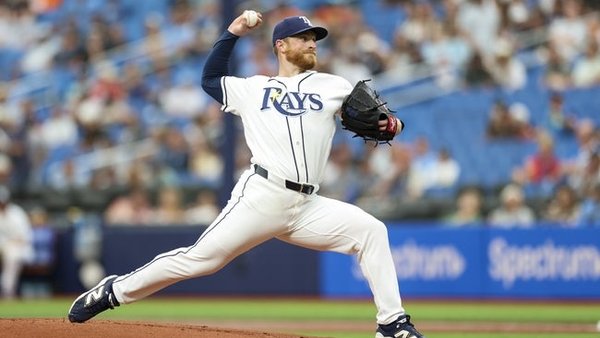
Drew Rasmussen’s 0.92 WHIP and elite changeup profile face an Athletics lineup stripped of Rooker, Kurtz, and Soderstrom — three regulars lost to the 60-day IL. The 7.5 total prices Springs’ volatility symmetrically against both offenses, but Oakland’s ability to score against a true run-suppressor is severely compromised, and that asymmetry is where the number comes under pressure.
Jeffrey Springs vs Drew Rasmussen: Athletics at Tampa Bay Rays Betting Preview
The Rays are -286 on the moneyline. That number tells you everything the market thinks about this game — and it’s probably right about who wins. The problem is that -286 is a juice trap, and the real edge here isn’t on the outcome, it’s on the run environment. When you put one of the AL’s better starters against a crippled, strikeout-prone Oakland lineup inside a dome that suppresses scoring, the question isn’t whether Tampa Bay wins. It’s whether the combined total stays south of 7.5.
The Rays followed up Tuesday’s walk-off with a 4-3 win Wednesday — their fifth straight. Now Drew Rasmussen takes the ball, and the pitching matchup shifts dramatically in Tampa Bay’s favor compared to the Martinez start that closed out yesterday’s win. The under at -104 is the cleanest number on the board.
The market has set this at 7.5 for a reason — Springs is a legitimate over threat if he gets shelled early. But Rasmussen’s ceiling suppression on the other side of the ledger is the factor that doesn’t get enough weight at this total.
Game Info & Betting Lines
- Date/Time: Thursday, September 17, 2026 | 1:10 PM ET
- Venue: Tropicana Field (Dome, Park Factor: 0.95 — pitcher-friendly)
- Probable Starters: Jeffrey Springs (Athletics, 4-13, 5.93 ERA) vs Drew Rasmussen (Rays, 14-5, 2.81 ERA)
- Moneyline: Athletics +229 / Tampa Bay Rays -286
- Run Line: Tampa Bay Rays -1.5 (-122) / Athletics +1.5 (+101)
- Total: 7.5 (Over -116 / Under -104)
Why This Number Is Close
The market landed at 7.5 because it’s genuinely balancing two competing forces. On one side, you have Rasmussen — a bonafide ace who limits baserunners and stifles offense. On the other, Springs is among the worst starters in the American League by ERA, and the Rays’ lineup, led by Junior Caminero‘s 41 home runs and Yandy Díaz hitting .297, is capable of hanging a crooked number in the early innings before Rasmussen even throws a pitch.
The legitimate case for the over is simple: Springs gives up runs in bunches. His 33 home runs allowed in 135 innings is a rate that destroys totals. If the Rays score five or six before Oakland even comes to bat in the second inning, this total is already in jeopardy from the Tampa Bay side alone.
But here’s where the market is slightly wrong: it’s applying Springs’ volatility symmetrically, as if Oakland has the firepower to match whatever the Rays put up. They don’t. The Athletics are 61-91, missing Brent Rooker, Nick Kurtz, and Tyler Soderstrom — all on the 60-day IL — and rank among the league’s worst strikeout teams with 1,296 punchouts on the season. The run environment on the Oakland side of the ledger is severely compressed. The 7.5 total implicitly assumes Oakland contributes 3.5-plus runs, which is asking a lot of a depleted lineup facing Rasmussen.
What Separates the Pitching
This is not a close pitching matchup. Drew Rasmussen is operating at a level Springs hasn’t approached in years, and the gap between these two arms is the defining factor in the run environment.
Rasmussen’s arsenal is built around four quality offerings, led by a 90.0 mph cutter he deploys on 29% of pitches, generating a .289 xwOBA against and a 23% whiff rate. His 95.8 mph four-seam fastball pairs with a 95.2 mph sinker that gets grounders — the sinker holds hitters to a .258 xwOBA. The true knockout pitch is his changeup: sitting at 89.6 mph with a 33.5% whiff rate and a .202 xwOBA against — one of the more dominant offspeed weapons in the league. His season numbers confirm what the pitch-level data shows: 2.81 ERA, 0.92 WHIP, 8.98 K/9, with only 27 walks in 160.1 innings. That command profile is elite, and it’s specifically punishing to a lineup like Oakland’s that whiffs at a league-worst rate.
The Statcast matchup data underscores the mismatch. Henry Bolte leads off for Oakland with a 28.0% season strikeout rate and a 31.1% whiff rate — a profile that plays directly into Rasmussen’s arsenal. He’s also just 0-for-2 in career plate appearances against Rasmussen. Alika Williams bats second with a .285 xwOBA and a 20.6% whiff rate — not the profile of a hitter who solves an elite command arm. Even Shea Langeliers, Oakland’s best bat at a .444 xwOBA, has just a 7 PA sample against Rasmussen hitting .143.
Springs, meanwhile, is the inverse. His 91.3 mph four-seam generates only an 11.1% whiff rate and a .362 xwOBA against — hittable velocity with limited deception. His changeup (35% whiff rate, .265 xwOBA) is his best weapon, but it hasn’t been enough to compensate for a four-seamer and slider combo that the Rays’ lineup — with Caminero’s .410 xwOBA and Jonathan Aranda’s .409 xwOBA — can punish. Rasmussen creates soft-contact, low-baserunner innings. Springs creates traffic.
The Pushback
The case against this under deserves honest treatment, because it’s real. Springs’ 5.93 ERA and 33 home runs allowed in 135 innings isn’t just a bad stretch — it’s a pattern. Junior Caminero has a .425 xwOBA against left-handed pitching, and Tampa Bay’s Ryan Vilade — batting second in the Rays’ lineup — posts a .417 xwOBA against lefties. If Springs gets pounded for four or five runs in the first two innings, Oakland needs to manufacture runs against Rasmussen for the under to survive, and there’s very little evidence this lineup can do that.
The numbers project this game at 8.7 total runs, pointing toward the over. That projection is real and I’m not dismissing it. But run-projection frameworks lean on recent team-level run production and pitcher ERA, and Springs’ ERA is inflated enough to pull the forecast past 8. The piece the projection doesn’t fully account for is the structural quality gap between Oakland’s current lineup — stripped of Rooker, Kurtz, and Soderstrom — and a typical opposing offense. The Athletics aren’t a league-average offense facing an average starter. They’re a depleted roster facing one of the better run-suppression profiles in the AL. That asymmetry is what the projection smooths over, and it’s the reason the under still has value at -104 despite the numbers leaning over.
The run line is also worth addressing briefly. Tampa Bay -1.5 at -122 has obvious appeal given the pitching disparity, but with Springs’ run projection already embedded in the total, the run-line juice is asking you to pay for a margin that’s already partially priced. The moneyline at -286 is a juice ceiling that makes the return-on-risk unattractive. Neither side bet offers the same pricing efficiency as the total.
The Pick
Rasmussen’s run-suppression profile is elite — a .202 xwOBA on his changeup, a 0.92 WHIP on the season, and a command structure that’s built to neutralize exactly the kind of strikeout-heavy, contact-challenged lineup Oakland is rolling out today. The Athletics are missing three legitimate lineup contributors to the 60-day IL and enter this game as one of the least threatening offenses Rasmussen will face all year. Springs’ volatility is real, but it’s the Tampa Bay side of the run total that’s being mispriced — the market is applying his blowup risk symmetrically when Oakland’s ability to respond is severely compromised. At -104, the under on 7.5 is the sharpest number on this board. Take it for 2 units at moderate confidence.
Bet: Total Under 7.5 (-104) — 2 Units | Moderate Confidence