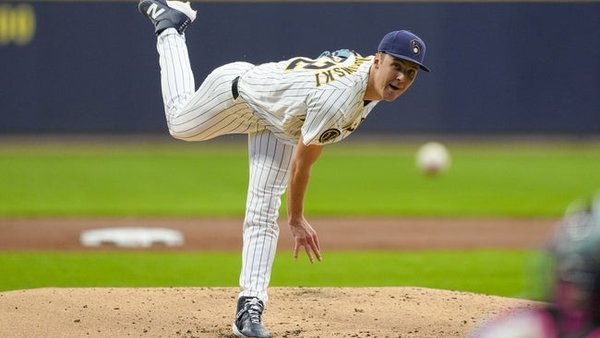
Jacob Misiorowski’s 1.73 ERA and 0.75 WHIP represent one of the most dominant starter profiles in baseball this season — David Peterson’s 5.11 ERA and .426 xwOBA-against on his primary pitch represent something closer to the opposite. The total sits at 8.5 with the under already juiced to -117, and the gap between these two arms is wide enough that the number hasn’t fully settled where the matchup points.
Jacob Misiorowski vs. David Peterson: Milwaukee Brewers at Chicago Cubs Betting Preview
After Tuesday’s 9-4 Milwaukee win leveled out Monday’s 17-3 Cubs blowout, the series has already produced two wildly different run environments in back-to-back nights. Tonight the pitching matchup resets entirely, and that reset changes everything about how to approach the number.
The numbers project a combined 9.2 runs — barely 0.7 over the posted 8.5. That gap isn’t large enough to make the over compelling, but the breakdown of who scores those runs matters more than the combined total. Milwaukee’s half of this game belongs to Jacob Misiorowski, one of the most dominant starters in baseball this season. Chicago’s half is in the hands of David Peterson, a back-of-rotation arm who has been inconsistent at best. The under case isn’t built on both offenses going cold — it’s built on Misiorowski suppressing his side so thoroughly that Peterson’s volatility can’t fully offset it.
The Brewers moneyline is priced at -162, which is off the table. When you’re laying that much juice on a single starter, you’re paying a price that eliminates the edge — even with Misiorowski on the mound. The total is the cleaner angle.
Game Info & Betting Lines
- Date/Time: Wednesday, September 2, 2026 | 7:40 PM ET
- Venue: Wrigley Field | Park Factor: 1.02 (virtually neutral)
- Probable Starters: Jacob Misiorowski (MIL) vs. David Peterson (CHC)
- Moneyline: Milwaukee Brewers -162 / Chicago Cubs +134
- Run Line: Milwaukee Brewers -1.5 (+102) / Chicago Cubs +1.5 (-122)
- Total: 8.5 (Over -103 / Under -117)
Why This Number Is Close But Leans Under
The market has set 8.5 with the under juiced to -117, and that pricing reflects genuine respect for Misiorowski. Books don’t move juice without reason, and -117 on the under signals that sharp money has already identified the primary suppression force in this game. The legitimate case for the over rests almost entirely on Peterson’s volatility — a starter with a 5.11 ERA and 1.52 WHIP who has shown he can unravel in a single inning, giving Milwaukee a chance to post five or six runs on their own.
But here’s the problem with the over case: it requires Peterson to blow up and Misiorowski to allow three or four. That’s a two-condition parlay on a night when one of those conditions is extremely unlikely. The Cubs offense — despite Monday’s nine-homer explosion — will be working against a pitcher who has held hitters to a 0.75 WHIP over 151 innings this season. Monday’s franchise-record power display came off a different arm in a different game environment. The Cubs don’t replicate that kind of output by accident, and they certainly don’t do it against an arm like Misiorowski’s.
The market is balancing real offensive capability on both sides against one genuinely elite suppression force. The lean is under because that force is real, sustained, and operating at historic-pace numbers.
What Separates the Pitching
The gap between these two starters is as wide as any you’ll find in a single game this season. Misiorowski’s numbers — 1.73 ERA, 0.75 WHIP, 13.23 K/9 over 151 innings — represent the kind of line that gets compared to Cy Young campaigns. His four-seam fastball sits at 100.4 mph, used 62.3% of the time, generating a 36.4% whiff rate and holding hitters to a .228 xwOBA. He complements it with a curveball that produces a 42.6% whiff rate and a .159 xwOBA-against — a put-away pitch that elite hitters genuinely struggle to identify. His walk rate of 2.09 BB/9 (35 walks in 151 innings) means the Cubs will get almost no free baserunners. They’ll have to earn every baserunner they get.
The BvP data against Chicago’s top hitters is telling. Pete Crow-Armstrong — the Cubs’ most dangerous bat, with a .943 OPS and 38 home runs — is 0-for-12 with nine strikeouts in 12 plate appearances against Misiorowski. Crow-Armstrong’s 25.9% strikeout rate and 24.2% whiff rate make him particularly vulnerable to Misiorowski’s high-velo, high-spin arsenal. Ian Happ is hitting .071 with eight strikeouts in 16 plate appearances against Misiorowski — a batting average that tells you exactly how these matchups have gone.
Peterson operates in an entirely different run environment. His sinker — used 30.4% of the time at 92.0 mph — carries a .426 xwOBA-against and a 14.6% whiff rate. That’s a pitch that gets hit, not missed. His four-seamer sits at 92.3 mph with a .331 xwOBA-against. The velocity and whiff-rate gaps between these two starters are not marginal — they’re structural. Misiorowski creates innings that look like chess; Peterson creates innings that look like triage.
The Pushback
The honest concern here starts with Monday night. The Cubs hit nine home runs in a single game — a franchise record — against a different Brewers starter. That kind of power doesn’t vanish overnight just because the pitching matchup changes. Alex Bregman had three of those homers, and this Cubs lineup, which leads the team with 196 home runs on the season, is genuinely capable of stacking a crooked number against a leaky arm like Peterson when they’re swinging hot.
The Peterson blowup risk is real. His sinker is getting hammered to a .426 xwOBA-against, and a lineup that includes Pete Crow-Armstrong (.461 xwOBA, 38 HR) and Jackson Chourio (.415 xwOBA, 20 HR) can chain together damage in a hurry if Peterson loses command of his fastball command in the early innings. One bad inning from Peterson and Milwaukee could be posting five or six before the bullpen ever sees action.
And speaking of the bullpen — the Cubs’ relief corps is legitimately depleted. Porter Hodge, Ben Brown, Hunter Harvey, Riley Martin, and Phil Maton are all on the IL. That’s real bullpen attrition, and if Peterson exits early, Craig Counsell will be reaching into a thinner-than-usual group of arms to hold the score. Counterintuitively, that bullpen depletion cuts slightly against the under — not for it — because Peterson’s floor as a starter is lower than usual with fewer quality bridge options behind him.
There’s also a legitimate counter-signal in the Seiya Suzuki BvP data. Suzuki, hitting second in Chicago’s lineup with a .863 OPS and a .405 xwOBA, has gone .308 with two home runs in 15 plate appearances against Misiorowski. That’s not noise — that’s the Cubs’ second-best hitter demonstrating real success against an otherwise dominant arm. If Suzuki finds his spots tonight, he has the history against Misiorowski to do damage where almost everyone else in this lineup hasn’t.
These are legitimate signals. The over case isn’t nothing. But the pushback cases all require things to break a specific way — Peterson unravels, the bullpen can’t hold it, and the Brewers pile on. That’s the two-condition parlay problem again. Suzuki’s BvP gives me pause, but two home runs in 15 PA against a pitcher with a 42.6% curveball whiff rate tells me he’s the exception, not the rule, for this lineup.
Run Environment & Game Shape
The 9.2 combined run projection is built on asymmetric contributions from both halves of this game. Misiorowski’s side of the ledger — the Cubs’ offensive output against him — is the controlled variable. His 1.73 ERA, elite pitch mix, and the BvP data all point toward Chicago producing somewhere in the range of two to three runs against him through six or seven innings. That’s the floor and ceiling of what his track record projects, and it’s a narrow band. Wrigley’s 1.02 park factor barely nudges the needle.
Peterson’s side is the open variable. His 5.11 ERA and 1.52 WHIP mean the Brewers’ contribution to the total carries a wider range — anywhere from three runs in a clean outing to six or seven if he loses the strike zone early. The 9.2 figure essentially prices in a middle-outcome Peterson start of around five or six Brewers runs, combined with two to three Cubs runs off Misiorowski. That math gets you to the posted total or just over it — but only if Peterson performs near the middle of his range.
Here’s where the structural argument for the under sharpens: the Misiorowski half of this total is close to locked. His WHIP, his BvP data against this specific Cubs lineup, and his 222-strikeout pace all point toward suppression. The Peterson half is volatile, yes — but the Brewers’ lineup, while capable, isn’t the kind of offense that chains five-hit innings against even average pitching. Milwaukee is averaging around 4.9 runs per game on the season, and Peterson has enough of a ground-ball profile with that sinker to generate weak contact even when he’s getting hit. The realistic projection has Misiorowski holding Chicago to two or three, Peterson allowing three to five to Milwaukee, and the final number landing somewhere between six and eight — well inside the posted 8.5. You need both halves to break toward their extremes to get over this number, and one of those halves features one of the best starters in baseball.
The Pick
The under is the play. Misiorowski’s elite suppression profile controls his half of this game, Peterson’s volatility is real but doesn’t guarantee an explosion, and the Cubs’ best hitters — outside of Suzuki — are carrying historically poor BvP numbers against tonight’s starter. The juice at -117 is the price of admission for a legitimate edge, and I’m comfortable paying it.
The Pick: Under 8.5 (-117), 2 units