Two starters with sub-2.85 ERAs and identical 1.15 WHIPs share the same Friday night stage at Great American Ball Park — a venue that historically inflates run totals. The market has posted 8.5 with the Over priced at -121, leaning on park factor and roster-level offensive averages while the pitching matchup argues for a sharply different run environment.
Clay Holmes vs Chase Burns: Chicago Cubs at Cincinnati Reds Betting Preview
The market has set this total at 8.5, and on the surface that looks reasonable for a mid-September game between a wild card contender and a team already below .500. But the raw numbers here tell a more specific story. You have Clay Holmes (2.85 ERA, 1.15 WHIP) facing a Cincinnati lineup that is posting a .703 OPS as a unit — and on the other side, Chase Burns (15-3, 2.80 ERA, 1.15 WHIP) facing a Cubs lineup that has genuinely cooled off in recent days. The pitching quality on both sides is unusual enough that the standard run environment math starts to bend.
The Reds are coming off an 8-2 blowout loss to the Dodgers — a bad night driven by a starter (Brady Singer) who allowed seven runs in 3.1 innings. That’s noise. Tonight they hand the ball to their best pitcher, a legitimate ace with 181 strikeouts in 151.1 innings. The price on this total at +101 for the Under is the number that caught my eye — near even money on a game where both starters project to suppress run scoring at an elite rate.
The projected total lands at 9.9 combined runs, flagging a strong edge on the Over. I’m going the other direction, and I want to explain exactly why — and where this bet can fall apart.
Game Info & Betting Lines
- Date/Time: Friday, September 18, 2026 | 6:40 PM ET
- Venue: Great American Ball Park | Park Factor: 1.10 (hitter-friendly)
- TV: MLB.TV, Marquee Sports Net, Reds.TV
- Away Starter: Clay Holmes (6-7, 2.85 ERA, 1.15 WHIP, 91.2 IP)
- Home Starter: Chase Burns (15-3, 2.80 ERA, 1.15 WHIP, 151.1 IP)
- Moneyline: Chicago Cubs -131 / Cincinnati Reds +109
- Run Line: Chicago Cubs -1.5 (+123) / Cincinnati Reds +1.5 (-149)
- Total: 8.5 (Over -121 / Under +101)
Why This Number Is Close But Off
The market is balancing a legitimate set of competing signals here. Great American Ball Park carries a 1.10 park factor — it historically plays as one of the more run-friendly environments in the NL, and the sportsbooks know that. Add in the Cubs’ season average of 5.34 runs per game and their 211 home runs on the season, and there’s a credible structural argument that 8.5 is not too high. The Over is priced at -121 for a reason — the market is leaning that direction.
But here’s the problem with accepting that framing: park factor and team run averages reflect a broad sample that includes starts from average and below-average pitchers. Tonight, neither team is sending out an average arm. When you have two starters with identical 1.15 WHIPs and ERAs under 2.85, the normal run environment math doesn’t hold. The park gives runs back, but elite starting pitching takes them away faster.
The projection landing at 9.9 total runs is where I push back hardest. That number almost certainly bakes in roster-level offensive averages — the Cubs’ 5.34 runs per game, the Reds’ 4.14 — without fully pricing in what two elite starters do to those baselines on a given night. The Under at +101 represents value precisely because the market is weighting the park and the lineups more than I think the pitching matchup warrants.
What Separates the Pitching
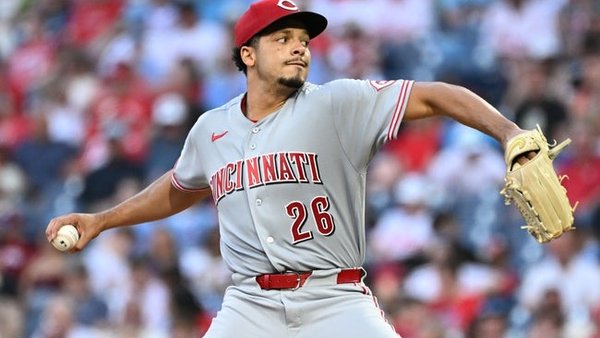
The gap between these two starters and the rest of baseball is the central fact of this game. Chase Burns is one of the better arms in the National League this season — 15-3, 2.80 ERA, and 10.76 K/9 in 151.1 innings is not a small-sample illusion. His arsenal is built around a 97.7 mph four-seam fastball that he throws 55.6% of the time, pairing it with a slider at 90.2 mph that generates a 50.4% whiff rate and holds hitters to a .198 xwOBA. That slider is the pitch that makes him elite — it profiles perfectly against a Cubs lineup that is leaning on power.
The Cubs’ strikeout-prone hitters are a legitimate matchup concern against Burns. Pete Crow-Armstrong (.474 xwOBA season, .503 xwOBA vs. RHP) is the obvious threat, and his 4 PA against Burns include a home run — a sample too small to weight heavily but worth flagging. The rest of the Cubs’ order is more vulnerable: Michael Busch is 0-for-4 with three strikeouts against Burns, and Alex Bregman is 0-for-3 with a strikeout. Burns’ slider doesn’t care about lineup construction; it generates outs at an elite rate regardless.
On the other side, Clay Holmes brings a fundamentally different profile. His sinker sits at 93.2 mph and accounts for 48.7% of his pitches — a ground-ball-first approach designed to generate weak contact and suppress hard-hit rates. His changeup (14.1% usage, 32.8% whiff rate, .207 xwOBA) is the swing-and-miss weapon that keeps the Reds’ lineup from sitting on the sinker. The Reds’ team OPS of .703 is one of the weaker offensive baselines in the NL, and their strikeout rates tell the story: Eugenio Suárez at 33.8% K rate, Elly De La Cruz at 27.7%, Tyler Stephenson at 27.7%. Holmes may not have Burns’ ceiling, but he doesn’t need it against this lineup.
The head-to-head gap between these two starters and an average pitching matchup is measurable. Two sub-3.00 ERA starters in the same game is genuinely rare. That rarity is worth more than the standard park factor discount the market is applying.
Run Environment & Game Shape
Burns’ workload this season tells you something important about how deep he can go. In 151.1 innings across 15 wins, he’s been used as a genuine innings-eater — the kind of starter who reaches the seventh and beyond, which limits the exposure to Cincinnati’s bullpen. That matters less for the Under thesis and more for understanding the game shape: Burns is likely to control the pace and keep the Cubs from stringing together crooked innings early.
Holmes is a different animal — his sinker-heavy approach means he lives and dies by contact management rather than strikeouts, and his 6.97 K/9 reflects that. Against a Reds lineup that ranks among the NL’s weakest offensive units, that’s a workable profile. The concern isn’t Holmes getting lit up; it’s whether he can get deep enough to keep Chicago’s battered bullpen out of the game. The Cubs currently have seven relievers on the injured list — Porter Hodge, Ben Brown, Riley Martin, Hunter Harvey, Phil Maton, Gavin Hollowell, and Trent Thornton are all unavailable — which means any Holmes exit before the seventh could get messy in a hurry.
Great American Ball Park’s 1.10 park factor is real, but the run-environment baseline it represents is built on games with league-average starters. Tonight’s pitching matchup sits well above that baseline. The park nudges the total up; Burns and Holmes push it back down. On balance, the elite starting talent outweighs the venue adjustment.
The Pushback
The honest version of the case against this bet comes down to two things: Pete Crow-Armstrong and the Cubs’ bullpen depth — or lack of it.
Crow-Armstrong is having a historic season for a Cubs left-handed hitter — 44 home runs, 105 RBI, .956 OPS. His .503 xwOBA against right-handed pitching is elite, and Burns is a right-hander. His 4 PA against Burns is genuinely too small to weight, but his underlying RHP split is legitimately scary — a .503 xwOBA against right-handers is the kind of number that makes even elite starters uncomfortable. One swing from Crow-Armstrong can reshape a game total in a hurry.
The depleted Cubs bullpen is the structural risk I can’t fully dismiss. If Holmes exits before the sixth — whether from pitch count, a rough inning, or just normal mid-September management — the Cubs are leaning on a thin relief corps. Cincinnati isn’t a scary offensive unit, but .703 OPS teams can still do damage against fatigued or overexposed bullpens. A multi-run inning against a stressed Cubs pen isn’t a crazy scenario.
The projection landing at 9.9 and flagging a strong Over edge is the loudest counter-signal here. I’m not ignoring it — I’m betting against it because I think it’s overweighting the park factor and team-level run averages at the expense of what this specific pitching matchup is worth. That’s a defensible disagreement, not a dismissal.
The Pick
The friction is real on both sides. Crow-Armstrong’s RHP split is a genuine threat, and a depleted Cubs bullpen is a legitimate structural vulnerability if Holmes doesn’t go deep. The projection points firmly to the Over. I’m not pretending those signals don’t exist.
But the core argument holds: two sub-2.85 ERA starters with identical 1.15 WHIPs, facing lineups with real strikeout vulnerabilities, in a game where the market is essentially offering even money on the Under. Burns’ 50.4% whiff slider against a Cubs lineup that punches out 25.8% of the time with Crow-Armstrong leading off is the dominant matchup fact. Holmes’ changeup-sinker combo profiles well against a .703 OPS Reds unit that whiffs at an elevated rate across the lineup. The park factor is baked into the line — what isn’t fully priced is the compounding effect of two genuinely elite starters working in the same game.
The bullpen risk gives me pause, but it’s a secondary concern when the starting pitching matchup is this strong. I’ll take the Under and accept the Cubs’ relief situation as the primary way this bet loses.
Bet: Under 8.5 at +101 — 2 units, moderate confidence.