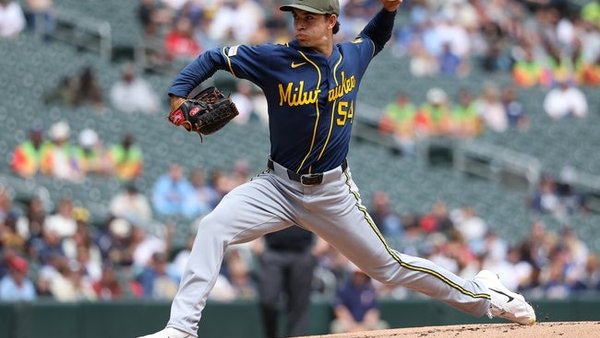
Roki Sasaki’s .457 xwOBA-against on his four-seam fastball runs headlong into a Milwaukee pitching staff that has held the Dodgers to one run across nine consecutive regular-season meetings. The total sits at 9 with the under priced at -122 — tight juice on a number the run-environment data and bullpen depth suggest is still a half-run too high.
Roki Sasaki vs. Robert Gasser: Los Angeles Dodgers at Milwaukee Brewers Betting Preview
Friday’s 5-1 Milwaukee win — where the Brewers shelled Justin Wrobleski in the first two innings and three relievers locked down the Dodgers on three total hits — set the tone for this series. Tonight, the pitching matchup shifts dramatically, and not necessarily in a direction that screams offense. The Dodgers send Roki Sasaki (5.09 ERA, 1.45 WHIP) to the mound, a starter who has been one of the more volatile arms in the National League. Milwaukee counters with Robert Gasser, whose four-inning sample size is essentially meaningless, but whose presence means the Brewers’ staff will carry a heavy load early.
The market has set this total at 9, pricing the under at -122. The legitimate case for the over centers on Sasaki’s blow-up risk and a Dodgers lineup that carries real power. But the case for the under rests on Milwaukee’s 3.12 team ERA, a neutral park environment, and a pitching staff that has owned this LAD lineup across nine consecutive regular-season wins. The price doesn’t scream value, but it does reflect a game shape where the pitching environment has consistently suppressed runs.
Today’s puzzle is tight — but the structural forces are in play. This is a 2-unit moderate lean, not a screaming edge.
Game Info & Betting Lines
- Date/Time: Saturday, May 23, 2026 | 7:15 PM ET
- Venue: American Family Field (Park Factor: 1.00 — neutral run environment, domed)
- TV: MLB.TV, FOX
- Probable Starters: Roki Sasaki (LAD) vs. Robert Gasser (MIL)
- Moneyline: Los Angeles Dodgers -126 / Milwaukee Brewers +108
- Run Line: Milwaukee Brewers +1.5 (-162) / Los Angeles Dodgers -1.5 (+134)
- Total: 9 (Over +100 / Under -122)
Why This Number Is Close — But Not Quite Right
The market is doing reasonable work here. A total of 9 acknowledges that Sasaki is capable of surrendering big innings while also recognizing that Milwaukee’s pitching staff has been elite. The over at even money (+100) is the market’s concession that Sasaki’s volatility is real — if he implodes in the first two innings the way Wrobleski did on Friday, you’re already halfway to busting the under before Gasser throws a pitch.
That’s the legitimate case for the other side, and I’m not dismissing it. Sasaki has allowed 9 home runs in just 40.2 innings, a home run rate that is genuinely alarming. Brice Turang carries an overall xwOBA of .447 and an even more dangerous .496 xwOBA against right-handed pitching, and Jackson Chourio posts a .430 xwOBA vs. righties with an 8.3% barrel rate. Those are not lineup slots that roll over against a shaky arm.
But here’s the problem with the over: a total of 9 already bakes in a Sasaki blow-up scenario. The market isn’t naive. And when you pair Milwaukee’s 3.12 team ERA with the fact that American Family Field carries a perfectly neutral park factor of 1.00 — no altitude, no short porches inflating the run environment — there’s simply no environmental tailwind to push this over the number. The numbers project 9.1 combined runs. At -122, you’re collecting a modest cushion on what is essentially a coin-flip projection, and the structural lean is toward fewer runs given who’s throwing in Milwaukee’s ‘pen tonight.
What Separates the Pitching
The gap between these two starters is less about quality and more about certainty. Sasaki’s four-seam fastball sits at 97.1 mph with 43.1% usage, but hitters have posted a .457 xwOBA against it — an alarming number that suggests the pitch is being squared up at an above-average rate despite the elite velocity. His forkball (40.2% whiff rate, .242 xwOBA) and slider (39.0% whiff rate, .245 xwOBA) are genuine swing-and-miss offerings, which is why he’s not an automatic disaster. But the fastball-first approach against a team that has feasted on right-handers is a real vulnerability. Turang’s .496 xwOBA vs. RHP — his true split against right-handed pitching when facing a starter like Sasaki — and Yelich’s .417 xwOBA vs. RHP suggest Milwaukee can do real damage when they get into the fastball zone.
Gasser’s four-inning sample is so thin it barely constitutes usable data. His sinker generates a microscopic .128 xwOBA against with only a 3.8% whiff rate, suggesting ground-ball contact rather than strikeouts — which could be effective or disastrous depending on the Dodgers’ approach. His sweeper at 81.1 mph carries a 32.3% whiff rate but a troubling .549 xwOBA against, meaning when hitters do connect, they connect hard. The Dodgers lineup — Ohtani (.480 overall xwOBA, .520 vs. RHP), Freeman (.412 xwOBA), Pages (.402 xwOBA) — will not be intimidated by a first-time extended starter.
The key distinction is what happens after both starters exit. Milwaukee’s staff — the one posting that 3.12 team ERA — has been the actual story of this series. Friday’s three relievers held LAD to two hits over four innings. The Dodgers’ bullpen, meanwhile, is short Diaz (60-Day IL, elbow), Stewart (15-Day IL), Dreyer (15-Day IL), and Casparius (60-Day IL). When Gasser inevitably hands the ball off early, Milwaukee’s ‘pen takes over against a lineup it has dominated. When Sasaki exits — and he will exit early given his 40.2-inning track record — the Dodgers are forced into a depleted relief corps that has already been stretched by this series.
The Pushback
Let me be honest about where the over makes a credible case, because dismissing it would be intellectually lazy. Sasaki has been genuinely bad. A 5.09 ERA and 1.45 WHIP in 40.2 innings is not a small-sample mirage — he’s been hit, and hit hard. Against a Milwaukee lineup that is 8-2 in its last 10 games with a run differential of +79, that’s a real concern.
The Dodgers’ own offense isn’t helpless either. Shohei Ohtani brings a 9.6% barrel rate and a .520 xwOBA vs. RHP into this matchup against a left-handed starter in Gasser. Freeman’s .412 xwOBA and Pages’ .402 xwOBA round out a lineup that is capable of putting up crooked numbers against an inexperienced arm on short rest. If Gasser can’t get through three innings cleanly and the Dodgers strike early, you could be staring at a combined 6 runs before either bullpen enters the picture.
The over at +100 is also the sharpest number on the board tonight. Even money on the over means you’re getting paid at breakeven juice to fade a struggling starter. That’s not nothing.
But I keep coming back to the same structural reality: this Milwaukee pitching staff, top to bottom, has held the Dodgers to one run across nine consecutive regular-season matchups. That is not luck. That is a systematic pattern, and the team ERA of 3.12 backs it up. The Dodgers’ best hitters — Ohtani, Freeman, Tucker — are capable of breaking that streak tonight, but capable isn’t the same as likely at -122.
Run Environment & Game Shape
American Family Field is a dome with a perfectly neutral park factor of 1.00. There is no wind to carry fly balls, no altitude to juice exit velocity, no quirky dimensions to manufacture extra-base hits. What you see is what you get — a controlled environment that does nothing to inflate the run total. That matters when you’re splitting hairs at a total of 9.
The game shape that emerges from this pitching matchup points toward a front-loaded, low-run contest. Sasaki will likely face Milwaukee’s dangerous top of the order — Chourio, Turang, Contreras — in the first two innings, and that’s where his blow-up risk is highest. But if he survives the first time through, his forkball and slider profile gives him a legitimate path to five innings without catastrophic damage. Gasser, meanwhile, figures to hand the ball to Milwaukee’s bullpen by the fourth or fifth inning regardless of how he performs, turning this into a game where the dominant relievers carry the weight.
Milwaukee’s nine consecutive regular-season wins over Los Angeles are not just a narrative curiosity — they’re a structural data point. This staff has a blueprint for suppressing this lineup, and the 3.12 team ERA reflects sustained execution, not a single hot stretch. The Dodgers, operating with a depleted bullpen and a volatile starter, are in a structurally unfavorable position to produce offense above the number.
The total projects at 9.1, the line is set at 9, and the under costs -122. That’s a thin cushion on a tight number, but the park is neutral, the Dodgers’ relief corps is banged up, and Milwaukee’s staff has earned the benefit of the doubt in this matchup. I’m not chasing the over at even money on the back of one volatile starter when everything else points toward a low-scoring game.
Bet: 2 units — Under 9 (-122). The price is not a gift, but the structural case is sound. Take the under, play it at 2 units, and let Milwaukee’s pitching staff do what it has done nine times in a row against this Dodgers lineup.