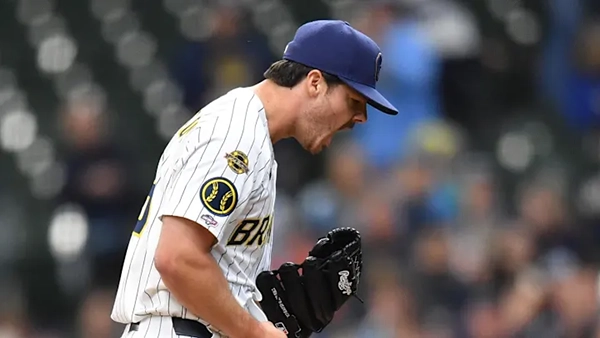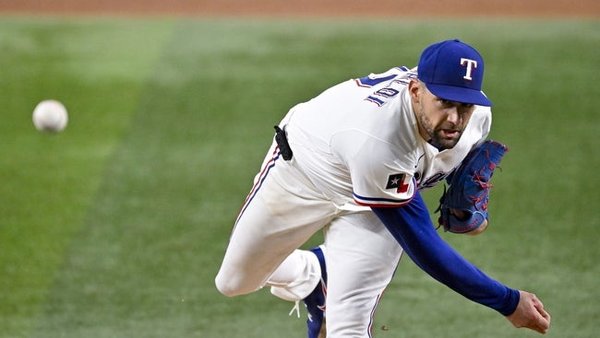
Walbert Urena’s 5.13 BB/9 rate is a structural problem the Angels have papered over with sequencing luck — and Saturday’s opponent may be the worst possible matchup for it. Texas has drawn 181 team walks on the season, meaning Urena’s control issues don’t just create traffic; they invite the kind of compounding damage that turns a 2.70 ERA into a one-game disaster. The number at -136 prices this closer to a coin flip than the pitching gap justifies.
Nathan Eovaldi vs. Walbert Urena: Texas Rangers at Los Angeles Angels Betting Preview
The Angels bounced back in a big way Friday, dropping 9 runs on Texas and handing the Rangers a 9-6 loss. Zach Neto’s two-homer night and Oswald Peraza’s go-ahead shot in the seventh made it look like a comfortable Angels win in the end. Saturday’s matchup, though, shifts the pitching picture significantly — from Grayson Rodriguez (who started Friday’s game for the Angels) to Walbert Urena, and that’s a meaningful step down regardless of where you think Rodriguez sits in the pecking order.
The market has Texas at -136, which is a number I respect but can’t fully endorse as a standalone play. The Rangers’ edge here is real — Eovaldi is the clearly superior starter, the Angels are 18-34 with a -66 run differential, and Urena’s surface ERA masks a control problem that should concern anyone laying a run or a total. But at -136, you’re paying for a lean, not a conviction. The numbers project this essentially as a coin flip — Rangers at 51.8% — and that gap between probability and price is the tension the rest of this analysis has to resolve.
The Angels are one of the worst teams in baseball right now. Their last 10 games: 2-8. That context matters, but it’s already baked into the line. The question is whether -136 is the right price for a game where one pitcher is legitimately fragile and the other is one of the more reliable starters in the American League.
Game Info & Betting Lines
- Date/Time: Saturday, May 23, 2026 | 10:05 PM ET
- Venue: Angel Stadium — Park Factor: 0.95 (slight pitcher-friendly lean)
- TV: MLB.TV, Rangers Sports Network, Angels.TV
- Probable Starters: Nathan Eovaldi (TEX) vs. Walbert Urena (LAA)
- Moneyline: Texas Rangers -136 / Los Angeles Angels +116
- Run Line: Texas Rangers -1.5 (+130) / Los Angeles Angels +1.5 (-156)
- Total: 8 (Over -110 / Under -110)
Why This Number Is Close But Not Quite Right
The market is balancing two legitimate arguments. On one hand, Texas is the better team — their rotation is deeper, their lineup is more disciplined, and Eovaldi is a genuine top-of-rotation arm. On the other hand, Urena has a 2.70 ERA and has managed to keep runs off the board despite his control problems. The market is giving the Angels enough credit for that ERA to keep the line from blowing past -140 or -150.
Here’s where I think the market is slightly wrong: Urena’s ERA is a lagging indicator. A 5.13 BB/9 rate — 19 walks in 33.1 innings — is not sustainable, and it’s particularly dangerous against a Rangers lineup that has accumulated 181 team walks on the season. Texas doesn’t just wait out walks; they manufacture pressure through base-on-balls accumulation better than most AL clubs. When a pitcher loses the zone against this lineup, the damage compounds quickly.
That said, the legitimate case for the Angels rests on Mike Trout, who posts a .500 xwOBA against right-handed pitching — a number that puts him in a class almost entirely alone in this lineup. Eovaldi is right-handed, and Trout hits RHP at a .523 xwOBA clip. That’s the one matchup in this game that keeps me from going any heavier on Texas.
What Separates the Pitching
Nathan Eovaldi enters Saturday with a 3.62 ERA, 1.15 WHIP, and 9.05 K/9 over 54.2 innings. Those numbers reflect a pitcher who misses bats, limits base traffic, and creates weak contact at a consistent rate. His four-seam fastball remains his primary weapon, and he complements it with enough secondary offerings to navigate any lineup twice through without significant exposure.
Walbert Urena is a different story. His 2.70 ERA is the headline, but the peripherals underneath it are concerning. The 1.35 WHIP and 19 walks in 33.1 IP signal a pitcher who has been bailed out by strand rate and sequencing — not process. His four-seam fastball sits at 93.9 mph with a 17.3% whiff rate and a relatively benign .297 xwOBA against. His best pitch is his curveball — 72.7 mph, 36.5% whiff rate, .263 xwOBA — but at 10.9% usage, it’s a weapon he deploys sparingly, not a foundation he builds around.
The gap between these two arms is clearest in the type of innings they create. Eovaldi generates quick outs with strikeouts and weak contact — his 9.05 K/9 keeps base traffic manageable. Urena generates traffic constantly. His sinker, used at just 3.6% of the time, posts a .418 xwOBA against — the worst mark in his arsenal — and his changeup at .324 xwOBA isn’t generating the weak contact you’d want from a pitch used 11.4% of the time. Josh Jung’s .393 xwOBA and Brandon Nimmo’s .433 xwOBA represent the kind of contact quality that punishes a pitcher who can’t consistently command the strike zone.
The Pushback
The strongest argument against leaning Texas here starts and ends with Mike Trout. At a .500 xwOBA overall and a .523 xwOBA against right-handed pitching, Trout is the one hitter in either lineup who genuinely changes a game’s trajectory by himself. Eovaldi is a good pitcher — 3.62 ERA, 9.05 K/9 — but Trout’s RHP numbers are elite enough to be a real drag on any Texas probability edge.
The rest of the Angels’ lineup around Trout is less threatening. Jorge Soler posts a .406 xwOBA with 9 home runs and carries a 36.1% whiff rate — he’s a boom-or-bust bat that Eovaldi can attack with secondary stuff. Zach Neto had a monster night Friday (two homers), but his .414 xwOBA against RHP is the product of a hitter who runs a 30.5% strikeout rate — exactly the kind of profile Eovaldi’s 9.05 K/9 handles. Jo Adell is the wild card: his .548 xwOBA vs. left-handed pitching is eye-catching, but that number collapses to .340 against righties — the handedness that matters tonight.
The Angels’ best-case scenario is Trout doing damage early, the lineup stringing something together in the middle innings, and Urena — despite his control issues — getting enough called strikes to strand the traffic he creates. That’s a real sequence of events. It’s just not the most likely one.
Run Environment & Game Shape
Angel Stadium’s park factor of 0.95 tilts this game slightly toward pitchers, which matters in a matchup where one pitcher is already suppressing contact at a reasonable clip and the other is generating base traffic at an unsustainable rate. The posted total of 8 feels roughly right — the numbers project 8.3 combined runs — but the distribution of how those runs get scored is lopsided toward Texas.
Urena’s control issues create a specific game shape: lots of baserunners early, pressure accumulating, and one or two crooked numbers if Texas gets a two-out rally going. The Rangers’ lineup construction — McCutchen leading off, Jung and Nimmo hitting second and third, Duran and Burger protecting behind them — is built to grind at-bats and punish pitchers who can’t locate. Against Urena’s 5.13 BB/9, that lineup structure is exactly the kind of pressure system that turns a 2-1 game into a 5-2 game in a hurry. Eovaldi, meanwhile, figures to keep the Angels’ hitters off balance enough that a Trout HR or Neto carrying momentum from Friday are the primary blow-up risks — isolated events rather than sustained rallies.
The game shape here favors a Rangers win that isn’t necessarily clean. Expect Urena to walk a couple of Rangers in the first two innings, give up a run or two on a timely hit, and exit before the fifth. Texas’s bullpen — despite some injury attrition — is the better back-end unit. That’s exactly the kind of setup that justifies a moneyline lean without justifying a -136 conviction play.
The Pick
This is a lean, not a hammer. The structural case for Texas is sound — superior starter, disciplined lineup against a walk-prone pitcher, worse team on the other side — but the numbers put the Rangers at 51.8% win probability, and -136 asks you to pay for about a 57.6% implied probability. That gap is real and it matters.
If the Rangers were -118 or -120 here, this is a play I’d make without reservation. At -136, I’m comfortable with it as a parlay leg or a small “beer money” sprinkle — not a standalone unit play. The edge is directionally right, but the price compression eats enough of it that aggressive sizing doesn’t make sense.
Bet: Texas Rangers Moneyline (away) — lean only. Parlay leg or beer money at -136. Do not oversize.