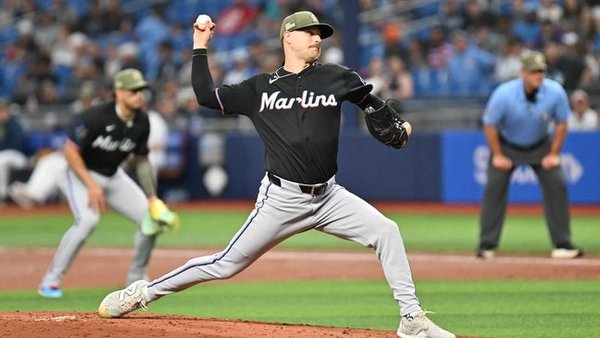
Andrew Alvarez brings an 8.5 K/9 and a curveball generating a 31.8% whiff rate against a Marlins lineup where the top of the order strikes out at 30%-plus clip. The total of 9.0 is priced as if Washington’s 9-2 blowout from the series opener defines this pitching matchup — it doesn’t.
Janson Junk vs Andrew Alvarez: Miami Marlins at Washington Nationals Betting Preview
Washington won the series opener 9-2 and took yesterday’s game 5-4 in ten innings on a Dylan Crews walk-off single, and the recency optics are pushing this total in a direction the underlying pitching matchup doesn’t fully support. A 9-2 blowout skews perception; strip that out and this series has been playing tighter than the scoreboard suggests. Today the starters change everything — Andrew Alvarez is a legitimate suppression threat with an 8.5 K/9 against a Miami lineup that strikes out at historic rates, and Janson Junk, while unspectacular, has kept the ball in the park well enough to limit damage against a Washington lineup missing one of its key run-producers.
The posted total of 9.0 (Over -107, Under -112) is sitting right at the edge of the projected combined output of 9.2 — which on the surface argues for a pass. But that projection is a ceiling number, not a floor. Both starting pitchers have the profiles to push the actual outcome into the 8-run range, and Nationals Park carries a 0.98 park factor, a modest but genuine tilt toward the Under. The slight juice difference — paying -112 for the Under versus -107 for the Over — suggests the market is leaning toward scoring, which is exactly where I want to be on the other side.
Game Info & Betting Lines
- Date/Time: Sunday, August 30, 2026 | 12:15 PM ET | TV: Peacock
- Venue: Nationals Park | Park Factor: 0.98 (slight run suppressor)
- Probable Starters: Janson Junk (MIA, 6-8, 4.21 ERA) vs Andrew Alvarez (WSH, 2-6, 3.72 ERA)
- Moneyline: Miami Marlins -108 / Washington Nationals +101
- Run Line: Washington Nationals +1.5 (-170) / Miami Marlins -1.5 (+140)
- Total: 9.0 — Over -107 / Under -112
Why This Number Is Slightly Off
The market’s case for the Over is legitimate: Washington has scored 9 and 5 runs in the first two games of this series, both bullpens are depleted, and the numbers project 9.2 combined runs — fractionally above the number. If you’re betting mechanically off the projection, you’re on the Over. I get it.
But here’s the problem with that framing — both of those Washington offensive outputs came against Sandy Alcantara and a badly overextended Eury Pérez who walked the first three batters on 14 pitches and collapsed in the third inning. Today the Nationals face Janson Junk, whose numbers are uneven but who has kept the ball in the yard at a rate (12 HR in 98.1 IP) that limits the big inning against a Washington lineup that generates power in bunches but not consistently. Meanwhile, Alvarez is a completely different caliber of starter than what Miami has faced this series.
The juice tells you something, too. The market is posting Over at -107 and Under at -112 — meaning the casual money is on scoring. That’s where Washington’s recent run production is pulling the public. The Under at -112 isn’t a screaming value, but in a game shaped by two functional starters against offenses with genuine strikeout exposure, that 5-cent juice differential represents modest closing-line value on the quieter side of the market.
What Separates the Pitching
The gap between these two starters is real, and it runs entirely in Washington’s favor — which is why the moneyline at +101 is somewhat tempting. Alvarez’s curveball is the headline pitch: deployed 30.7% of the time, it sits at 82.8 mph and generates an extraordinary 31.8% whiff rate with a 0.216 xwOBA against and a 26.4% put-away rate. That is a genuine swing-and-miss offering against a Miami lineup that carries real strikeout vulnerability throughout the order. Kyle Stowers leads off and strikes out at a 30.6% clip; Griffin Conine, hitting cleanup, carries a nearly identical 30.4% K rate. Heriberto Hernández is a slightly different profile — his strikeout rate is 26.8%, more manageable, but his whiff rate jumps to 31.6%, meaning he makes more contact than Stowers or Conine but still gets beaten in the zone at a similar frequency. Alvarez can work through this lineup with that curveball and back it with a slider that generates an elite 35.2% whiff rate at 83.9 mph. That slider does carry a 0.382 xwOBA when contact actually occurs — an honest tension worth noting — but against a lineup this swing-happy, generating whiffs is half the battle, and Alvarez wins that half comfortably. His four-seam allows a 0.398 xwOBA, which is the real vulnerability — but against contact-weak hitters, he rarely needs to lean on it to dominate.
Junk is a different story. His 6.22 K/9 is modest, and his four-seam at 94.1 mph produces only a 10.3% whiff rate with a 0.319 xwOBA against — functional but not overpowering. His best weapon is actually his changeup: 87.3 mph with a 21.7% whiff rate and a 0.294 xwOBA, which sets up well against a Washington lineup that is right-hand heavy in the top of the order. CJ Abrams is hitting .500 in 8 plate appearances against Junk in limited BvP history with zero strikeouts, which is the clearest danger sign in this matchup. But Daylen Lile carries a 0.285 xwOBA against left-handed pitching — a significant platoon disadvantage that Junk can exploit from the left side. The concern is that Junk’s elevated WHIP of 1.30 and modest K rate mean base runners accumulate. The innings he creates are grind-it-out, jam-the-bases affairs rather than clean 1-2-3 frames — and depleted bullpens don’t handle inherited runners well.
The pitching gap favors Alvarez meaningfully, but both starters project for quality starts in the 5-6 inning range. That’s where the Under case gets built.
The Pushback
I’m not going to pretend the friction doesn’t exist. The projection sitting at 9.2 — above the number — is the most honest argument against this play, and I’ve already acknowledged it. Beyond the model, there’s a real bullpen concern on both sides: Miami is without Andrew Nardi (60-Day IL, elbow), Anthony Bender (15-Day IL, lower leg), and Pete Fairbanks (15-Day IL, hand) — three legitimate late-inning arms. Washington is missing Mitchell Parker (60-Day IL, elbow), Richard Lovelady (60-Day IL, triceps), and PJ Poulin (60-Day IL, forearm). When both teams are this thin late in games, the third time through the order becomes a different conversation entirely.
That’s the real Over case — not the starters, but the innings 6 through 9 where replacement-level relievers are absorbing inherited pressure. I take that seriously. It’s why I’m at moderate confidence rather than pounding this number. If either starter exits early, the Under case deteriorates quickly. Junk in particular has the profile of a guy who can get through five innings cleanly but unravels in the sixth if his changeup command goes sideways.
Run Environment & Game Shape
Nationals Park’s 0.98 park factor isn’t a dramatic suppressor, but in a game sitting on a round number like 9.0, even a modest environmental lean matters at the margin. This isn’t Coors Field going the other way — it’s a neutral-to-slightly-quiet environment that adds one more gentle thumb on the Under side of the scale.
The shape of this game points toward a low-scoring, starter-driven first five innings followed by unpredictable bullpen work. Both offenses generate strikeouts at punishing rates — Miami has posted 1,115 punchouts on the season, Washington 1,145 — and neither lineup is particularly efficient at converting baserunners into runs when they’re facing pitchers who live in the zone and generate weak contact. Alvarez’s arsenal is built for exactly that outcome against this Miami lineup. Junk is the shakier half of the equation, but Washington’s order has enough platoon vulnerability — particularly Lile against a lefty and Ortiz’s 0.212 xwOBA against southpaws — to keep the damage contained.
The market is expecting a moderate-scoring afternoon based on two days of inflated offensive production against inferior pitching. That recency bias is the edge. Today’s starters are better than what either team has seen this series, the park leans quiet, and the strikeout profiles on both rosters make a 9-run combined total a ceiling rather than a floor.
The Pick
Two suppression starters, two strikeout-heavy offenses, a slight park tilt, and a number set by recency bias rather than today’s actual pitching matchup — that’s the core of this play. I’m not chasing the projection sitting at 9.2; I’m fading the public money that drove this line based on two games against the wrong pitchers.
Bet: Under 9.0 (-112) — 2 units, moderate confidence.