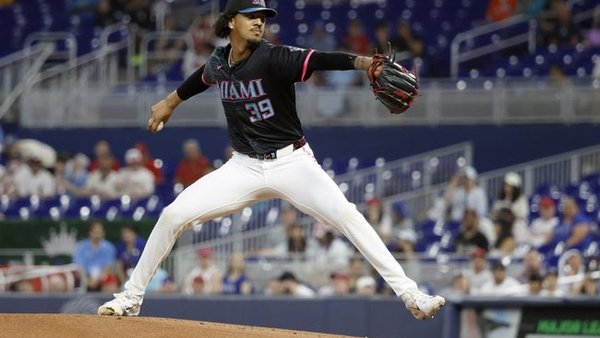
Eury Perez’s 3.44 ERA and 9.78 K/9 represent a genuine mound advantage over Noah Cameron’s 3.98 ERA and 7.9 K/9 — yet the moneyline prices this game like a coin flip, with Miami at -108 and Kansas City at -111. Kansas City’s -86 season run differential sits beneath their recent 7-3 surge, and that structural gap doesn’t vanish because the Royals had a decent August.
Eury Perez vs Noah Cameron: Miami Marlins at Kansas City Royals Betting Preview
The market sees two teams hovering around .500 ball and sets the price accordingly. Miami’s 70-69 record and Kansas City’s 62-77 mark don’t scream separation, and the Royals’ 7-3 run over their last 10 games adds surface-level credibility to the home side. But the market’s job is to split the money, not to identify the better team on the mound tonight — and that’s where the real gap lives.
Eury Perez is the primary driver here. A 3.44 ERA, 1.13 WHIP, and 9.78 K/9 across 130.2 innings represent a starter operating at a level meaningfully above Noah Cameron‘s 3.98 ERA, 1.22 WHIP, and 7.9 K/9 over 149.1 frames. That’s not a coin-flip pitching matchup. It’s a genuine edge hidden behind a near-even price.
After Miami rolled Kansas City 6-3 on Tuesday — with Tyler Phillips spinning five innings of one-hit ball and the offense providing a 6-0 cushion before any late-game noise — the Marlins arrive at Wednesday’s game with momentum and a rotation upgrade. At -108, you’re essentially getting the better pitcher at pick’em odds.
Game Info & Betting Lines
- Date/Time: Wednesday, September 2, 2026 | 7:40 PM ET
- Venue: Kauffman Stadium | Park Factor: 0.95 (run-suppressing)
- Probable Starters: Eury Perez (MIA) vs. Noah Cameron (KC)
- Moneyline: Miami Marlins -108 / Kansas City Royals -111
- Run Line: Miami Marlins -1.5 (+152) / Kansas City Royals +1.5 (-184)
- Total: 8.5 (Over -118 / Under -102)
Why This Number Is Off
The market is doing its job: balancing the Royals’ recent 7-3 surge, home field, and the general difficulty of pricing late-September games between two non-contending teams. Kansas City at -111 is a reasonable price for a team that’s won seven of its last ten at home. That’s the legitimate case for the other side, and I’m not dismissing it.
But here’s the problem: Kansas City’s season-long run differential sits at -86. That number is the structural truth beneath the recent variance spike. Teams don’t fix -86 run differentials with a 7-3 blip — they regress toward the mean. Meanwhile, Miami’s +15 run differential over a full season reflects a genuinely better baseball operation, and their staff ERA of 3.92 versus Kansas City’s 4.69 represents a 0.77 run advantage in pitching quality that doesn’t disappear because the Royals had a decent August.
The numbers project Miami at 4.4 runs and Kansas City at 4.2, with a 58% win probability for the Marlins. At -108, the implied probability is roughly 52%. That’s a 6-point gap in expected value — meaningful in a sport where closing a 3-point edge on a moneyline is considered a sharp bet. The number is off, and the price is there to exploit.
What Separates the Pitching
The gap between these two starters is more pronounced than the ERA difference suggests. Perez works off a 98.2 mph four-seam fastball that he throws 38.8% of the time, generating a 21.8% whiff rate and holding hitters to a .315 xwOBA. His breaking ball arsenal is where things get genuinely elite. The slider — used 16.1% of the time at 88.2 mph — actually leads the entire repertoire in whiff rate at 41.2%, with a .302 xwOBA allowed. The sweeper — deployed 13.3% of the time at 83.7 mph — is the weak-contact weapon of the two, sitting at a .217 xwOBA allowed and a 36.9% whiff rate; it’s the pitch that generates soft ground balls when hitters do make contact. Layer in a changeup posting a 44.8% whiff rate and you’ve got a three-pitch swing-and-miss arsenal that creates problems in every count.
Cameron operates in a different tier. His four-seamer sits at 92.4 mph — nearly 6 mph slower than Perez’s — and allows a .381 xwOBA with a 14.2% whiff rate. That’s a fastball hitters can square up. His best weapon is the changeup (.284 xwOBA, 34.3% whiff), and his curveball posts a solid .230 xwOBA, but Cameron lacks the plus-velocity or premium swing-and-miss that makes a starter hard to solve late in lineups.
Against Cameron’s sinker — used only 3.8% of the time but allowing a .425 xwOBA — Miami’s top-of-order hitters are particularly dangerous. Griffin Conine carries a .488 xwOBA overall and a .526 xwOBA against right-handers. Heriberto Hernández posts a .445 xwOBA overall. Both project as genuine threats against a Cameron fastball that gives up hard contact. Perez, meanwhile, faces a Kansas City lineup where Caglianone’s .497 xwOBA against right-handers is the real concern — but Perez’s slider and sweeper combo is specifically designed to neutralize power hitters fishing off the plate.
The innings Perez creates — high strikeout, low baserunner, minimal traffic — are different from what Cameron produces. And that difference compounds when both bullpens enter a tie or close game.
The Pushback
The concern here is real, and I’d be doing this analysis a disservice by glossing over it. Miami’s injury list is extensive: Andrew Nardi, Pete Fairbanks, Anthony Bender, and William Kempner are all unavailable in the bullpen. Three starting pitchers are on the 60-Day IL. After Perez exits — and with a 130-inning workload in September, his pitch count will be managed — Miami is going to a depleted relief corps. In a close game, that matters.
Cameron’s edge is durability. At 149.1 innings, he’s eating more frames, and Kansas City’s bullpen — while far from elite — doesn’t carry the same catastrophic injury attrition Miami’s does. If Perez hands a one-run lead to the sixth inning and Miami has to piece together the final nine outs with replacement-level arms, the advantage evaporates quickly.
That’s also why the run line is a pass. The numbers say Miami wins this game by roughly 0.2 runs. Laying -1.5 at +152 in a near-coin-flip game with a hollowed-out bullpen is not where I want to be. The moneyline captures the edge; the run line asks you to win a different game entirely.
Run Environment
Kauffman Stadium’s 0.95 park factor nudges this toward a lower-scoring outcome, which plays into Perez’s strengths. The projected total of 8.6 barely clips the 8.5 line, and the shape of this game — a 4-3 or 3-2 lead heading into the seventh — is exactly the scenario where the starter quality gap matters most and the bullpen risk becomes real. A run-suppressing environment keeps the game close; a close game in the late innings is where Miami’s injury list creates genuine exposure. It’s also why the total has no actionable edge here — this isn’t a strong lean either direction on runs scored.
Joe Jensen’s Pick
Perez is the best pitcher on the mound tonight, the numbers back Miami by 6 implied probability points at this price, and you’re getting that at near pick’em odds. The bullpen caveat is real — Nardi, Fairbanks, Bender, and Kempner all out is a legitimate structural risk — but that risk is baked into the moderate confidence here, not a reason to walk away from a genuine starter-driven edge. Projected score: Miami 4.4, Kansas City 4.2.
Bet: Miami Marlins Moneyline -108 | 2 Units | Moderate Confidence