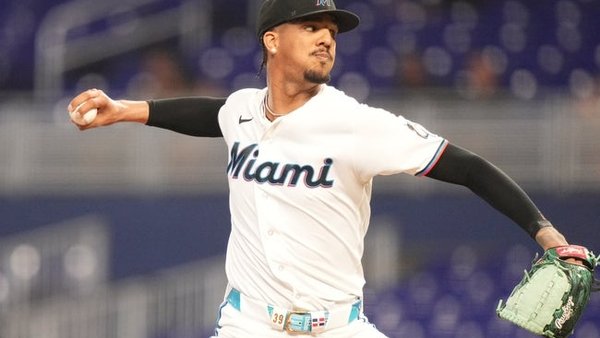
Eury Perez carries a 3.72 ERA and 135.1 innings of sustained strikeout volume into loanDepot park opposite Jonah Tong, who has issued seven walks in ten MLB innings. The Marlins are priced at just -121 — a number that treats a veteran ace against a command-challenged rookie as something close to a coin flip, and the run differential gap between these two clubs runs 63 runs deep.
Jonah Tong vs Eury Perez: New York Mets at Miami Marlins Betting Preview
The market has set this at Marlins -121, which on the surface reads as a modest home favorite getting a slight edge. But the headline here isn’t home-field or standings — it’s the chasm between what these two starters actually are. Eury Perez brings 135.1 innings of 2026 track record, a 3.72 ERA, and a 1.18 WHIP into this start. Jonah Tong brings 10 MLB innings and seven walks. These are not comparable arms, and the price doesn’t fully account for that gap.
The Mets are arriving from a split series against San Francisco — they dropped two of three before rallying Sunday on Bo Bichette’s go-ahead three-run homer. The Marlins bounced back from a rough Friday with a dominant 10-3 win over the Cubs on Sunday, with Heriberto Hernández and Javier Sanoja going deep. Miami enters this series with some offensive momentum, but the real story is the arm they’re sending to the mound.
The standing separation reinforces the thesis. Miami sits at 72-72 against New York’s 65-78 — a seven-game gap in the NL East. The run differential tells an even starker story: Miami at +15, New York at -48. That’s a 63-run chasm that reflects sustained, real-world performance over a full season, not noise. The pitching matchup is the engine, but the underlying team quality separation gives it teeth.
Game Info & Betting Lines
- Date/Time: Monday, September 7, 2026 | 1:10 PM ET
- Venue: loanDepot park (Dome — weather neutral | Park Factor: 0.95, slight pitcher lean)
- Probable Starters: Jonah Tong (NYM) vs. Eury Perez (MIA)
- Moneyline: New York Mets +100 / Miami Marlins -121
- Run Line: Miami Marlins -1.5 (+168) / New York Mets +1.5 (-205)
- Total: 8.0 (Over -106 / Under -113)
Why This Number Is Off
The market is doing reasonable work here. Books see a rookie starter with a thin sample and are hedging — they can’t fully punish Tong’s command issues without creating an exploitable number on the Mets side. At +100, the Mets moneyline has genuine appeal if Tong pitches even adequately for five innings. Books know that small-sample pitchers are volatile in both directions, and they’re pricing the uncertainty accordingly.
But here’s the problem with treating this as a coin flip: Perez’s 9.64 K/9 over 135-plus innings is not a small-sample artifact. It’s a legitimate strikeout arm with volume behind it, sitting opposite a starter whose 6.30 BB/9 in his brief MLB stint signals structural command problems, not early-game jitters. The market is balancing Perez’s quality against Tong’s volatility and landing on -121. I think that undersells how much a command-challenged rookie gets exposed by a lineup featuring three hitters — Griffin Conine (.478 overall xwOBA; no vsRHP split available in the data, but the overall figure reflects a legitimate plus hitter), Kyle Stowers (.454 xwOBA), and Heriberto Hernández (.448 xwOBA) — capable of punishing elevated pitch counts and free passes.
Miami’s lineup edge is real, too: a .725 OPS versus New York’s .697, a 28-point gap that compounds when a starter is going to be grinding through free bases early. The number at -121 clears my juice ceiling comfortably. This is a playable price.
What Separates the Pitching
The gap between these two arms is about as wide as you’ll see in a regular-season game with comparable ERAs listed in the box score. Perez’s 3.72 ERA and 1.18 WHIP over 135.1 innings is backed by a Statcast arsenal that explains exactly why: his 98.2 mph four-seam fastball generates a 21.8% whiff rate and holds hitters to a .326 xwOBA while running 38.4% of his pitches. His slider is genuinely elite — 41.1% whiff rate, .307 xwOBA. The sweeper adds another layer at 38.2% whiff and .217 xwOBA. His changeup? 44.1% whiff rate and .281 xwOBA. This is a four-pitch pitcher with legitimate swing-and-miss at the top of the zone and off it, and 135 innings of evidence that he can sustain it.
Tong’s arsenal tells a different story. His four-seam runs at 95.5 mph — functional, but not dominant — and his changeup actually profiles well at a .121 xwOBA against with 28.2% whiff. The concern is that his cutter sits at a .415 xwOBA against, and his overall command has not translated to the zone consistently enough at the MLB level. Seven walks in ten innings isn’t just a bad stretch — at 6.30 BB/9, that’s a pitcher still figuring out how to execute in the big leagues.
The matchup data sharpens this. Juan Soto carries a .479 xwOBA against right-handed pitchers, and in 6 plate appearances against Perez he’s slashing .500 with two home runs — a genuine threat. But the Miami hitters facing Tong carry vsRHP xwOBAs of .489 (Stowers), .420 (Hernández), and .442 (Owen Caissie). A right-hander with control problems against a lineup loaded with right-handed power threats is a bad combination. Perez creates efficient, high-strikeout innings. Tong creates pitch-count crises. That shapes the entire game.
Pushback: What Could Go Wrong
I’m not hiding it — there are real reasons to pause before laying -121 here. The Marlins bullpen is a wreck: Andrew Nardi, Anthony Bender, Pete Fairbanks, and William Kempner are all on the IL, which means if Perez runs into trouble or exits early, Miami’s late-inning coverage is thin. That’s a legitimate risk in a game where the total is set at 8.0.
I also considered the Marlins -1.5 run line at +168, which looks attractive on paper given the pitching gap — but I rejected it. With a depleted bullpen and Tong’s small-sample volatility cutting both ways, multi-run separations are unreliable enough that the extra juice exposure isn’t worth it.
On the Mets side, Soto’s BvP line against Perez is legitimately alarming — .500 with two home runs in six plate appearances. That’s a small sample, but it’s not nothing. And Tong’s volatility works in both directions: he could just as easily throw five scoreless innings as implode in the third. The market is right to leave some Mets equity in the price. The question is whether +100 adequately compensates for that scenario, and I don’t think it does given the structural advantages Miami carries into this one.
Run Environment & Game Shape
loanDepot park’s 0.95 park factor nudges this game ever so slightly toward the pitchers, and the dome eliminates weather as a variable entirely. The total sitting at 8.0 implies a moderately active scoring environment — neither a pitcher’s duel nor a slugfest — which is the right framing given that Perez is a genuine strikeout arm while Tong is an unknown quantity who could either limit damage or unravel quickly.
The dome context interacts meaningfully with both starters’ profiles. For Perez, it means consistent grip and release conditions — no wind, no humidity variance, no late-afternoon glare — which tends to benefit pitchers who rely on precise movement and spin, exactly what his sweeper (.217 xwOBA, 38.2% whiff) and changeup (.281 xwOBA, 44.1% whiff) demand. For Tong, the controlled environment removes one potential excuse; if his command is structurally broken, a dome won’t fix it. The 8.0 total suggests the market sees this as a game that stays in a reasonable scoring range, but it doesn’t account for the asymmetry in how these starters get there. Perez gets to 8.0 by efficiently retiring hitters with swing-and-miss stuff; Tong gets there by surviving free bases and hoping the Marlins leave runners stranded. Those are very different game shapes, and the one Tong creates — high pitch counts, runners on base, bullpen exposure early — favors the home side regardless of how the total ultimately settles.
Play: Miami Marlins ML (-121) | 2 Units | Moderate Confidence
The thesis in one line: Eury Perez’s legitimate 135-inning strikeout profile against a lineup carrying a 63-run run differential advantage is simply too much for the market to paper over by pricing Jonah Tong’s volatility as a coin flip.