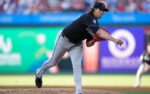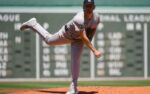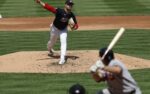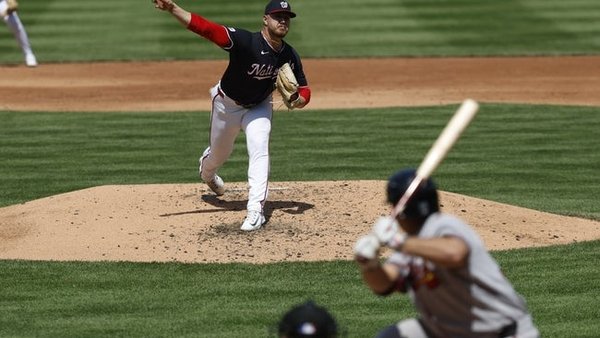
The total sits at 7.5 with the over juiced to -116, but the market is treating this like a run-friendly environment — and Busch Stadium’s neutral 1.00 park factor gives it no help. Cade Cavalli’s 8.74 K/9 lands directly against a Cardinals lineup that posts a .698 OPS and rarely barrels up against swing-and-miss arms.
Cade Cavalli vs. Kyle Leahy: Washington Nationals at St. Louis Cardinals Betting Preview
The market is pricing this game as a slight over, and there’s a surface-level argument for it — both bullpens have holes, the Nationals have genuine power in the middle of their lineup, and the numbers suggest a combined 9.4 runs in play. I get it. But a raw run projection and the betting outcome aren’t the same thing, and the specific pitching matchup here leans hard toward a controlled, pitcher-driven game that keeps the final number under 7.5.
Cade Cavalli brings the better profile to the mound: a 3.35 ERA, 1.27 WHIP, and 99 strikeouts in 102 innings — an 8.74 K/9 that plays directly into a Cardinals lineup posting a .698 OPS. He’s allowed only 5 home runs all season. Against a St. Louis club that ranks among the weaker offensive units in the NL, that combination is a suppression blueprint.
Kyle Leahy counters with durability and command — 160 innings pitched, a 3.83 ERA, and just 45 walks all year. The concern is the 20 home runs allowed, and Washington does carry real power. But Leahy’s contact management and workload suggest innings, not implosions. The pitching gap here is real, and it points toward a game that stays tight and low.
Game Info & Betting Lines
- Date/Time: Friday, September 18, 2026 | 8:15 PM ET
- Venue: Busch Stadium | Park Factor: 1.00 (neutral)
- Probable Starters: Cade Cavalli (Washington Nationals, 3.35 ERA) vs. Kyle Leahy (St. Louis Cardinals, 3.83 ERA)
- Moneyline: Washington Nationals -105 / St. Louis Cardinals -115
- Run Line: St. Louis Cardinals +1.5 (-193) / Washington Nationals -1.5 (+158)
- Total: 7.5 (Over -116 / Under -104)
Why This Number Is Off
The over is priced at -116 juice and the under comes back at -104 — the market is telegraphing a slight lean toward the over, and it’s not unreasonable. Both offenses have real components: James Wood (.909 OPS, 30 HR) is a genuine threat, and Alec Burleson is having a legitimate All-Star caliber season with 23 home runs and a team-leading 111 RBI. When the combined run environment looks elevated and there are bullpen vulnerabilities on both sides, you can see how the market lands where it does.
But here’s where I think the market is slightly wrong: it’s not accounting for how specifically bad the Cardinals’ offense is against a strikeout-heavy arm. St. Louis is hitting .242/.316/.382 with a .698 OPS and only 158 home runs as a team. Cavalli’s curveball generates a .215 xwOBA and a 31.1% whiff rate — that’s a put-away pitch against a lineup that doesn’t barrel up. The Cardinals’ top of the order features José Fermín at a .294 xwOBA and Victor Scott II at .314. That’s not the profile that cracks a pitcher throwing 8+ K/9.
Meanwhile, Busch Stadium’s park factor is exactly 1.00 — no inflation, no wind aid, nothing to push the total over the line organically. The under at -104 is the lighter-juiced side of a market that hasn’t fully priced in how cleanly Cavalli matches up against this particular lineup.
What Separates the Pitching
Cavalli and Leahy are both functional starters, but the gap between them is meaningful — and it matters for the total, not just the outcome.
Cavalli’s arsenal is built around swing-and-miss. His curveball sits at 82.9 mph and draws a 31.1% whiff rate against a .215 xwOBA — that’s a true out-pitch. His slider complements it at a 34.1% whiff rate, and even his changeup at 86.3 mph holds hitters to a .197 xwOBA. The Cardinals’ leadoff man, Fermín, carries an 11.3% whiff rate and rarely makes loud contact (1.3% barrel rate). Third in the order, Burleson is a legitimate hitter (.426 xwOBA), but his splits favor right-handers and his 20.3% whiff rate is manageable for a pitcher with Cavalli’s shape differential. The type of innings Cavalli creates — quick counts, strikeouts, minimal base traffic — suppresses run expectation regardless of the lineup behind him.
Leahy is a different animal. His 6.3 K/9 won’t dominate Washington’s lineup, but his 45 walks in 160 innings reflects strong command and the ability to get through a lineup without extended damage. His changeup (86.9 mph, 27.4% whiff, .315 xwOBA) is his best neutralizer. The concern is that his sinker (.308 xwOBA) and curveball (.291 xwOBA) keep the ball in play — meaning Washington’s lineup can put the ball in play and create opportunities. But his four-seam fastball has held a .384 xwOBA, not a disaster, and his overall durability suggests he’s pitching to contact by design rather than failing to miss bats.
The gap between them is real: Cavalli is pitching a strikeout game, Leahy is pitching a contact-management game. Both favor fewer baserunners and fewer multi-run innings than a lineup matchup analysis might suggest. The combined inning shapes point toward a score that stays in the 4-5 range per team — exactly where the under needs it.
Bet: Under 7.5 — 2 units | Moderate confidence