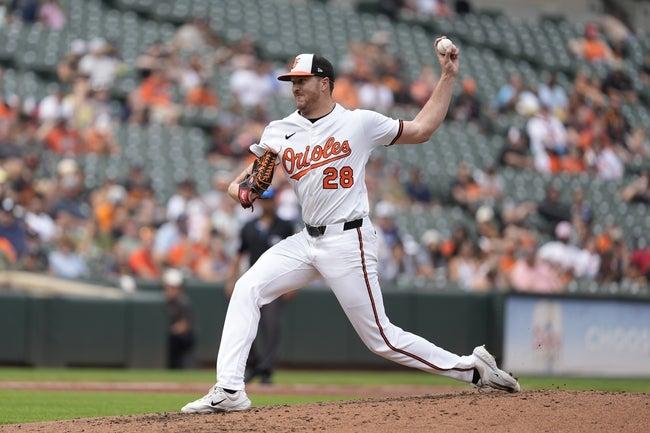
Two starters with near-identical 4.48-4.50 ERAs take the mound inside a run-suppressing dome, but Arrighetti’s 4.83 BB/9 against a lineup featuring Alonso and Basallo is the fault line the total of 9 doesn’t fully account for. The Under is juiced to -122 — the market leans that direction but won’t make it easy, and the gap between Rogers’ efficiency and Arrighetti’s walk tendencies is the real tension this number has to answer for.
Trevor Rogers vs. Spencer Arrighetti: Baltimore Orioles at Houston Astros Betting Preview
Today’s matchup presents a genuine puzzle. The total sits at 9, the juice on the Under is -122, and two middling starters are taking the ball inside a dome that quietly suppresses run scoring at a 0.96 park factor. None of those individual ingredients scream value. But when you stack them — contained environment, mediocre offenses, a number that reflects exactly where the run environment should land — the Under becomes the disciplined play in what shapes up as a tight, low-margin game.
The market noise here is real. Baltimore enters on a five-game win streak with offensive momentum, and Yordan Alvarez is on a legitimate AL Triple Crown pace. Houston won the series opener on Saturday before dropping Friday’s game 3-2. Neither team is playing particularly well over a longer stretch — both sit around .478-.476 in win percentage — but the recent results keep the total from drifting lower. That’s exactly where the price stays uncomfortable enough to create a marginal edge.
Game Info & Betting Lines
- Date/Time: Saturday, July 18, 2026 | 4:10 PM ET
- Venue: Daikin Park (Minute Maid) — Dome | Park Factor: 0.96 (mildly run-suppressing)
- Probable Starters: Trevor Rogers (BAL, 6-7, 4.48 ERA) vs. Spencer Arrighetti (HOU, 7-5, 4.50 ERA)
- Moneyline: Baltimore Orioles -106 / Houston Astros -110
- Run Line: Houston Astros +1.5 (-178) / Baltimore Orioles -1.5 (+146)
- Total: 9 (Over +100 / Under -122)
Why This Number Is Close
The books set this total at 9 for good reason. Both offenses are functional but far from elite — Baltimore carries a .721 OPS and Houston a .728 OPS, numbers that reflect lineups capable of scoring but not routinely threatening to blow open a game. The Under at -122 reflects roughly 55% implied probability, which is exactly what you’d expect when the run environment lands on the number rather than below it.
The legitimate case for the Over is real. Baltimore has scored multiple runs in each of their last several wins, and Houston’s lineup — anchored by Alvarez — is capable of manufacturing crooked numbers in a single inning. Neither bullpen is lights-out, and if either starter exits early, the middle relief exposure increases. The Over is priced at flat +100, meaning the market sees a coin-flip once you remove the juice consideration.
But here’s the problem with the Over: neither starter is a blowup risk in the traditional sense. Rogers has allowed only 10 HR in 90.1 innings, and his WHIP of 1.31 suggests he’s keeping traffic manageable even when he’s not dominating. Arrighetti has a strikeout rate of 8.89 K/9 that can get him through innings cleanly despite the walk concerns. The dome eliminates wind variables. And the 0.96 park factor tilts — however slightly — toward the pitcher. The market is right that this is close. The edge isn’t wide; it’s just real enough to act on.
What Separates the Pitching
On paper, Rogers and Arrighetti look like photocopies of each other — both sitting at roughly 4.48-4.50 ERA, both carrying WHIPs just above 1.30. But the gap between them matters for how innings are constructed, and that difference has real implications for the total.
Rogers is the more efficient arm. His four-seam fastball sits at 93.4 mph, deployed 43.7% of the time, generating a .346 xwOBA against — workable, not dominant. His best weapon is his sweeper, which holds hitters to a .211 xwOBA with a 29.7% whiff rate — the put-away pitch he leans on when he needs a swing-and-miss. The changeup (.332 xwOBA, 22.1% whiff) gives him a second off-speed option that keeps righties honest. Critically, Rogers has issued only 31 walks in 90.1 innings — a 3.09 BB/9 that limits the free baserunners that cascade into crooked innings.
Arrighetti is the higher-variance arm. His curveball is genuinely elite — thrown 32.1% of the time at 76.6 mph with a 35.7% whiff rate and a .274 xwOBA against. That’s a put-away pitch capable of neutralizing a lineup for stretches. But his four-seam fastball is a liability: .417 xwOBA against with a 29.5% usage rate means hitters are squaring it up when he leaves it up. More damaging is his sinker — .487 xwOBA and 0.0% put-away rate. When Arrighetti misses location, he misses badly. His 44 walks in 82 innings (4.83 BB/9) is the number that keeps this analysis honest — free passes against a lineup featuring Pete Alonso (.462 xwOBA) and Samuel Basallo (.432 xwOBA) are dangerous.
The pitching gap slightly favors Rogers in terms of floor. Arrighetti has higher upside — that curveball can carve through a lineup — but also a higher blowup ceiling. For the Under, Rogers matters more: his ability to limit walks and keep the ball in the yard is the structural reason this game stays in range. Arrighetti’s walk rate is the primary Over lever. Six innings from each starter is the baseline; anything shorter shifts the calculus toward the Over in a hurry.
The Pushback
I’m not going to pretend this is an easy Under. Alvarez leads the AL with 31 home runs and 70 RBI — he’s the kind of hitter who can single-handedly move a total two runs in one swing. His xwOBA against left-handed pitching is .522, which is genuinely alarming for a Rogers start. Jeremy Peña is 5-for-11 lifetime against Rogers with a homer. The Astros aren’t a bad lineup; they’re a lineup with one transcendent bat surrounded by serviceable contributors.
Baltimore’s most dangerous bats — Alonso, Rutschman, and Basallo — are capable of doing damage against a pitcher with Arrighetti’s walk tendencies. Alonso’s .428 xwOBA vs. left-handed pitching means he shouldn’t be overlooked just because Arrighetti’s curveball is sharp. If Arrighetti falls behind in counts and starts working from the stretch, Baltimore can scratch enough runs to push this over 9.
The honest answer is: this is a lean, not a lock. You’re laying -122 on a total that sits exactly where the run environment suggests it should. There’s no fat in this line. What you’re betting is process — that the dome, the walk rates, the mediocre OPS figures, and the quality of both starting pitchers combine to produce a game that finishes at 8 or 9 rather than 10 or 11.
Run Environment & Game Shape
The dome matters here, but not dramatically. A 0.96 park factor is a tiebreaker, not a thesis — it tilts the environment slightly toward pitchers without fundamentally reshaping what either offense can do. Where it helps most is in eliminating the wind-driven variance that turns a 350-foot fly ball into a homer at an outdoor park. In Daikin Park, that ball stays in the yard.
The numbers point toward a game that plays out something like 4-3 or 4-4 — a total in the 7-8 range sits comfortably under, while a 5-5 or 5-4 finish is the realistic Over scenario. Neither bullpen is dominant enough to guarantee shutdown innings if a starter labors, but both are adequate enough that a middle-inning lead doesn’t automatically spiral. The modal outcome here is a low-to-mid single-digit game on both sides — the kind of final that this total was built around.
The structure of both lineups reinforces this. Baltimore’s order outside of Alonso and Basallo doesn’t generate elite exit velocity or barrel rates. Houston’s supporting cast behind Alvarez — Walker (.349 xwOBA), Altuve (.325 xwOBA), and Nick Allen (.250 xwOBA) — is serviceable but not threatening to put up a five-spot on its own. This is a game where individual performances matter more than lineup depth, which is exactly the environment where a starting pitcher’s floor becomes the key variable.
Rogers’s floor — walk rate, HR rate, sweeper as a put-away weapon — is what makes the Under holdable even knowing Alvarez lurks in the two-hole. The bet isn’t that Alvarez goes 0-for-4; it’s that the game stays structured enough around both starters that nine total runs is a ceiling more often than a floor.
The pick: Under 9, -122, 1 unit, lean confidence. The juice is real and the pushback is real, but the run environment, the pitching floors, and the dome all point the same direction. You’re not getting a gift price here — you’re getting a disciplined number in a game that was built for exactly this kind of result. Lay the -122, keep the unit size appropriate for a lean, and let the starting pitching do the work.