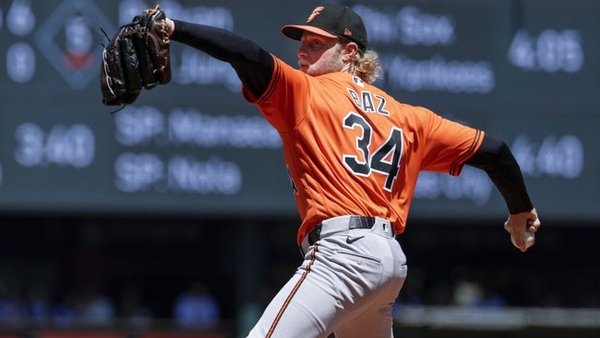
Globe Life Field carries only a mild 1.05 park factor, and the total sits at 8 — a number that may not yet fully account for Baltimore’s stripped-down batting order, which is missing both Blaze Alexander and Samuel Basallo to the IL. Eovaldi’s 2.12 BB/9 command profile against a depleted lineup points in one direction; the question is whether the market has caught up to that structural reality.
Shane Baz vs Nathan Eovaldi: Baltimore Orioles at Texas Rangers Betting Preview
The posted total of 8 is already modest, but the market set it before fully absorbing the damage done to Baltimore’s lineup. Blaze Alexander (.807 OPS) and Samuel Basallo (.756 OPS, 16 HR) are both on the IL, stripping the Orioles of meaningful depth behind their top names. Even with Pete Alonso (.802 OPS, 23 HR) still active, the surrounding cast that would otherwise extend an inning or punish a mistake has thinned considerably. Baltimore is now sending a batting order that already ranked among the league’s weaker offensive clubs into a dome park against a pitcher with an elite command profile. That combination tilts this game toward fewer runs, not more.
Neither starter here is an ace, but both are competent mid-rotation arms who manage rather than dominate. The edge on the under comes less from dominant pitching and more from the structural reality that one lineup is meaningfully depleted and the other — Texas at .720 OPS — isn’t exactly a run-creation machine itself. The market may have been slow to fully price in Baltimore’s depth problem, and that’s where the value sits.
The numbers put the combined score at 9.4, which is right at — or just above — the posted total. That’s not a screaming under edge, but in a dome game with two command-oriented starters and a stripped-down Baltimore lineup, the lean is real enough to back with two units.
Game Info & Betting Lines
- Date/Time: Friday, August 7, 2026 — 8:15 PM ET
- Venue: Globe Life Field (Dome) | Park Factor: 1.05 (mildly hitter-friendly)
- TV: Apple TV
- Probable Starters: Shane Baz (BAL) vs Nathan Eovaldi (TEX)
- Moneyline: Baltimore Orioles +124 / Texas Rangers -146
- Run Line: Texas Rangers -1.5 (+146) / Baltimore Orioles +1.5 (-176)
- Total: 8 (Over -110 / Under -110)
Why This Number Is Close But Slightly Off
A total of 8 in a dome game is already telling you the market expects a tight, pitcher-driven outcome. That framing isn’t wrong — Globe Life Field carries only a mild 1.05 park factor, and both starters have spent the season in the 3.86-to-4.31 ERA range, which suggests manageable rather than dominant. The market is pricing this as a coin-flip game where both offenses stay contained.
The legitimate case for the over is real. Nathan Eovaldi has surrendered 24 home runs in 127.1 innings — a 1.70 HR/9 rate that gives any hitter a chance to go deep in a favorable environment. And Shane Baz‘s WHIP of 1.37 signals consistent baserunner traffic. If either starter runs into trouble early and hands things to a depleted bullpen — both teams have multiple relievers on 60-day IL — the runs could cluster quickly.
But here’s the problem with the over lean: the market is weighing those risks without fully accounting for just how thin the Baltimore lineup has become. Losing Alexander and Basallo doesn’t just remove two names — it removes legitimate depth pieces who turn baserunners into runs. Alonso is still dangerous, but the hitters around him who would otherwise extend innings against a pitcher with Eovaldi’s command profile are now replacement-level. Texas’s own lineup, sitting at a .720 OPS with Josh Jung also on the IL, isn’t positioned to compensate with a crooked-number inning of their own. The under at -110 is the number that reflects this offensive reality more honestly.
What Separates the Pitching
The gap between these two starters is subtle but meaningful, and it runs through walk rate more than anything else. Eovaldi has issued just 30 walks in 127.1 innings — a 2.12 BB/9 that is genuinely elite. He’s a power pitcher built around two primary weapons: his 4-seam fastball operates at 97.3 mph with 41.3% usage and a 23.1% whiff rate, and his slider sits at 91.2 mph with 36.6% usage, a 36.6% whiff rate, and a .251 xwOBA — a true put-away pitch that limits damage on contact. That combination of elite command and swing-and-miss stuff against a Baltimore lineup now missing its key depth pieces makes Eovaldi a legitimate run suppressor tonight. Gunnar Henderson has seen Eovaldi 11 times with a .182 average and 3 strikeouts; Jackson Holliday is 0-for-6 with 3 strikeouts against him. The top of the order has history working against it tonight.
Baz operates differently. His primary weapon is a sinker at 94.7 mph (33.7% usage) that generates weak contact — just .303 xwOBA against — and a curveball that sits at 84.6 mph with a 40.6% whiff rate and .253 xwOBA. That’s a legitimate put-away pitch. But the WHIP of 1.37 reflects the cost of operating without Eovaldi’s command: Baz allows more baserunners, and the Texas middle of the order is capable of capitalizing. Brandon Nimmo carries a .441 xwOBA with a .464 mark against right-handed pitching batting third for Texas, and Joc Pederson sits at .410 xwOBA with a 31.3% hard-hit rate. These are hitters who can punish a sinker that catches too much of the zone.
The net result: Eovaldi creates cleaner innings against a weaker lineup; Baz creates more traffic against a lineup with real damage threats. The innings Baz generates — baserunners, contact, occasional walks — are inherently more volatile. That said, Baz has allowed only 9 home runs in 128.1 innings, which keeps the ceiling on any single inning relatively low. This is a game where the pitching difference shows up in the margins, not in blowout fashion, and that’s precisely what the under needs.
The Pushback
The strongest case against the under starts with Eovaldi’s home run rate. Allowing 24 HR in 127.1 innings is a real liability in a dome with even a mild park factor boost, and Baltimore still has genuine power threats despite the roster losses. Pete Alonso (.466 xwOBA, .473 vsRHP, 23 HR) is the primary concern — he’s faced Eovaldi 5 times and is hitting .500 with a home run. Christian Encarnacion-Strand (.484 xwOBA, 10.6% barrel rate) is the other legitimate pushback hitter; that barrel rate is elite and he only needs one mistake to change the run total equation. These two represent real over insurance, and ignoring them would be sloppy handicapping.
On the Texas side, Eovaldi’s 24 HR allowed means a single Alonso or Encarnacion-Strand swing can move the needle meaningfully. Add in Baz’s 1.37 WHIP creating runners for the Rangers middle of the order to drive in, and the path to 9 or 10 combined runs isn’t far-fetched. The bullpen situations compound this: both teams are working with reduced relief corps, and a short start from either starter hands innings to arms that aren’t fully trusted. Garcia, Baumler, Beeks, and Junis are all on the Texas IL; Baltimore’s relief depth has its own holes. Late-inning runs in a depleted-bullpen game are a real mechanism for the over to cash.
The other concern is whether the Baltimore injury angle is already priced in. The market knows about Alexander and Basallo. If sharp money had a strong view that these absences were underweighted, the line would likely have moved below 8. It hasn’t. That means either the market is comfortable with the current number or the injury impact is smaller than it looks on paper. With Alonso still anchoring the middle of the order and Encarnacion-Strand providing legitimate pop, this isn’t a total top-of-order wipeout — it’s a depth loss that makes the lineup more one-dimensional, not toothless.
Angles Considered and Rejected
The run line was the first place I looked. Texas -1.5 at +146 is a number that catches the eye, and the home team carries a 58% win probability here. But the projected gap between these teams is only about 0.2 runs — that’s not a margin that justifies backing a -1.5 spread, even at plus money. The run line demands a comfortable win, and nothing in this matchup signals comfort. Rejected.
The moneyline at -146 is priced for a team that should win this game more than 59% of the time. Texas’s 58% implied win probability doesn’t clear that bar. There’s no juice ceiling worth chasing here when the edge is that thin. Rejected.
That leaves the total, and specifically the under. The 9.4 combined projection sits above the posted 8, which is an honest acknowledgment that this isn’t a layup. But the structural lean — depleted Baltimore depth, Eovaldi’s elite command and swing-and-miss arsenal, a Texas lineup that ranks as a modest offensive unit — all point toward a game that plays out closer to 8 than 9.4. The under at flat -110 offers the best value on the board tonight.
Run Environment & Game Shape
Globe Life Field’s 1.05 park factor is a real consideration — dome parks with even mild hitter-friendly characteristics can suppress the variance that outdoor conditions introduce, meaning what you see is closer to what you get. The expected game shape here is a 4-5 run night for Texas with Baz allowing baserunners but limiting the big inning, and a 3-4 run night for Baltimore against a pitcher who generates whiffs and throws strikes. That’s a combined 7-9 range, straddling the line in a way that requires the injury angle to tip the scales.
And it does tip them. The Baltimore depth losses — Alexander and Basallo gone, the lineup now leaning heavily on Alonso and Encarnacion-Strand to do damage — create a ceiling problem for the Orioles offense. Even when Baz struggles and creates traffic, the run-conversion rate for this lineup is lower than it was two weeks ago. That’s the marginal edge the under needs when the numbers project just above the posted total. The injury angle isn’t a knockout argument, but it’s the final push that makes the under the right side at this price.
The Pick: Under 8 (-110) — 2 units.