A 0.92 park factor, two of baseball’s weakest offenses, and a Giants roster carrying 10 players on the IL all point toward a suppressed run environment — yet the total sits at 8.0 with near-flat juice on both sides. The model projects 8.3-8.4 combined runs before Oracle Park trims the number, leaving a razor-thin margin where environmental factors and roster damage become the deciding variables.
Zebby Matthews vs Blade Tidwell: Minnesota Twins at San Francisco Giants Betting Preview
Monday night at Oracle Park sets up as one of the quieter run environments on the September slate — two eliminated teams, a pitcher-friendly ballpark, and a combined offensive output that has been anemic even by late-season standards. The posted total of 8.0 looks reasonable on the surface, but reasonable doesn’t mean accurate. When you layer the park factor, the Giants’ depleted roster, and the profile of both starters on top of each other, the case for the under starts to take shape.
The market has landed on -102 juice on the under — nearly flat pricing on a suppression play. That’s where the value entry point exists. You’re not paying a premium to fade two bad offenses in a run-suppressing environment. The edge isn’t enormous here, and the numbers project 8.3-8.4 combined runs — only a sliver above the posted total. But Oracle Park tilts that sliver in the right direction, and the roster damage on the San Francisco side makes the scoring floor lower than the number suggests.
The Giants are arriving off a three-game sweep at Dodger Stadium, having scored just 7 runs in the series against one of baseball’s best pitching staffs. Minnesota just hung 8 on the Angels, which is the one piece of friction in this thesis — but that was against a 59-win club in their home finale. The Twins shift now to a harder pitching environment against an opponent that, while bad, is better than Los Angeles’s 2026 rotation.
Game Info & Betting Lines
- Date/Time: Monday, September 21, 2026 | 9:45 PM ET
- Venue: Oracle Park | Park Factor: 0.92 (run-suppressing)
- TV: MLB.TV, Twins.TV, NBC Sports BA
- Probable Starters: Zebby Matthews (MIN) vs Blade Tidwell (SF)
- Moneyline: Minnesota Twins -118 / San Francisco Giants -102
- Run Line: San Francisco Giants +1.5 (-171) / Minnesota Twins -1.5 (+141)
- Total: 8.0 (Over -118 / Under -102)
Why This Number Is Close But Slightly Off
The case for the over is real and shouldn’t be dismissed. Minnesota just scored 8 runs in a shutout win over the Angels and has a season-long average of 4.56 runs per game. The Twins have genuine pop — 180 home runs on the season — and Blade Tidwell has only 28 innings of MLB experience to his name. Small samples crack under pressure, and a rookie arm making a September start against a lineup with run-scoring momentum is a legitimate over trigger.
But here’s the problem: the market has already baked in some of that concern by pricing the over at -118 and the under at -102. Books are charging you extra to take the over — they see the same Twins momentum angle you do. Meanwhile, the under is available at near-flat juice, which tells you there’s genuine two-way action on this game, not a one-sided hammer. That pricing structure, combined with Oracle Park’s 0.92 run factor, suggests the market slightly overweights Minnesota’s offensive burst while underweighting the environment and the Giants’ injury-riddled lineup.
The numbers project 8.3-8.4 combined runs — just above the total. But the park factor alone trims that projection closer to the line. Even slight execution variance tips this under, and with -102 juice, you don’t need a dominant performance to profit.
What Separates the Pitching
This is not a matchup between two aces, but the gap between the two starters is meaningful and favors the under thesis in different ways.
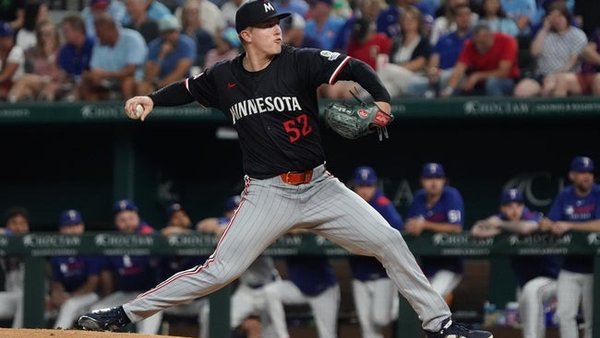
Zebby Matthews is the more established arm. His season ERA sits at 3.81 across 172.1 innings — a substantial workload with a WHIP of 1.23. The ESPN-reported number of 4.74 diverges from that, suggesting some recent regression that’s worth flagging honestly: Matthews may not be quite as sharp as his season line implies. What holds up regardless is his strikeout rate — 10.39 K/9 — backed by a genuinely nasty arsenal. His cutter sits at 89.7 mph with a 35.0% whiff rate and a .244 xwOBA against, and his split-finger generates a 31.8% whiff with a .233 xwOBA. Those are swing-and-miss pitches that play well against a Giants lineup built around strikeout-prone hitters. Jonah Cox leads the order with a 38.4% strikeout rate, and Victor Bericoto — batting third — carries a 26.7% K rate. Matthews’ put-away stuff matches up well against a lineup that already struggles to make consistent contact. His four-seam sits at 97.2 mph but is vulnerable (.385 xwOBA against), so his best path to a quality start runs through the cutter and splitter combination.
Blade Tidwell brings a very different profile. In just 28 innings, he’s posted a 1.11 WHIP with only 6 walks — a command-first approach that limits free baserunners and prevents the big-inning sequences that push totals over. His curveball at 84.5 mph generates a 33.3% whiff rate and a microscopic .215 xwOBA against, and his slider (.228 xwOBA) gives him a second genuine put-away offering. The concern with Tidwell isn’t just the sample size — it’s also his changeup. At 21.4% usage, it’s his second-most-deployed pitch, and it’s getting hit: .368 xwOBA against with just an 8.3% put-away rate. That’s a real vulnerability, and it matters because Josh Bell (.384 xwOBA) and Kody Clemens (.397 xwOBA) are exactly the kind of hard-contact hitters who can punish a hittable off-speed pitch. If Tidwell leans on the changeup the way his usage suggests he does, Bell and Clemens are the names to watch. The broader concern with Tidwell remains the overall sample: 28 innings tells you almost nothing definitive, and his 4.18 ERA suggests the underlying results have been mixed even if his walk rate is clean.
The Pushback
Minnesota scored 8 runs Sunday — that’s the headline number working against this pick. But context matters: that game came against the Angels’ Ryan Johnson in the home finale of a 59-win team’s season, and Dean Kremer’s six-inning gem kept the total contained on the other side. The Twins’ 8-run output was a lineup catching a dead arm in a meaningless game, not a sign that their offense has turned a corner. Their season OPS sits at .720 and they rank mid-pack in runs scored.
The Twins’ bullpen also has real gaps. Anthony Banda (lat) and Cole Sands (elbow) are both on the IL, which means Minnesota’s late-game relief depth is thinner than usual. If Matthews exits early, the arms behind him aren’t particularly deep, and that could theoretically allow a big inning from a Giants lineup that — while limited — still features Bryce Eldridge (.444 xwOBA) and Victor Bericoto (.410 xwOBA) as genuine power threats.
On the San Francisco side, Tidwell’s changeup vulnerability is real friction for this thesis. If Bell and Clemens get into favorable counts and see that pitch, the exit velocity could climb fast. And the Giants’ bullpen — already depleted with Peguero, Gage, and Winn all on the IL — is not built to hold leads or strand baserunners if Tidwell falters early.
These are genuine risks. They’re also why this is a lean, not a max bet.
Roster Damage and the Oracle Park Context
The Giants are playing with 10 players on the IL, including Matt Chapman (abdomen), Harrison Bader (foot), and both primary catchers — Daniel Susac (knee) and Jesus Rodriguez (elbow). That’s not roster inconvenience; that’s structural damage to a lineup that was already 64-92 before the injuries hit. The lineup San Francisco is running out Monday features significant depth-chart names, and their season OPS of .713 likely overstates what this particular group can produce.
Oracle Park’s 0.92 park factor doesn’t sound dramatic until you apply it across a full game. In a contest where both offenses are already limited, that 8% run suppression can be the difference between a total landing at 7 and landing at 9. The park isn’t exotic — it’s a steady, consistent downward pressure on run scoring that compounds the weaknesses already present on both sides.
The Pick
You’ve got two sub-.500 offenses playing in a pitcher-friendly environment, a rookie starter whose most-used secondary pitch is genuinely hittable but who still limits walks in a park that depresses run scoring, and an experienced arm with plus swing-and-miss offerings that match up well against a strikeout-prone Giants order. The over is priced at -118 for a reason — books respect the Twins’ recent offensive output and Tidwell’s inexperience. But paying a 16-cent premium over the under to chase one big game against the Angels is not a bet I want to make.
Oracle Park suppresses, both rosters are damaged, and the juice is essentially flat on the under. That’s not the profile of a game that blows past 8 runs with any regularity — it’s a game that grinds to a low-scoring finish while the over bettors wait on a Twins explosion that the park and the pitching are both working to prevent.
Bet: Under 8.0 (-102) | 1 Unit | Lean