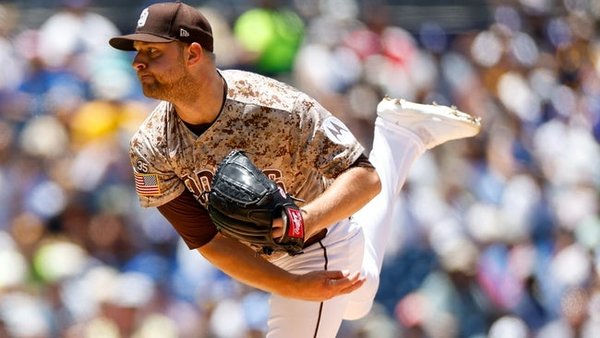
Michael King’s 3.03 ERA and 175-inning workload walk into a Coors Field total set at 11.0 — a number built around the park factor but not fully adjusted for what a workhorse suppressor does to one side of the run environment. Tanner Gordon’s 5.55 ERA keeps the blowout ceiling intact, but the pitching gap cuts both directions on this total in ways the over/under pricing hasn’t resolved cleanly.
Michael King vs. Tanner Gordon: San Diego Padres at Colorado Rockies Betting Preview
The betting story here isn’t whether San Diego wins. It’s whether you can find value in a game where the favorite is priced beyond what the edge justifies. The Padres -170 moneyline reflects a legitimate talent gap — Michael King (3.03 ERA, 1.15 WHIP, 175 IP) is a genuine top-of-rotation arm, and Tanner Gordon (5.55 ERA, 1.48 WHIP) has been consistently hittable all season. The market knows this, and it’s already priced in.
After yesterday’s 9-3 San Diego win in Game 1 of this series, the line on tonight’s game has absorbed the narrative momentum. The sharper angle is the total. Coors Field inflates the posted number to 11.0, but King’s presence — averaging over 6 innings per start — changes the run environment calculus in ways the park factor alone doesn’t capture. The question isn’t just how many runs score. It’s how many innings King pitches and how many lineup spots he shuts down before the bullpen ever enters the equation.
The tension in this play is real: the numbers project 12.7 combined runs, which clears the posted total of 11.0. This is not a slam-dunk play. It’s a bet that King outperforms the park projection, and the pricing spread between the under (-120) and over (+100) tells you the market is leaning the same direction as the projection — not toward the under. That friction is worth respecting, and I’ll address it directly.
Game Info & Betting Lines
- Date/Time: Thursday, September 17, 2026 | 3:10 PM ET
- Venue: Coors Field (Park Factor: 1.38 — extreme hitter’s park, outdoor)
- Probable Starters: Michael King (SD) vs. Tanner Gordon (COL)
- Moneyline: San Diego Padres -170 / Colorado Rockies +140
- Run Line: San Diego Padres -1.5 (-112) / Colorado Rockies +1.5 (-108)
- Total: 11.0 (Over +100 / Under -120)
Why This Number Is Off
The market set 11.0 for a reason: Coors Field’s 1.38 park factor is the single most powerful run-inflation environment in baseball, and pairing it with Gordon’s 5.55 ERA creates a credible path to a high-scoring blowout. The over at +100 is essentially the sportsbook saying: we think this goes over, and we’ll give you even money to agree. That’s a notable signal.
But here’s where the market is slightly wrong: it’s treating Gordon as the only variable. King is not a generic road starter — he’s a 175-inning workhorse with a 3.03 ERA who limits traffic consistently. His changeup (27.0% usage, 25.4% whiff rate, .284 xwOBA against) and sweeper (19.4% usage, 25.7% whiff rate, .296 xwOBA against) are his genuine run-prevention weapons — two distinct swing-and-miss options that suppress quality contact even against aggressive lineups. His sinker (28.8% usage, 93.1 mph) generates groundballs and keeps the ball out of the air, though hitters do make solid contact when they connect (.392 xwOBA). The Colorado lineup, while carrying a .742 OPS, is facing a pitch mix built to neutralize hard contact in ways Gordon simply cannot match on the other side. Zac Veen’s 37.0% strikeout rate against right-handed pitching — and a .470 xwOBA vsRHP that is entirely contact-quality dependent — is the kind of profile King neutralizes through tunneling and his changeup/sweeper combination rather than overpowering.
The market built 11.0 by averaging the park boost and both starters. King’s upside deserves a separate adjustment that the posted number hasn’t fully made.
What Separates the Pitching
The gap between these two arms is substantial, and it matters beyond just the moneyline. Michael King enters Coors with a profile built for volume suppression. His changeup sits at .284 xwOBA against with a 25.4% whiff rate; his sweeper clocks a .296 xwOBA with a 25.7% whiff rate. Those two pitches are the spine of his run-prevention case — not the sinker, which generates groundballs but allows solid contact (.392 xwOBA). Hunter Goodman — 38 home runs, .440 xwOBA — is day-to-day with a thumb injury, and his absence from the lineup removes the one bat in Colorado’s order capable of single-handedly changing a run environment through one swing. Goodman’s barrel rate of 6.9% is the highest on the Colorado roster by a significant margin, and with him potentially out, the ceiling on Colorado’s damage compresses meaningfully against King’s changeup and sweeper.
Tanner Gordon is the opposite profile. His four-seam fastball accounts for 42.1% of his pitches at 92.8 mph — modest velocity with a .345 xwOBA against, meaning hitters are making solid contact when they connect. His sinker is genuinely alarming: a .601 xwOBA against in limited usage. He leans on his changeup (21.7%, .314 xwOBA) and slider (21.8%, .310 xwOBA) as secondary options, but neither generates elite whiff rates. Against a San Diego lineup where Fernando Tatis Jr. carries a .434 xwOBA and Jackson Merrill sits at .448 xwOBA against right-handers, Gordon has to execute with precision he hasn’t demonstrated at a 5.55 ERA pace. The innings type matters too: King creates quick innings through strikeouts and his groundball sinker; Gordon creates baserunner traffic that puts pressure on Colorado’s already-depleted bullpen — Chase Dollander and Jose Quintana are both on the 60-day IL.
The net effect: King’s innings suppress the run environment on one side, while Gordon’s innings carry blowout risk on the other. The bet is that King’s suppression outweighs Gordon’s leakage.
The Pushback
The strongest argument against this under is the one I’d make if I were betting the other side: Coors Field historically destroys unders. The 1.38 park factor isn’t a suggestion — it’s a structural inflation engine, and unders at Coors cash at a rate that should make any totals bettor at least pause before laying juice. The over is +100. That’s free money on the side the park is pointing you toward, and the edge engine agrees — the raw projection sits at 12.7 combined runs, which is 1.7 runs over the posted number. I’m not going to pretend that’s a comfortable gap to bet through.
The recent series context cuts both ways. San Diego dropped 9-3 last night, which feeds the over narrative. But Tuesday’s 9-3 Rockies win came against Robbie Ray, not Michael King. Those are different pitching environments. The Padres have also gone for 9 runs in back-to-back games in this series, which is exactly the ammunition someone betting the over would point to. I’m not dismissing it. The Padres’ 9-1 L10 with a +23 run differential is a legitimate counter-argument against any under ticket in a game they’re likely to dominate offensively.
What keeps me on the under despite all of that: King’s innings volume. He’s averaging over six per start. If he pitches six-plus innings and limits Colorado to three or four runs, the under wins even if San Diego scores five or six on Gordon. The math works without needing an exceptional performance — it just needs King to be King.
Run Environment & Game Shape
The structure of this game matters as much as the raw run totals. King is a 175-inning pitcher, which means San Diego’s bullpen — already missing Jason Adam and Jeremiah Estrada to IL stints — is unlikely to be heavily taxed. King goes deep, the game shape stays controlled on the Padres’ half of every inning, and the under stays alive as long as Colorado can’t string together big innings against him.
Colorado’s bullpen, depleted by injuries, represents the greatest under threat from the opposite direction: if Gordon exits early and the Rockies turn to a patchwork relief corps, the Padres could pile on runs in the middle innings. That’s the scenario that blows the under up. But it requires Gordon to implode quickly — and even then, King’s ability to keep his own run total manageable means the combined total needs both halves to explode simultaneously. That’s a tougher path to 11-plus than the over bettors are pricing in.
The Goodman injury is the final piece. A lineup without their best power bat — a guy who barrels balls at 6.9% and carries a .440 xwOBA — is a legitimately different run-environment threat against an elite right-hander. King’s changeup and sweeper were already built to suppress hitters of Goodman’s profile. Without him, the Rockies lean on a top of the order where Veen’s .470 vsRHP xwOBA comes with a 37.0% strikeout rate — exactly the kind of high-variance hitter King can neutralize with secondary stuff.
When you stack King’s suppression against Coors inflation and the over projection, this isn’t a confident slam. But the price is right enough to take a position. Under 11.0 (-120), 2 units, moderate confidence. Yes, you’re paying -120 while the over is sitting at +100 — that’s a real cost, and I’d rather have the over’s price. But King’s innings-eating suppression outweighs Coors inflation often enough at this number to justify the juice. The pick is the under.