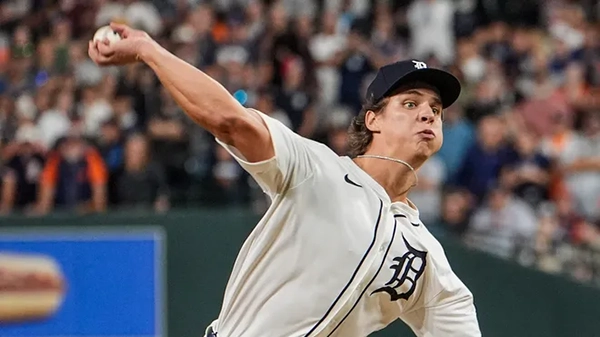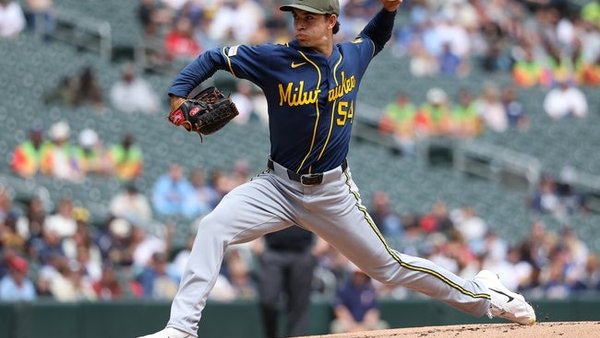
Chase Burns (2.73 ERA, 148.1 innings) is a different animal than anything Milwaukee’s lineup has faced this weekend — yet the total at 8.0 is still absorbing residue from 42 combined runs over two games. The recency bias is doing heavy lifting on that number, and the gap between a Cy Young-caliber arm and a 4.43 ERA back-of-rotation starter hasn’t been fully priced in.
Chase Burns vs. Robert Gasser: Cincinnati Reds at Milwaukee Brewers Betting Preview
The last two games of this series were unlike almost anything in recent baseball history — a 20-0 blowout followed by a 13-9 slugfest, 42 combined runs, a historic offensive weekend for Milwaukee. The total for Sunday’s game sits at 8.0, and the market is asking whether the fireworks continue. My answer is no — and the reason is standing on the mound for Cincinnati.
Chase Burns is not a continuation of the pitching that surrendered 47 runs in three games. He is a Cy Young-caliber arm in the middle of a dominant season, and the total at 8.0 has not fully adjusted for the shift in run environment he creates. The recency bias from this series is doing real work on that number, and that’s where the edge lives.
Robert Gasser is a real vulnerability on Milwaukee’s side, and the Reds’ bullpen is a known disaster — but Burns gives Cincinnati a chance to control this game deep into the middle innings, keeping the combined total well below what the market is implying.
Game Info & Betting Lines
- Date/Time: Sunday, September 13, 2026 | 2:10 PM ET
- Venue: American Family Field (Dome) | Park Factor: 1.00 (neutral)
- Probable Starters: Chase Burns (CIN, 15-3, 2.73 ERA) vs. Robert Gasser (MIL, 4-5, 4.43 ERA)
- Moneyline: Cincinnati Reds +169 / Milwaukee Brewers -206
- Run Line: Milwaukee Brewers -1.5 (+105) / Cincinnati Reds +1.5 (-126)
- Total: 8.0 (Over -110 / Under -109)
Why This Number Is Off
The market has a legitimate reason to keep this total at 8.0. Milwaukee’s offense is real — a .748 OPS, 775 runs scored on the season, and a lineup that just posted 42 runs in two games. The Brewers are the best team in baseball, and Gasser’s 4.43 ERA is not inspiring confidence on the Cincinnati side of the ledger. The over case is not hard to construct.
But here’s where the market is slightly wrong: it’s pricing in both starters as roughly equivalent contributors to run scoring, and they are not. Burns at 2.73 ERA over 148.1 innings is a legitimate ace. Gasser at 4.43 ERA over 91.1 innings is a back-of-rotation arm. The gap between them is significant, and that gap suppresses the Cincinnati run total dramatically.
The other factor the market may be overweighting is recent series results. Those games were outliers driven by Cincinnati’s catastrophic bullpen — not a signal that every game in this ballpark ends with double-digit run totals. American Family Field plays at a neutral park factor of 1.00. There’s no environmental inflation baked in. With Burns eating innings and Cincinnati’s lineup posting a brutal .705 OPS on the season, the under at -109 is priced almost fairly — but the edge is still there.
What Separates the Pitching
The gap between these two starters is the core of this bet. Chase Burns brings a two-pitch arsenal that generates elite swing-and-miss at every level. His four-seam fastball sits at 97.7 mph and accounts for 55.7% of his pitches, holding hitters to a .327 xwOBA — above average, but it sets up his true weapon. His slider is one of the nastiest pitches in baseball this season: 38.4% usage, 90.2 mph with elite shape, a 49.7% whiff rate, and an xwOBA of just .199 against. That slider puts hitters away at a 32.0% clip. When a pitcher can generate those numbers on his secondary pitch, he controls at-bats rather than reacting to them.
Against Milwaukee’s lineup, the BvP data shows Burns limits damage even against quality hitters. Chourio is 1-for-6 with three strikeouts against him. Turang is 1-for-5 with two strikeouts. Christian Yelich is 0-for-6 with one strikeout. Bauers has a homer in five plate appearances, which is the clearest threat in the data — his .454 xwOBA and 8.1% barrel rate make him a legitimate concern. But the broader pattern holds: Burns generates whiffs and weak contact even against a lineup this capable.
Robert Gasser is a different profile entirely. His sweeper (25.4% usage, .261 xwOBA) and four-seamer (23.3%, .266 xwOBA) give him functional weapons, but his sinker generates a .363 xwOBA and his cutter sits at .401 — hittable offerings that Cincinnati’s better hitters can square up. Elly De La Cruz carries a .483 xwOBA on the season and a .485 xwOBA against left-handed pitching specifically, making him the most dangerous matchup Gasser faces. Sal Stewart hit .400 in five plate appearances against him. The concern isn’t that Gasser gets demolished — it’s that he creates more base traffic and higher-leverage situations than Burns does, contributing to a higher Milwaukee run total that the under can absorb only if Burns holds Cincinnati in check.
Burns holds the line. Gasser creates exposure. That asymmetry drives the combined total below 8.0.
The Pushback
The strongest argument against the under is sitting right in front of us: the last two games in this series went 13-9 and 20-0. That’s 42 combined runs in 48 hours. Even accounting for Cincinnati’s historically bad recent bullpen performance — 47 runs allowed over three games, a stretch not seen since 1901 — the Brewers’ offense is genuinely elite. Jackson Chourio, Brice Turang, Jake Bauers, and Garrett Mitchell have all gone deep in this series. The lineup isn’t cold. It’s dangerous.
The secondary concern is Burns himself. He’s on 148.1 innings through mid-September, and if Cincinnati pulls him early — say, five innings or fewer — the Reds’ bullpen takes over. That bullpen has been historically bad in this series. Milwaukee’s middle-relief unit isn’t carrying major injury flags, but Brian Fitzpatrick, Rob Zastryzny, Angel Zerpa, and Bryse Wilson are all on the IL. The backend is thinner than you’d want. If Burns exits early and Cincinnati’s bullpen implodes, 8.0 clears with room to spare.
That’s a real scenario. I’m not dismissing it. But it requires Burns to underperform his entire season arc in a context where he’s been one of the most durable, consistent starters in baseball. The risk is there — it just doesn’t outweigh the structural edge the under holds when Burns is on the mound.
Run Environment & Game Shape
American Family Field is a dome with a neutral park factor of 1.00. There’s no wind, no humidity variance, no elevation — the environment doesn’t inflate or deflate run scoring on its own. This game plays exactly as the pitching matchup dictates.
The numbers project this game at Milwaukee 4.8, Cincinnati 4.3 — a 9.1 combined total. That raw figure technically favors the Over, and I understand why some sharp money lands there. But the key number is Cincinnati’s 4.3 projection. That’s the one Burns can beat. A pitcher with a 2.73 ERA, a 49.7% whiff rate on his slider, and a track record of suppressing offense all season is not surrendering 4.3 runs against a .705 OPS Cincinnati lineup. The Milwaukee side at 4.8 is where Gasser’s leakiness lives — and that exposure is already baked into the total. The market has accounted for Gasser giving up runs. What it hasn’t fully priced is Burns suppressing the Reds’ already-struggling offense (.230 AVG, .705 OPS) well below that projection, keeping the combined total manageable, and that Cincinnati’s offense cannot generate enough runs against any competent pitching to push this over 8.0.
The Pick
The thesis is simple: Chase Burns is a legitimate ace who will hold Cincinnati’s anemic offense (.230 AVG, .705 OPS) well below the market’s implied run total, and no amount of Gasser leakiness on the Milwaukee side can push the combined number over 8.0 when the Reds can’t score. The last two games were historic outliers driven by catastrophic bullpen failure. Today the pitching changes. The number doesn’t need to.
Bet: Under 8.0 | -109 | 2 Units | Moderate Confidence