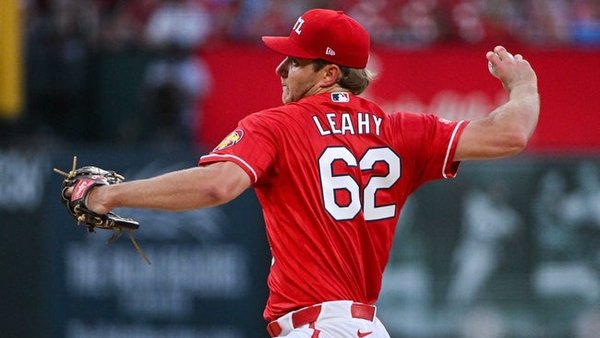
Luis Castillo’s true 2.71 ERA is buried under a surface ERA of 5.57 — and the market is pricing Chicago at -104 as if both starters are equals. Leahy’s four-seam fastball is allowing a .432 xwOBA, a vulnerability that Murakami, Vargas, and Grichuk are built to exploit, yet the number hasn’t moved to reflect it.
Luis Castillo vs. Kyle Leahy: Chicago White Sox at St. Louis Cardinals Betting Preview
Surface-level, this game looks like a reasonable Cardinals lean. St. Louis is at home, Kyle Leahy is 10-4 with a 3.41 ERA, and the White Sox have lost four straight. The market has set Chicago at -104 — essentially a pick’em. That pricing reflects the noise perfectly: a slumping road team, a home pitcher with a winning record, and a Cardinals squad that just handled these same White Sox 7-3 the night before.
But strip away the record and the recent skid, and the actual pitching edge in this game belongs to Chicago. Luis Castillo’s ESPN-listed ERA of 5.57 is a fiction built on run support failures and bullpen collapses — his real-season ERA is 2.71 across 83 innings with a 1.13 WHIP. The market appears to be punishing him for outcomes he didn’t create. At -104, bettors are essentially being offered near-pick’em odds on a pitcher who has been legitimately good this year against a starter who is solid but beatable.
After yesterday’s 7-3 Cardinals win, the public narrative has shifted further toward St. Louis. That’s exactly the kind of market noise that creates a real price discrepancy — and that’s the bet.
Game Info & Betting Lines
- Date/Time: Saturday, September 12, 2026 — 7:15 PM ET
- Venue: Busch Stadium — Park Factor 1.00 (neutral run environment)
- Probable Starters: Luis Castillo (CHW) vs. Kyle Leahy (STL)
- Moneyline: Chicago White Sox -104 / St. Louis Cardinals -116
- Run Line: Chicago White Sox -1.5 (+161) / St. Louis Cardinals +1.5 (-196)
- Total: 8.5 (Over -105 / Under -115)
Why This Number Is Off
The market is doing exactly what it should — it’s pricing in the White Sox’s brutal recent stretch (9 losses in 12 games), Castillo’s misleading 4-11 record, and the home-field tilt toward St. Louis. At -116, the Cardinals price is defensible. Leahy has been one of the more reliable arms in the National League this season, and home teams in neutral parks carry a modest but real structural edge. The line isn’t wildly wrong.
But here’s where I think it’s slightly off: the market is weighting Castillo’s record and surface ERA rather than his actual performance. A 2.71 ERA and 1.13 WHIP over 83 innings isn’t a fluke — that’s sustained execution. Meanwhile, Leahy’s 1.33 WHIP signals more traffic on the bases than his ERA suggests, and his 14 home runs allowed in 132 innings (0.95 HR/9) is a genuine vulnerability against a White Sox lineup that has clubbed 192 home runs on the season.
The Cardinals are also below .500 at 73-75 and just 5-5 in their last ten. The home-field advantage narrative doesn’t carry much weight when the team playing there isn’t actually a home-field threat. At -104, Chicago offers clear value on the superior starting pitching arm in a neutral park. I also looked hard at Cardinals -116 and passed — Castillo’s true 2.71 ERA makes backing the inferior starter at that price a value-negative proposition. And while White Sox -1.5 (+161) is a tempting number, Chicago’s four-game skid and a projected 4.5 runs scored don’t support a multi-run win thesis — the moneyline is the right vehicle here.
What Separates the Pitching
Castillo’s arsenal is legitimately elite. His four-seam fastball sits at 94.5 mph with a 36.6% usage rate and generates a 23.8% whiff rate — and hitters are managing just a .272 xwOBA against it. His slurve, thrown 30.6% of the time at 82.6 mph, pairs perfectly as the primary chase pitch, generating a 28.7% whiff rate and .273 xwOBA. Those two pitches account for nearly 70% of what Castillo throws, and both are suppressing contact at an elite level. His curveball sits at just 4% usage but holds hitters to a microscopic .116 xwOBA — a genuine put-away option when he wants it. The Cardinals’ top of the order offers limited upside against this arsenal: José Fermín carries a .293 xwOBA, Iván Herrera checks in at .342, and Ramón Urías — who hits righties at just a .174 xwOBA — is a potential soft spot in the three-hole every time Castillo works to his side.
Leahy’s profile is more scattered. His four-seam fastball at 94.2 mph generates only a 13.1% whiff rate and allows a .432 xwOBA — that’s the kind of heater hitters are squaring up. His off-speed mix is better: his changeup produces a 29.2% whiff rate and .307 xwOBA, and his sweeper checks in at .311 xwOBA. But the power bats in Chicago’s lineup specifically target his fastball vulnerability. Munetaka Murakami — batting second in this lineup — carries a season-wide .479 xwOBA, a 9.8% barrel rate, and a 34.8% hard-hit rate. Against right-handed pitching specifically, Murakami’s xwOBA jumps to .484. That’s the mismatch the market isn’t fully pricing. Miguel Vargas at .416 xwOBA and Randal Grichuk at .423 xwOBA give this lineup three legitimate power threats who can turn Leahy’s flat fastball into damage.
The Pushback
The case against this bet is real, and I’m not brushing it aside. The White Sox have lost four straight and nine of their last twelve. Yesterday’s 7-3 loss to these same Cardinals wasn’t a moral victory — they loaded bases in the sixth and came up empty, squandering opportunity in a game that felt like it could have turned. The night before that, Pittsburgh shut them out 2-0 on one hit through seven innings. And in the game before that, Chicago managed just 2 runs in a 4-2 loss to the Pirates. Five combined runs across those three games — 3, 0, and 2 — is a genuine cold stretch that goes well beyond random variance, even if it’s not a total offensive blackout.
Leahy also deserves more credit than the rejected-bet framing suggests. He’s 10-4 with a 3.41 ERA and 124 strikeouts across 132 innings — that’s a real pitcher, not a paper record. His off-speed mix, particularly that 29.2% whiff changeup, gives him a legitimate weapon against a right-heavy White Sox lineup. And the bullpen concern is real: with Jordan Leasure, Huascar Brazoban, and Tyler Davis all unavailable, Chicago’s late-inning depth is thinner than I’d like behind Castillo.
The numbers do lean Cardinals — a 58% home win probability and a component breakdown that gives St. Louis a starter edge. I’m not ignoring that. But the gap between Castillo’s surface ERA (5.57) and his real ERA (2.71) is too large to let the market price stand unchallenged. The Cardinals are a below-.500 team at home. The home-field edge the market is implying just isn’t there.
That friction is why this is 2 units, not 3. Enough to back the conviction, sized for the genuine uncertainty.
Jensen’s Pick
Chicago White Sox Moneyline (-104) — 2 Units. Castillo’s true 2.71 ERA versus the ESPN-listed 5.57 creates a mispriced near-pick’em — the market is penalizing him for outcomes he didn’t cause while overlooking Leahy’s .432 xwOBA against on his primary fastball. Back the better pitcher at essentially even money in a neutral park, sized at 2 units to account for Chicago’s real offensive cold stretch and thin bullpen depth. Check our daily MLB picks page for more plays throughout the weekend series.