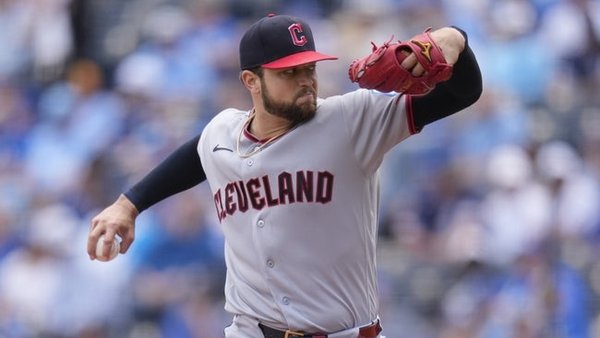
Slade Cecconi has surrendered 9 home runs in 57.1 innings while Tyler Samaniego carries a 1.04 ERA and 1.15 WHIP — a 4.14-run ERA differential between starters that the moneyline is not reflecting. The number is being driven by team narrative and home-field weight, not the pitching gap that actually determines individual game outcomes.
Tyler Samaniego vs. Slade Cecconi: Boston Red Sox at Cleveland Guardians Betting Preview
The Red Sox arrive in Cleveland carrying the weight of a 1-5 homestand, a 23-32 record, and a fanbase openly calling for a teardown. The Guardians are 33-25, riding momentum, playing at home. On paper, this looks like a spot to back Cleveland without much thought. But the market is pricing this game almost entirely on team narrative — and that’s where the value opens up for Boston.
The core thesis is straightforward: Tyler Samaniego owns a 1.04 ERA and 1.15 WHIP in 17.1 innings this season, while Slade Cecconi is carrying a 5.18 ERA, 1.48 WHIP, and has allowed 9 home runs in 57.1 innings. The numbers project this game at Boston 4.4, Cleveland 4.3 — a near pick’em — yet Boston is available at +104 on the moneyline. Getting plus money on the team with the dominant starter in a coin-flip game is the definition of positive expected value.
Yesterday’s pick took the under 7.5 in Minnesota at Chicago and came away empty. That loss is a reminder that run environments don’t always cooperate with the numbers. Today the angle is different — it’s about the pitching gap and the price, not the total.
Game Info & Betting Lines
- Date/Time: Friday, May 29, 2026 | 7:10 PM ET
- Venue: Progressive Field | Park Factor: 0.98 (neutral-to-slightly pitcher-friendly)
- Probable Starters: Tyler Samaniego (BOS) vs. Slade Cecconi (CLE)
- Moneyline: Boston Red Sox +104 / Cleveland Guardians -122
- Run Line: Cleveland Guardians -1.5 (+172) / Boston Red Sox +1.5 (-210)
- Total: 8 (Over -105 / Under -115)
Why This Number Is Off
The market is doing exactly what it should do on the surface: pricing Cleveland as a modest favorite because they’re at home, they’re 10 games over .500, and Boston is a mess. The -122 on Cleveland is defensible. Home field adds roughly 0.3 runs in expected run differential, and the Guardians’ 7-3 record over their last 10 games reflects a team that actually executes. The line is not irrational.
But here’s the problem — the market is weighting team quality and home field almost entirely, while underweighting the single biggest driver of individual game outcomes in baseball: the starting pitching gap. A 4.14-run ERA differential between starters in a game projected near the total should not produce a -122 favorite price for the team with the inferior arm. The market appears to be applying a regression discount to Samaniego’s ERA given his 17.1 inning sample — which is fair — but it’s overcorrecting. His 1.15 WHIP isn’t a mirage, and his pitch mix shows genuine deception. Meanwhile, Cecconi’s numbers aren’t bad luck; they’re bad pitching. Nine home runs in 57 innings is a contact quality problem, not a sequencing fluke.
Boston’s win probability works out to 54.4% based on the underlying component splits — starter advantage, run prevention, and offense. At +104, implied probability sits at roughly 49%. That 5.4% gap represents real edge at a fully valid price point.
What Separates the Pitching
The gap between these two starters is wider than the moneyline suggests, and the Statcast data makes that case clearly.
Samaniego works primarily off a sinker (38.6% usage, 92.9 mph) that generates weak contact — opponents post just a .316 xwOBA against it. His four-seamer at 93.4 mph generates a 23.9% whiff rate, and his sweeper (17.5% usage, 82.0 mph) holds hitters to a .287 xwOBA with a 25.0% whiff rate. The pitch that stands out most is his changeup: despite only 7.8% usage, it produces a microscopic .053 xwOBA against — elite at tunneling hitters off the heater. His profile creates soft contact early, whiffs in two-strike counts, and minimal walks given the game shape. Against Cleveland’s top of the order, José Ramírez posts a .343 xwOBA against right-handed pitching — below his overall .372 mark — and the Guardians are without Steven Kwan, who is on the bereavement list. Kwan’s absence removes a disciplined, on-base leadoff threat and disrupts Cleveland’s typical lineup construction.
Cecconi is a different story. His four-seamer (34.0% usage, 93.5 mph) generates a .373 xwOBA against — hitters are squaring it up. His cutter at 26.8% usage holds a .284 xwOBA, which is functional, but his curveball (14.4% usage) gives up a .364 xwOBA despite a 32.8% whiff rate — batters who make contact are doing damage. The nine home runs in 57.1 innings aren’t random; they’re a predictable outcome of a pitcher who gives up hard contact on his primary pitch. Willson Contreras (.491 xwOBA overall, .470 vs. right-handers) is exactly the type of hitter who punishes Cecconi’s fastball. Wilyer Abreu carries a .387 xwOBA against righties with a manageable 19.9% whiff rate — he makes contact and drives the ball. This Boston lineup, for all its flaws, has multiple hitters built to exploit a pitcher who lives in the strike zone with a hittable heater.
The Pushback
The case against Boston is real, and I’m not dismissing it as noise.
Start with Samaniego himself: 17.1 innings is a tiny sample. He’s 0-2 despite the elite ERA — run support has been nonexistent — but the record also hints at a team that struggles to score behind him when the lineup is depleted. There’s no guarantee the underlying contact suppression holds as opposing scouts accumulate more looks at his arsenal. A pitcher with only 13 strikeouts in 17.1 innings (6.75 K/9) is relying heavily on soft contact rather than swing-and-miss. If Cleveland’s hitters elevate their barrel rates against him, the ERA could unravel fast.
Cleveland is also the better baseball team by most measures — their 33-25 record and +13 run differential aren’t flukes, and their bullpen depth is real. Cade Smith has an MLB-leading 19 saves, and a late-inning lead is likely to hold in this park. The Guardians’ offense isn’t dominant — .230 average, .693 OPS — but they draw walks (239 on the season), they run (54 steals), and they manufacture runs. Kyle Manzardo (.443 xwOBA, .543 vs. left-handers) is a genuine power threat against a left-handed pitcher, and his 35.0% strikeout rate is the only thing keeping him from being a lineup anchor. Boston’s pitching staff ERA of 3.74 is respectable, but the bullpen has real concerns — Garrett Whitlock is on the IL with a knee issue, Garrett Crochet is on the IL with a shoulder injury, and the Red Sox are thin behind Samaniego if he exits early.
Finally, this is a Boston team that just got blown out 10-2 by Atlanta, finished a 1-5 homestand to audible “sell the team” chants, and is traveling to face a club playing better baseball. Momentum and morale are not betting factors I weight heavily, but a demoralized clubhouse can show up in small execution errors — missed cutoffs, poor at-bats with runners on base — that swing tight games. This bet is about the number, not about rooting for a demoralized Red Sox club.
Run Environment and the Total
The total is set at 8, and the over/under split (-105/-115) leans slightly toward the under. That’s the right lean given Samaniego’s profile. But the projected total of 8.7 runs creates a moderate over case — driven almost entirely by Cecconi’s volatility on the road side of the ledger. If Cecconi gets touched early and the Red Sox bullpen is forced into action before the Guardians pen, the over becomes a live threat.
That’s exactly why the run line (-1.5 at +172 for Cleveland) doesn’t make sense as a play. A multi-run Cleveland win requires either Samaniego to implode on a thin sample or the Guardians to break through against a Boston bullpen that, while compromised, isn’t a complete sieve. The coin-flip win probability projection doesn’t support a spread bet. The moneyline is the cleaner vehicle to capture the edge.
The Pick
This is a spot where the market is pricing narrative — Boston’s losing record, Cleveland’s home advantage, the general chaos surrounding the Red Sox — and discounting the most predictive variable in a single game: which pitcher is taking the ball. A 4.14-run ERA gap between starters, a neutral park, and a plus-money price on the team with the better arm is a combination worth backing at 2 units.
The sample size concern on Samaniego is real, and this is a moderate-confidence play, not a max-bet situation. But the price is right and the underlying numbers support Boston in a game the market has mispriced toward Cleveland.
Bet: Boston Red Sox Moneyline +104 — 2 Units