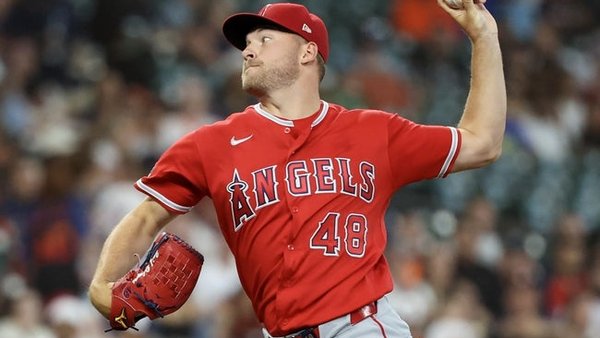
Angel Stadium’s mild run-suppression factor (0.95) quietly reshapes what both starters’ ERA profiles mean here — Joe Ryan and Reid Detmers each carry home run risk, but they’re also facing lineups with elite strikeout totals and bottom-tier OPS numbers. The over is priced at -125 while the under sits at +104, a 29-cent gap that doesn’t quite match a game where neither offense is built to sustain big innings.
Joe Ryan vs Reid Detmers: Minnesota Twins at Los Angeles Angels Betting Preview
After Friday’s 3-0 shutout in Anaheim, the pitching matchup shifts to Joe Ryan and Reid Detmers — two starters with real ERA concerns but equally real suppression ability against a pair of lineups that rank among the worst in the league at generating runs. The market has set the total at 7.0, with the over priced at -125 and the under available at +104. That pricing gap is where this bet lives.
The temptation is to load up on the over given both starters’ ERAs and walk rates. Ryan sits at a 5.35 real ERA and Detmers at 4.88, and neither is inspiring confidence on paper. But ERA is a noisy number, particularly late in a season where a handful of multi-run implosions can distort the full picture. What the ERA doesn’t tell you is that these two offenses — Minnesota at a .720 OPS and Los Angeles at a .677 OPS — are among the most punchless lineups Ryan and Detmers will face all year.
The clearest edge in this game is not directional — it’s structural. The over is expensive at -125 and demands conviction that two bad offenses, in a run-suppressing park, against pitchers with genuine strikeout stuff, will combine for more than seven runs. I’m not buying that story at that price.
Game Info & Betting Lines
- Date/Time: Saturday, September 19, 2026 — 9:38 PM ET
- Venue: Angel Stadium | Park Factor: 0.95 (mild run suppressor)
- Probable Starters: Joe Ryan (MIN, 5.35 ERA, 1.24 WHIP) vs Reid Detmers (LAA, 4.88 ERA, 1.34 WHIP)
- Moneyline: Minnesota Twins -108 / Los Angeles Angels -112
- Run Line: Los Angeles Angels +1.5 (-196) / Minnesota Twins -1.5 (+161)
- Total: 7.0 — Over -125 / Under +104
Why This Number Is Close
The market isn’t wrong to set this at 7.0. Both starters have ERA profiles that could go sideways fast — Ryan has surrendered 17 home runs in 77.1 innings, and Detmers has issued 39 walks in 90.1 innings, a BB/9 rate that creates baserunner clusters even when he’s not getting hit hard. There’s a legitimate case that one bad inning from either starter blows the total open, and the over at -125 is priced to reflect that plausibility.
But here’s where I think the market is slightly wrong: the juice differential. The over demands you pay -125 while the under is sitting at +104. That’s a 29-cent swing on a game where both offenses are genuinely bad and neither starter is facing a lineup capable of sustaining big innings. The market is pricing in ERA volatility without fully accounting for the strikeout profiles of each pitcher against lineups that K at elite rates. Minnesota has punched out 1,233 times this season; Los Angeles leads that with 1,468 strikeouts, one of the highest totals in the AL.
A coin-flip total at +104 versus -125 is not a coin flip. There’s juice on the wrong side of what I think is a marginal lean toward suppression.
What Separates the Pitching
Ryan and Detmers are stylistically different, but they share a common trait in this context: each generates the type of swing-and-miss that keeps the Angels’ and Twins’ lineups from stringing together big innings.
Ryan’s most dangerous weapon is his split-finger, which draws a 38.6% whiff rate and holds hitters to a .243 xwOBA — elite suppression numbers. His cutter adds to that at 30.8% whiff and .273 xwOBA. The problem is his four-seam fastball (28.1% usage, 92.8 mph) is getting punished — .392 xwOBA against — and his sinker is worse at .445 xwOBA. That’s where the 17 home runs in 77.1 innings are coming from. Against the Angels’ Mike Trout, who posts a .460 xwOBA and a 7.2% barrel rate, Ryan’s fastball family is a genuine risk. But Trout carries a 26.4% strikeout rate and in 9 career PA against Ryan has managed just 1 home run and 2 strikeouts, which tempers that concern somewhat.
Detmers leans heavily on his cutter (37.2% usage, 89.9 mph, 23.5% whiff) and his sweeper (21.9% usage, 28.8% whiff, .282 xwOBA). His split-finger is nearly as effective as Ryan’s — 32.2% whiff, .256 xwOBA. The red flag for Detmers is his sinker, used nearly 20% of the time, with a 3.7% whiff rate and a .515 xwOBA against — a disaster pitch when elevated. It’s also worth noting that Detmers has allowed 18 home runs in 90.1 innings this season, a HR rate that is comparable to — and in raw terms exceeds — Ryan’s 17 in 77.1 innings. Both starters carry real home run risk; neither gets a pass on that front. Against the Twins’ core — Kody Clemens (.401 xwOBA, 6.0% barrel), Ryan Jeffers (.372 xwOBA), and Josh Bell (.382 xwOBA) — a sinker left in the middle of the zone gets punished. The saving grace is that Clemens has a 21.7% strikeout rate and Bell checks in at 19.7%, making prolonged rallies less likely.
The gap between these two arms isn’t wide — Ryan has the cleaner secondary arsenal, Detmers has the slightly better overall xwOBA profile on his off-speed mix. What matters for the under is that both create high-strikeout innings against offenses that are already prone to punching out.
The Pushback
I’m not going to pretend this is a slam dunk. The numbers project a combined 8.7 runs for this game — technically an over — and there are legitimate structural reasons to respect that figure. Detmers’ walk rate is a real problem: 39 free passes in 90.1 innings means runners are on base in clusters, and that’s how crooked numbers happen even against weak lineups. The Angels’ bullpen is also compromised, with Anthony Banda (lat), Cole Sands (elbow), and Samy Natera Jr. (forearm) all on the injured list. If Ryan struggles and Minnesota’s pen is leaned on early, the back end of the Los Angeles bullpen may not be equipped to hold the line.
The over argument is coherent. I just don’t think it’s priced correctly. The engine’s own projection of 8.7 combined runs sits only 1.7 above the number — a margin that falls well within normal variance for a game with two strikeout-heavy starters in a mild suppression park. When the over costs you -125 and the under pays +104 on a projection that only barely clears the bar, the value math points away from the expensive side. An against-the-numbers lean at plus money beats a consensus lean at juice, especially when the offenses involved are this limited.
Rejected Angle: The Over
The over at -125 requires the kind of conviction this game doesn’t earn. You’d need at least one starter to implode — which is possible with these ERAs — but you’d also need the opposing lineup to capitalize, and these are not lineups built for big crooked numbers. The Angels (.677 OPS) are one of the worst-scoring teams in the AL, and the Twins (.720 OPS) aren’t far behind. Paying -125 to bet on two bad offenses to go over seven in a mild pitcher’s park, in late September with playoff implications largely faded, is not a position I want to be in. The price is too steep for the story.
Run Environment & Game Shape
Angel Stadium’s 0.95 park factor is a mild but consistent suppressor — not a cavernous gap, but directionally in play when paired with two strikeout-oriented starters. Friday’s 3-0 final in the same series is recent, contextually relevant evidence that this environment is not producing crooked numbers right now. The market expects a low-to-moderate scoring game, and the over-under split reflects that — but the over is priced as though suppression is already the consensus, while the under is still paying a premium. That’s where the value lives: the under isn’t getting priced like the favorite; it’s getting priced like the underdog on a coin-flip proposition, which is exactly the kind of structural inefficiency worth betting into.
Both lineups are built to strikeout, both starters carry legitimate swing-and-miss weapons, and the bullpen injuries on both sides introduce more variance than pure suppression — but variance cuts both ways, and you’re getting paid to take the under side of that variance. I’ll take the plus-money side of a tight suppression environment over paying juice on a projection that barely clears the bar.
Bet: Under 7.0 at +104 — 1 unit, lean.