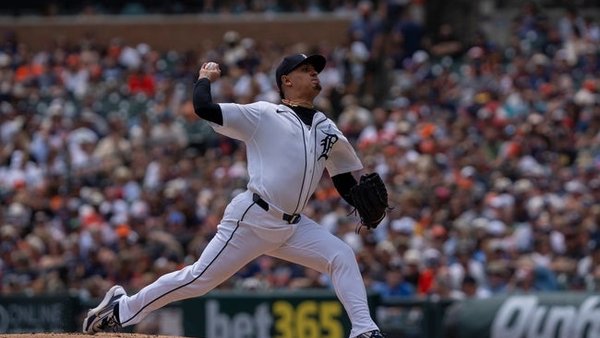
Keider Montero’s 3.22 ERA and 0.98 WHIP face off against Colin Rea’s -0.19 WAR and 1.42 WHIP — a structural gap the number refuses to acknowledge. Detroit sitting at -102 means the market is treating these two starters as interchangeable, and a gutted Chicago bullpen only widens the late-inning disparity.
Keider Montero vs Colin Rea: Detroit Tigers at Chicago Cubs Betting Preview
After Monday’s wild 8-6 Detroit win and Tuesday’s 11-2 Cubs blowout that burned the Tigers ML bet, this series finale presents a completely different pitching equation. The market has responded to Chicago’s home dominance — 23-10 in their last 33 games — and Detroit’s ugly loss last night by essentially calling it a coin flip. But coin flips require two comparable arms, and tonight doesn’t offer that.
Keider Montero brings a 3.22 ERA, 0.98 WHIP, and 2.96 WAR across 100.2 innings — the profile of a legitimate above-average starter on a strong developmental arc. Colin Rea counters with a 4.74 ERA, 1.42 WHIP, and -0.19 WAR across the same innings count. Negative WAR. A starter who has cost his team wins relative to replacement level. The market is pricing team records; tonight’s outcome is driven by who’s on the mound.
The value anomaly at Detroit -102 is the core of this bet. That’s essentially a pick’em price on a game where one team has a measurably superior starter, a better pitching staff top to bottom, and an opposing bullpen that has been gutted by injuries. The price doesn’t reflect the pitching gap — and that’s where the edge is.
Game Info & Betting Lines
- Date/Time: Wednesday, July 22, 2026 — 8:00 PM ET
- Venue: Wrigley Field | Park Factor: 1.02 (slight hitter lean)
- TV: ESPN
- Probable Starters: Keider Montero (DET) vs Colin Rea (CHC)
- Moneyline: Detroit Tigers -102 / Chicago Cubs -116
- Run Line: Detroit Tigers -1.5 (+152) / Chicago Cubs +1.5 (-184)
- Total: 8 (Over -108 / Under -112)
Why This Number Is Off
The market’s logic isn’t irrational on the surface. Chicago is 57-44; Detroit is 47-54. The Cubs just dropped 11 runs on the Tigers last night. Home field, overall roster quality, and recent momentum point toward Chicago as a mild favorite — and the -116 moneyline on the Cubs reflects exactly that reasoning.
But the market is handicapping roster records, not tonight’s pitching matchup. Sportsbooks set lines that account for team-wide talent and home field advantage — they don’t always adjust aggressively enough when one starter is significantly outperforming the other. Rea’s -0.19 WAR means he has been, by aggregate measure, a negative asset in his starts this season. His 1.42 WHIP means roughly 1.4 baserunners per inning — consistent traffic that compounds over six innings.
Montero at -102 is the market treating a legitimate starter as interchangeable with a negative-WAR arm. The Cubs’ superior record is real, but records reflect the full roster over months. Tonight, for nine innings, it comes down to Montero versus Rea — and that’s a gap the -102 price doesn’t come close to capturing.
What Separates the Pitching
The statistical distance between these two starters is not marginal — it’s structural. Montero’s 0.98 WHIP is elite. He’s allowing fewer than one baserunner per inning, keeping rallies isolated and preventing the kind of inning-expanding damage that inflates run totals. His 22 walks in 100.2 innings (just 1.97 BB/9) means he’s not gifting free bases — he’s making hitters earn everything. Nine home runs surrendered in 100.2 frames is a manageable rate. The 2.96 WAR stamps him as a genuine mid-rotation asset, not a backend arm surviving contact luck.
Rea’s profile reads almost as a mirror image. The 1.42 WHIP signals persistent baserunner traffic — 37 walks and 15 home runs in the same 100.2 innings as Montero creates a completely different run environment. When a pitcher walks 3.3 batters per nine and gives up home runs at nearly double Montero’s rate, he’s manufacturing his own trouble. His 4.74 ERA isn’t bad execution masking good underlying metrics — it’s accurate accounting.
Now consider the lineup Rea faces. Dillon Dingler (.855 OPS, 21 HR) has been the Tigers’ most dangerous bat all season — and he went deep twice in Monday’s series opener. Riley Greene (.854 OPS) and Spencer Torkelson (18 HR) give Detroit real middle-of-the-order power against a pitcher whose 1.42 WHIP will put runners on base consistently. Rea’s walk rate, combined with Detroit’s pop, is a dangerous combination for the Cubs’ starter.
Montero’s side isn’t without threats. Pete Crow-Armstrong (.890 OPS, 21 HR) is a legitimate force, and Seiya Suzuki (.834 OPS) gives Chicago a dangerous 1-2 punch at the top of the order. But Montero’s ability to limit free passes — just 22 walks all season — means he can pitch around individual danger without collapsing under sustained pressure.
The Pushback
Here’s where I slow down, because the case against Detroit is real. Chicago is the legitimately better team by any seasonal measure — 10 games better in the standings, a +69 run differential versus Detroit’s +24, and they’re operating at a 23-10 clip over their last 33 games. That’s not a mirage. Montero’s 6.26 K/9 isn’t a swing-and-miss profile that projects to dominant outings — he’s a contact manager, and against Chicago’s offense (.340 OBP, .753 OPS, 71 stolen bases) he’s going to face sustained pressure all night. Crow-Armstrong’s .890 OPS and the Cubs’ lineup depth make this a legitimate ask for any starter.
I also looked hard at Detroit -1.5 (+152) as a way to get paid for the pitching gap. The number is attractive on paper, but I passed. With both offenses projecting to score in the 4.7-run range, a Tigers blowout path requires Rea to completely unravel — and despite his ugly aggregate numbers, his volatility cuts both ways. He can just as easily piece together five messy but survivable innings as he can implode in the third. Betting on a margin-of-two outcome against a lineup like Chicago’s, at a venue with a 1.02 park factor, felt like pressing a moderate edge too far. The juice on the run line rewards the right scenario but punishes the most likely ones. Moneyline at -102 captures the pitching advantage without requiring a blowout.
Run Environment & Game Shape
Wrigley’s 1.02 park factor is essentially neutral — it nudges run totals marginally upward but doesn’t dramatically reshape game script. The total sitting at 8 reflects the pitching gap between these starters; Rea’s 37 walks and 15 home runs across 100.2 innings project more offensive opportunities than Montero’s cleaner profile allows.
The Chicago bullpen situation adds another layer. Hodge, Harvey, Palencia, Milner, Brown, Martin, and Roberts are all on the IL. That’s seven relievers unavailable to bridge from Rea to a save situation, which means if Rea exits early — and his WHIP gives him plenty of chances to do so — the Cubs are leaning on a thin relief corps. Detroit’s bullpen carries its own injuries, but it’s Chicago’s depth disadvantage that shifts the late-inning leverage toward the Tigers, amplifying the value in the Detroit moneyline as the game stretches into the sixth inning and beyond.
The pick: Detroit Tigers ML -102, 2 units, moderate confidence. The thesis is simple — Montero’s 3.22 ERA and 0.98 WHIP versus Rea’s 4.74 ERA and 1.42 WHIP is a real pitching gap that the market is pricing as a coin flip. At -102, you’re getting a measurably better starter at essentially even money. That’s the edge, and it’s enough to act on.