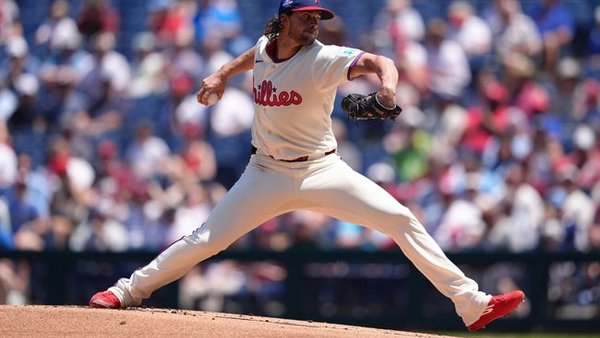
Aaron Nola’s 9.075 K/9 lines up against a Toronto offense carrying a -60 run differential and no reliable lineup depth — the Blue Jays simply do not manufacture runs, and the top of their order posts xwOBAs at or below .326 against right-handed pitching. The total is posted at 9.5 with the projected combined score barely clearing that threshold, and the Under is available at the better-priced side of a number the market has only marginally leaned away from.
Max Scherzer vs Aaron Nola: Toronto Blue Jays at Philadelphia Phillies Betting Preview
The surface read here is simple: Aaron Nola against a broken Max Scherzer, Citizens Bank Park, Phillies favored at -156. The matchup almost sells itself. But the Phillies ML exceeds the hard juice ceiling of -130, which makes it categorically unavailable regardless of how clean the pitching edge looks. That discipline forces the question: where is the legitimate money in this game?
The answer is the total. The market has this game posted at 9.5, with the Over priced at -115 and the Under at -105. The numbers project a combined score of 9.7 — barely clearing the line. That’s not a strong over signal. It’s a coin-flip with slightly worse juice on the over side, which is exactly the kind of marginal edge the Under exploits.
Nola’s ability to suppress Toronto’s anemic offense is the spine of this thesis. The Blue Jays carry a .678 team OPS and a -60 run differential on the season — they are one of the least productive offenses in context, and Nola’s strikeout rate gives him a real path to keeping their half of the scoreboard manageable. After yesterday’s 5-4 Blue Jays win that stayed under 9.5, the market may be inflating today’s number slightly — and we’re getting a favorable price to fade that inflation.
Game Info & Betting Lines
- Date/Time: Saturday, August 8, 2026 | 6:05 PM ET
- Venue: Citizens Bank Park | Park Factor: 1.02 (essentially neutral)
- TV: MLB.TV, NBC Sports Philadelphia, Sportsnet
- Probable Starters: Max Scherzer (TOR) vs Aaron Nola (PHI)
- Moneyline: Toronto Blue Jays +144 / Philadelphia Phillies -156
- Run Line: Philadelphia Phillies -1.5 (+128) / Toronto Blue Jays +1.5 (-154)
- Total: 9.5 (Over -115 / Under -105)
Why This Number Is Off
The market is doing reasonable work here. Scherzer’s 7.92 ERA and 9 home runs allowed in just 30.2 innings justify an elevated total — a starter this compromised against a lineup featuring Kyle Schwarber (33 HR), Bryce Harper (24 HR), and Luis Arraez (.326 AVG) creates genuine run-scoring upside for Philadelphia. The Over at -115 is the market’s slight lean, and it’s not irrational.
But the number being set at 9.5 is asking the combined offense to clear a meaningful threshold, and the data only marginally supports it. The projected combined score leaves less than a quarter-run of cushion above 9.5. That’s not a confident over — that’s a toss-up dressed up as a lean.
The flip side is that Nola has the strikeout profile to genuinely suppress Toronto’s lineup on any given night. His 9.075 K/9 across 120 innings is legitimate, and he’s facing a Toronto order built around Nathan Lukes, Alejandro Kirk, Myles Straw, and George Springer — hitters who sit at or below a .326 xwOBA against right-handed pitching. The Blue Jays don’t barrel the ball, don’t walk, and don’t manufacture runs in creative ways. If Nola is even slightly above his current ERA — which has been inflated by 28 home runs allowed — the Toronto half of the total looks capped.
The Under at -105 is the better-priced side of a close number. That’s where the edge lives.
What Separates the Pitching
The pitching gap in this game is real, but it runs in a complicated direction for the total. Nola is the clearly superior arm by ERA, WAR, and trajectory — but he’s been hit harder than his reputation suggests this season. His 5.55 ERA and 28 home runs allowed in 120 innings are legitimate concerns, not just bad luck. His knuckle curve is his best weapon, generating a 39.5% whiff rate and holding opponents to a .238 xwOBA — that pitch alone can change at-bats. But his four-seam fastball sits at 92.2 mph with only an 11.1% whiff rate, and hitters are attacking it (.395 xwOBA against). Against a Toronto lineup with Kazuma Okamoto posting a .403 xwOBA and a 6.2% barrel rate, those fastballs need to be spotted precisely.
Scherzer, meanwhile, is in genuine decline. His four-seam fastball now sits at 93.3 mph — still serviceable velocity — but hitters are posting a .393 xwOBA against it, and his curveball, which he throws 11.9% of the time, is generating a .538 xwOBA against. That’s not a pitch creating outs. His 6.75 K/9 tells the deeper story: he’s relying on contact suppression he no longer has. Bryce Harper has a .483 xwOBA against right-handed pitching and has historically punished Scherzer — 4 home runs in 24 plate appearances in career matchups. That’s a matchup the market has priced into the total correctly.
The gap between the two starters matters for the total in a specific way: Nola creates soft-contact, strikeout-heavy innings against Toronto’s weak lineup; Scherzer creates a different kind of chaos — more contact, more baserunners, more multi-run inning risk. The innings they generate are different in shape, but both can keep the total under 9.5 if Nola is on and Scherzer avoids the big explosion inning. That’s the bet.
Pushback
The real risk here is Scherzer imploding in one inning. His 9 home runs in 30.2 IP aren’t spread evenly — they cluster. One bad sequence against Harper, Schwarber, and Arraez could put 3-4 runs on the board before Toronto even bats. The Phillies lineup carries enough pop in the middle of the order that a Scherzer disaster inning isn’t a tail risk — it’s a reasonable base case.
What brings me back is Nola’s ability to single-handedly compress the Toronto half of the scoreboard. Lukes (.299 xwOBA), Kirk (.300 xwOBA), and Straw (.310 xwOBA) at the top of the order are soft-contact hitters who Nola’s knuckle curve was designed to eat alive. Even if Scherzer surrenders 5 runs, a Toronto offense with a -60 run differential and no lineup depth behind Okamoto and Giménez is not reliably getting to 5 on their own. The path to 9.5+ requires both starters to struggle simultaneously — that’s not where the probability mass lives.
Run Environment & Game Shape
Citizens Bank Park’s park factor of 1.02 is barely above neutral — this is not Coors Field. The environment doesn’t meaningfully amplify either side of the ledger, which means the total lives and dies on the pitching, not the venue. A 1.02 park factor is close enough to neutral that it adds essentially no premium to the over projection.
Bullpen depth is also worth factoring in here. Toronto’s relief corps is gutted by injuries — Joe Mantiply on the 60-Day IL, a rotation that’s already lost Jose Berrios, Patrick Corbin, and Trey Yesavage. The bulk of the Toronto bullpen workload falls on arms without established track records, which creates a ceiling-suppression dynamic late in games: they may allow runs, but they’re also capable of grinding through contact without getting torched. The Phillies bullpen has its own IL concerns with Tanner Banks and Brad Keller both out. Neither team has a dominant late-game shutdown arm beyond Philadelphia’s closer, which reinforces the expectation of a contained, low-octane back half of the game rather than a fireworks finish.
The shape of this game points toward a tight, controlled contest — not a blowout, not a shootout. Seven to nine combined runs is the reasonable range. The 9.5 total is asking for the upper end of that range on a consistent basis, and the numbers don’t support it at a price that demands action.
Pick: Under 9.5 at -105, 2 units, moderate confidence. This is a thin-edge play built on pitching matchup structure and lineup quality suppression — not a lock, but the better side of a close number at a fair price.