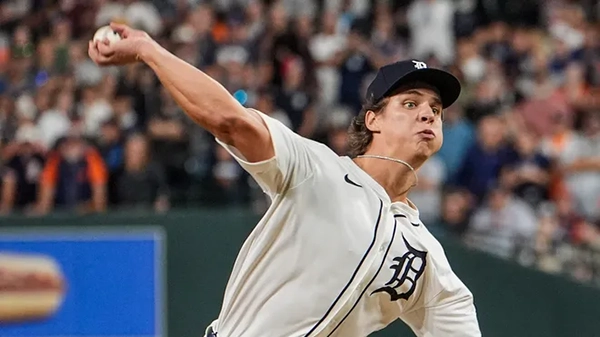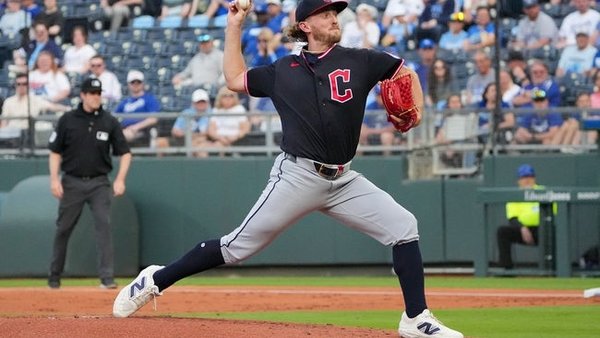
Detroit owns a +87 run differential against Cleveland’s -27 — a 114-run gap between two teams separated by one game in the standings and just eight cents on the moneyline. The market is pricing this as a coin-flip; the season-long output across offense, pitching, and run prevention says it is not.
Tanner Bibee vs Drew Anderson: Cleveland Guardians at Detroit Tigers Betting Preview
On paper, this looks like a coin-flip. Two AL Central clubs with nearly matching records, a neutral park, and a modest -120 moneyline price on Detroit. The market is doing its job, pricing this as a genuinely contested game. But the lines don’t always capture what’s happening beneath the surface, and in this case, the run differential is screaming something the standings are muffling.
Detroit sits at +87 run differential on the season. Cleveland checks in at -27. That’s a 114-run swing between two teams separated by one game in the standings. Run differential is one of the most reliable proxies for true team quality — it filters out the noise of one-run variance and reflects sustained performance across a full season. Cleveland’s -27 figure is not the profile of a team that should be trading at plus-money against a club outperforming them in virtually every run-creation and run-prevention metric.
The recent form reinforces this divide. Detroit is 7-3 over their last 10 games, coming off a successful West Coast trip. Cleveland has gone 3-7 in their last 10, losing five of their last six. The price at -120 is comfortably within range, and multiple signals are pointing the same direction.
Game Info & Betting Lines
- Date/Time: Tuesday, August 11, 2026 | 6:40 PM ET
- Venue: Comerica Park | Park Factor: 0.99 (essentially neutral)
- TV: MLB.TV, CLEGuardians.TV, Tigers.TV
- Probable Starters: Tanner Bibee (CLE) vs. Drew Anderson (DET)
- Moneyline: Cleveland Guardians +112 / Detroit Tigers -120
- Run Line: Detroit Tigers -1.5 (+159) / Cleveland Guardians +1.5 (-194)
- Total: 8.5 (Over -112 / Under -108)
Why This Number Is Close — But Not Close Enough
The market’s case for keeping this line tight is legitimate. Bibee’s 4-11 record looks terrible, but his 3.85 ERA and 1.13 WHIP tell a different story — this is a pitcher who has been let down by his offense, not one who has been getting shelled. If you’re building the Cleveland side, Bibee’s underlying performance is your foundation, and you’d be right to lean on it.
On the Detroit side, Drew Anderson carries real uncertainty. He has just 67.1 innings pitched this season — a limited track record that makes projecting him into a full start against a major-league lineup an exercise in partial information. The market knows this. The -120 price reflects a real edge, not a lopsided mismatch.
But here’s where the market gets slightly wrong: it’s treating these clubs as near-equals when the underlying output says otherwise. Detroit’s team OPS of .729 versus Cleveland’s .682 is a meaningful gap. The Tigers have hit 144 home runs to Cleveland’s 114, and scored 539 runs against the Guardians’ 473. Detroit’s pitching ERA sits at 3.49 with a 1.200 WHIP; Cleveland’s is 3.84 with a 1.280 WHIP. The edge isn’t enormous in any single category — but it runs in one direction across all of them, and -120 doesn’t adequately compensate for that consistency.
What Separates the Pitching
The gap between these two starters is real, but it requires context to understand correctly. Bibee is the more proven arm — 138 innings pitched against Anderson’s 67.1 — and his arsenal is built around deception rather than power. His cutter leads at 25.6% usage with a 31.6% whiff rate, complemented by a changeup posting a .255 xwOBA against and a 30.9% whiff rate. His four-seam sits at 94.0 mph and generates a solid .315 xwOBA. He’s a pitch-mixer who works counts and limits walks — 38 on the season.
The concern with Bibee isn’t his stuff; it’s the home run exposure. He has allowed 23 HR in 138 innings, and Detroit’s lineup is built to punish that. Dillon Dingler carries an xwOBA of .446 and a 5.7% barrel rate, and in 18 plate appearances against Bibee, has seen the matchup enough to be familiar. Riley Greene’s xwOBA of .457 with a 6.7% barrel rate is even more alarming — Greene hits right-handed pitching at a .491 xwOBA, and Bibee is a righty. These aren’t soft contact threats; they’re hitters who square the ball up.
Anderson comes from the other side of the equation — less proven, more swing-and-miss. His 10.43 K/9 against Bibee’s 7.17 is a meaningful separation, and his arsenal delivers it differently. Anderson’s four-seam sits at 95.7 mph and earns a .297 xwOBA against. His changeup is the weapon — 30.6% usage, 34.8% whiff rate, .255 xwOBA against. His curveball posts a 33.0% whiff rate and a remarkable .226 xwOBA against, making it a genuine put-away pitch. Cleveland’s lineup, batting .232 with 990 strikeouts on the season, is exactly the profile Anderson’s arsenal is designed to exploit. Nathaniel Lowe (.435 xwOBA, .824 OPS) is the legitimate threat in that order — but the rest of the Guardians’ lineup gives Anderson places to attack.
The Pushback
The strongest case against this play centers on Anderson himself. Sixty-seven innings is a thin sample, and a 4.01 ERA with a 1.29 WHIP isn’t inspiring. There’s real variance baked into any start he makes. Detroit’s bullpen is also banged up — Burch Smith, Brant Hurter, and Will Vest are all on the 60-day IL, which limits A.J. Hinch’s late-inning options if Anderson exits early.
Cleveland’s walk rate (433 BB on the season) is also worth respecting. If Anderson gets wild early — which is a genuine risk given his 1.29 WHIP — the Guardians have the lineup discipline to make him pay. José Ramírez (.355 xwOBA) and Chase DeLauter (.361 xwOBA) are both capable of working counts and capitalizing on free passes.
These are real concerns. But the pushback doesn’t overturn the primary case — it just keeps it from being a strong-lean situation. At -120, I don’t need Anderson to be dominant. I need him to be functional for five or six innings while Detroit’s lineup does its work against a pitcher giving up home runs at a rate of 1.50 per nine.
Run Environment & Game Shape
The total is set at 8.5, and my projected total of 8.9 lands just over — but not by enough to make a strong case for the over as a standalone play. The park factor at Comerica is essentially neutral (0.99), so park effects aren’t pushing this in either direction. The offensive advantage clearly favors Detroit: their .729 OPS lineup against a Bibee who has surrendered 23 home runs is a better setup for run production than Cleveland’s .682 OPS group facing Anderson’s swing-and-miss arsenal.
On shape, this game sets up as a medium-scoring affair where Detroit controls the tone. The Guardians’ recent run outputs have been inconsistent — an 8-run outburst to open last week’s Chicago series, followed by back-to-back 3-run efforts — which captures the broader problem with this Cleveland offense: it runs hot and cold, and “cold” against Anderson’s curveball and changeup is a real possibility tonight.
The run line at +159 is interesting in theory, but Bibee’s 3.85 ERA makes covering -1.5 too uncertain to advocate. Cleveland’s walk discipline keeps them dangerous in multi-run deficit situations. Stay away from the spread; the moneyline is the cleaner expression of the edge here.
The Pick
Everything in this game points the same direction. Detroit holds a 114-run differential advantage over Cleveland despite near-identical records — that’s the core of the angle, and it hasn’t gone away. The Tigers come in 7-3 over their last 10 games off a West Coast trip where they went 7-2 and outscored opponents comfortably. Cleveland enters having dropped five of six, with an offense that generates weak contact and ranks near the bottom of the league in OPS.
Anderson’s uncertainty and Detroit’s thin bullpen depth are real risks, and they’re exactly why this is moderate confidence rather than a strong lean. But at -120 — a price that implies roughly 55% probability — the numbers say Detroit is meaningfully better than that. The run differential edge, the lineup quality gap, and the matchup advantage against Bibee’s home run tendencies all clear that bar.
Bet: Detroit Tigers moneyline (-120) — 2 units — Moderate confidence