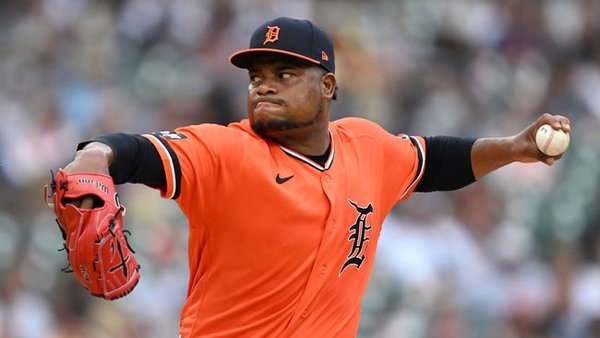
Foster Griffin’s 3.31 ERA and elite 2.16 BB/9 command rate are the cleanest data points on this slate — and neither is reflected in a total set at 8.0 with even juice on both sides. Framber Valdez’s 1.37 WHIP keeps traffic moving, but a .682 team OPS on the Cleveland side puts a real ceiling on the combined run environment, and Comerica’s neutral 0.99 park factor removes the standard over argument entirely.
Foster Griffin vs. Framber Valdez: Cleveland Guardians at Detroit Tigers Betting Preview
Detroit took the first game of this series last night, 6-4, with Kevin McGonigle driving in three and the Tigers bullpen holding the line. But last night’s game was shaped by an opener — Drew Anderson — and a collection of relief arms. Tonight is a different structure entirely. Foster Griffin takes the ball for Cleveland, and he is the cleanest signal in this game. His 12-4 record and 3.31 ERA over 133.1 innings is not a mirage. He’s limiting runners, limiting walks (32 BB in 133.1 IP, 2.16 BB/9), and generating soft contact at a consistent rate all season. On the other side, Framber Valdez carries a 4.17 ERA and a 1.37 WHIP that reflects a genuine tendency to put traffic on the bases. The pitching matchup leans Cleveland’s way, but the total — not the moneyline — is where that edge is cleanest. A neutral park, two above-average bullpens, and one of the weakest offenses in the AL all point toward a game that finishes under eight runs combined.
Game Info & Betting Lines
- Date/Time: Wednesday, August 12, 2026 | 6:40 PM ET
- Venue: Comerica Park | Park Factor: 0.99 (neutral-to-pitcher-friendly, no offensive amplification)
- Probable Starters: Foster Griffin (CLE, 12-4, 3.31 ERA) vs. Framber Valdez (DET, 7-7, 4.17 ERA)
- Moneyline: Cleveland Guardians +116 / Detroit Tigers -124
- Run Line: Detroit Tigers -1.5 (+162) / Cleveland Guardians +1.5 (-198)
- Total: 8.0 (Over -110 / Under -110)
Why This Number Is Close — But Leaning the Wrong Way
The market has priced this as a coin flip on the total, and the case for the over is not imaginary. Detroit has gone 8-2 over their last ten games and carries a +89 run differential on the season — this is a hot offense, not a dormant one. Dingler has 26 home runs. Riley Greene is posting a .457 xwOBA with a 6.7% barrel rate. Spencer Torkelson has 20 home runs. The Tigers are capable of a four- or five-run inning in any game, and last night they showed it.
But here’s the problem: the total doesn’t need to price in a Detroit blowout. It needs to price in the combined run output of both teams against quality starting pitching. Griffin, who has been one of the more effective starters in the AL this season, is facing a Cleveland lineup that checks in at a .682 team OPS — among the weakest in the league. That side of the ledger leans heavily under. Valdez has been leaky, but he’s allowing only 12 home runs in 127.1 innings — a figure that limits big-inning damage against a Cleveland lineup with only 116 HR on the season. The numbers project Detroit 4.5, Cleveland 4.3, for a combined 8.8. That’s close enough to the posted 8.0 that the under is a lean, not a hammer — but a lean in a game with even juice is a legitimate play.
What Separates the Pitching
The gap between these two starters is real, and it runs almost entirely in Cleveland’s direction. Griffin’s arsenal is built around deception and sequencing. His cutter — used 31.7% of the time at 88.3 mph — generates a 17.3% whiff rate and holds hitters to a .317 xwOBA. More damaging is his split-finger, deployed 6.3% of the time, which posts a .215 xwOBA against and a 32.0% whiff rate — a true swing-and-miss weapon late in counts. His sweeper (27.5% whiff, .290 xwOBA) rounds out a three-pitch mix that keeps hitters off-balance. Most critically: Griffin walks almost nobody. That 2.16 BB/9 is elite-tier command, and it means he’s not handing over free baserunners that snowball into crooked numbers.
Valdez is a different shape. He’s built around his sinker at 45% usage (93.9 mph) — a pitch that generates ground balls but holds a .372 xwOBA against, meaning hitters are making contact when they connect. His curveball (29.0% usage, 30.9% whiff, .261 xwOBA) is a legitimate out pitch. But his 1.37 WHIP reflects a real problem: 45 walks in 127.1 innings (3.18 BB/9) means Valdez routinely creates two-on, one-out situations that invite crooked numbers. Against Detroit’s lineup — Dingler (.442 xwOBA), Greene (.457 xwOBA), Torkelson (.412 xwOBA) — those traffic jams are dangerous. The concern is that Valdez’s baserunner tendency could hand the Tigers a five-run game before Griffin even finishes his night.
That said, Dingler carries a .442 xwOBA overall, but hits .456 xwOBA against right-handed pitching — the relevant split against Griffin — making him the one Tiger who presents a genuine mismatch.
The Pushback
Detroit’s bullpen situation is a legitimate red flag for the under. Verlander, Flaherty, Burch Smith, Hurter, and Vest are all on the IL. That is a decimated relief corps, and if Valdez hits a wall in the fifth or sixth inning — which his 1.37 WHIP suggests happens — the Tigers could be turning to depth arms to protect a one-run lead. Depth arms against a hot offense blowing past the posted total is a real scenario.
The flip side of that is Cleveland’s pitching. Their team ERA is 3.85, their WHIP is 1.270, and they’ve been able to patch together wins despite being 2-8 in their last ten games. The bullpen picture on both sides is messy enough that a late-game blowup is plausible. That’s the honest case for the over, and I’m not dismissing it.
Run Environment & Game Shape
Comerica Park checks in at a 0.99 park factor — essentially neutral, with no meaningful run amplification in either direction. That baseline removes one of the standard over arguments. Griffin takes the mound for Cleveland facing a Detroit lineup that has the power to do damage but also has enough strikeout exposure — Outman at 37.9% K rate, Torkelson at 29.2% — that Griffin’s sweeper and split-finger can manufacture zeros in the middle of the order. On the other side of the ledger, Cleveland’s .682 OPS is the number that keeps suppressing the ceiling on their half of the run total. Valdez will get runners on — he always does — but his 12 HR allowed in 127.1 innings suggests he can strand enough traffic to keep Cleveland’s run output manageable.
Angles Considered & Rejected
Moneyline (Detroit -124): The Tigers are the right side here in terms of win probability, but -124 for a team facing a legitimate ace-caliber arm is paying too much juice for a result that isn’t close to certain. Pass.
Run Line (Cleveland +1.5, -198): The market is implying a tight game. Laying -198 on the road underdog to stay within a run against a team that just scored six is not a structure I want. The juice kills the value entirely.
Total Over: The raw projection of 8.8 sits close enough to 8.0 that it does not provide a compelling reason to pay juice on the over. Griffin’s command — 2.16 BB/9, .317 cutter xwOBA, .215 split-finger xwOBA — puts a real ceiling on what the Detroit lineup can do against Cleveland’s half of the run environment. With even juice available on the under, there’s no reason to chase the over when the projection is within a run of the line.
The Pick
The combined projection of 8.8 sits close enough to the posted 8.0 that this is not a case where the numbers demand a strong lean in either direction on volume. But the under is still the play. Griffin’s elite command profile suppresses the ceiling on Cleveland’s half of the ledger, Comerica Park adds nothing to the offense, and Cleveland’s .682 team OPS is genuinely one of the weakest run-producing units in the AL. The 8.8 projection is within a run of the line — close enough that even juice makes the under a positive-expectation lean when you factor in Griffin’s ability to limit free baserunners. The over requires Valdez to have a short night and Detroit’s depth bullpen to give up a crooked number, which is possible but not probable in a game where the better arm is working against the weaker offense.
Bet: Under 8.0 — 2 units, moderate confidence.