T-Mobile Park’s 0.92 run factor is one of the most suppressive environments in baseball, and tonight it pairs with two genuine strikeout arms in Luzardo and Woo — yet the total sits at 7.0 with the under priced at only -118. The structure of this game points in one direction; the number hasn’t moved far enough to reflect it.
Jesus Luzardo vs Bryan Woo: Philadelphia Phillies at Seattle Mariners Betting Preview
Seattle just battered the Phillies in back-to-back games — a 9-2 demolition on Monday followed by a 4-1 follow-up on Tuesday — and now the Mariners step into Wednesday’s finale riding Cal Raleigh’s four-consecutive-at-bat home run tear and a fresh wave of momentum. The market knows all of this. That context is baked into the line. What the pregame narrative can’t fully price is the dramatic rotation shift happening tonight: Aaron Nola and Zack Wheeler, the two starters who just got shelled, are out. Jesus Luzardo is in.
The core tension here isn’t about who wins — the numbers project a near-coin-flip with Philadelphia holding a thin 54.9% win probability at -124 on the moneyline. The tension is about how many runs get scored in an environment structurally hostile to offense. T-Mobile Park’s 0.92 run factor is one of the most suppressive in baseball, both lineups rank below league average offensively, and the two pitchers taking the mound tonight have earned their reputations the hard way.
This game shapes as a pitcher’s duel priced at a total of 7.0. The under at -118 is where the value lives — not a hammer play, but the cleanest expression of everything this matchup is telling us.
Game Info & Betting Lines
- Date/Time: Wednesday, August 26, 2026 | 4:10 PM ET
- Venue: T-Mobile Park (Domed | Park Factor: 0.92 — pitcher-friendly)
- TV: MLB.TV, Mariners.TV, NBC Sports Philadelphia
- Probable Starters: Jesus Luzardo (PHI) vs Bryan Woo (SEA)
- Moneyline: Philadelphia Phillies -124 / Seattle Mariners +116
- Run Line: Philadelphia Phillies -1.5 (+135) / Seattle Mariners +1.5 (-163)
- Total: 7.0 (Over -102 / Under -118)
Why This Number Is Close
A total of 7.0 is already a respectably low number, and the market has tilted it slightly toward the under at -118 against an over at -102. That 16-cent gap signals consensus — oddsmakers aren’t neutral on this one. The legitimate case for the over rests on three pillars: Cal Raleigh is scorching hot (four home runs in four consecutive at-bats against this Phillies pitching staff), Philadelphia’s bullpen is compromised with Banks, Keller, and Kilian all on the IL, and both teams have shown they can explode on a given night, as Seattle’s 19-run Cubs game and Philadelphia’s recent nine-game win streak demonstrated.
But here’s the problem with chasing the over at this number: those Phillies beatdowns came against Nola and Wheeler, not Luzardo. The bullpen concern is real but partially offset by Luzardo’s capacity to eat innings — 156.0 IP this season proves he doesn’t hand the game to a depleted relief corps early. And Raleigh, for all his recent fireworks, carries a 31.0% strikeout rate against left-handed pitching — a strikeout profile that Luzardo’s sweeper was built to exploit.
Where the market is slightly off isn’t on direction — it’s on magnitude. The component projections come out to 4.0 Phillies runs and 3.9 Mariners runs, or just under 8.0 combined. That pre-park-adjustment figure theoretically points toward the over. But pitcher quality and park environment compress actual run totals below those raw estimates, and a 7.0 line with starters of this caliber deserves the under lean.
What Separates the Pitching
These two starters are excellent in completely different ways, and understanding the gap requires separating what each one actually does on the mound.
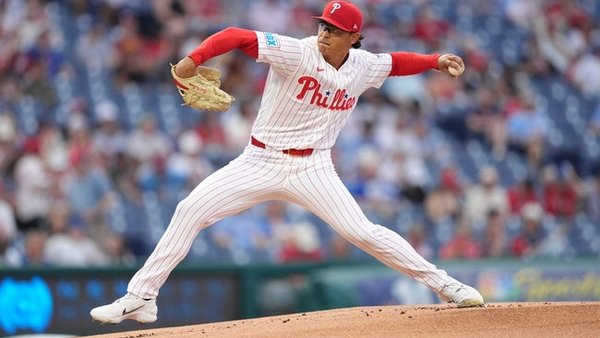
Jesus Luzardo is a swing-and-miss machine. His sweeper is the best pitch in this game: 37.5% usage, 86.0 mph, 45.2% whiff rate, .181 xwOBA against. That’s elite. When a pitcher posts a .181 xwOBA on a pitch he throws more than a third of the time, he can neutralize entire lineup segments in a single inning. His 4-seam fastball sits at 96.9 mph with a 13.4% whiff rate and .304 xwOBA, and his changeup at 86.0 mph generates a 36.7% whiff rate. The strikeout volume — 11.19 K/9 over 156 innings — isn’t a product of weak competition. It’s the sweeper-fastball combination creating genuine two-pitch leverage at every count.
Against this Seattle lineup, the matchup data is encouraging. Arozarena is 2-for-14 in limited BvP history, Julio Rodríguez carries a 25.5% whiff rate with a K rate of 22.0%, and Cal Raleigh — the hottest bat in the building right now — strikes out at a 31.0% clip against left-handed pitching and owns a 29.7% whiff rate. That strikeout vulnerability is exactly what Luzardo’s sweeper targets. Raleigh in three prior plate appearances against Luzardo: 0-for-3 with two strikeouts. The BvP sample is small, but it rhymes perfectly with the underlying K-rate data.
Bryan Woo operates with a fundamentally different profile. His 1.08 WHIP on only 29 walks in 138.1 innings is remarkable command discipline — the kind that prevents the multi-baserunner sequences that inflate run totals. His four-seam at 95.9 mph generates a 22.5% whiff rate with a .305 xwOBA, and his sweeper at 84.4 mph posts a .224 xwOBA. Woo also carries a slider at 87.0 mph with a 32.6% whiff rate — a legitimate secondary swing-and-miss weapon that gives him two breaking balls capable of generating weak contact and chases. The caveat is his 4.10 ERA — Woo has had blowup outings, and when Schwarber’s xwOBA against right-handers sits at .514 with an 8.1% barrel rate, one mistake in the zone can change the complexion of the game fast.
The gap between these arms is real but not cavernous. Luzardo’s stuff grades out higher at the top of his arsenal, but Woo’s command profile and two-breaking-ball mix give him a genuine path to a quality start against a Philadelphia lineup that posts a team OPS of .715 and strikes out 1,114 times on the season.
The Pushback
The honest version of the over case starts with Julio Rodríguez. His .471 xwOBA against left-handed pitching is a genuine mismatch — that’s a premium split for a middle-of-the-order hitter, and Luzardo will have to navigate him carefully in multiple at-bats. Rodríguez is 3-for-8 with a home run in eight prior plate appearances against Luzardo, which backs up the xwOBA split with actual production.
Then there’s the bullpen situation. Philadelphia is missing Banks, Keller, and Kilian from its relief corps. If Luzardo runs into trouble in the fifth or sixth inning, the falloff to the next arm is steeper than it would normally be. Seattle’s offense isn’t built to dominate — the Mariners rank below average in OPS and slugging — but a compromised bullpen in the late innings gives even a .687 OPS lineup legitimate run-scoring windows.
And Raleigh just hit four home runs in four straight at-bats against this Phillies staff. Momentum doesn’t show up in Statcast, but lineup confidence does, and this Mariners offense is running hot heading into tonight.
I hear all of that. What I keep coming back to is the structural picture: a domed pitcher-friendly park, a Luzardo who has the volume to protect a depleted bullpen, and a Seattle offense that — hot streak aside — ranks in the bottom third of baseball by OPS. Momentum is real, but it doesn’t override the run environment when the starter is this good.
Run Environment & Game Shape
T-Mobile Park’s 0.92 park factor is one of the most run-suppressive environments in the American League. The dome removes the variable of wind that can turn routine fly balls into extra-base hits in open-air stadiums — ball flight here is consistent, predictable, and slightly flattened relative to neutral conditions. Pitchers who generate soft contact and strikeouts benefit disproportionately in this setting, which means both Luzardo and Woo are pitching in an environment that amplifies their strengths rather than masking their vulnerabilities.
Factor in two below-average offenses — Seattle at .687 OPS, Philadelphia at .715 — and the ingredients for a sub-7.0 final are all present. Games like this one, with elite-to-above-average starters, suppressive home parks, and contact-limited lineups, consistently finish under their posted totals at a higher rate than the market accounts for. The 7.0 number is already reflecting some of this, but at -118, there’s still enough margin to make the under a reasonable 2-unit lean rather than a line you’re forced to buy through.
The shape of this game is a low-scoring affair decided late, with pitching doing the heavy lifting on both sides. That’s the bet.
Bet: Total Under 7.0 | 2 Units | Moderate Confidence