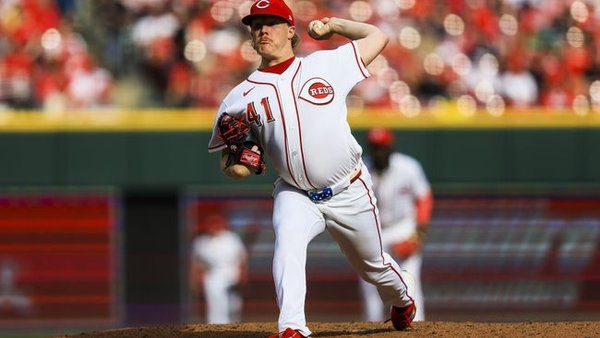
Wrigley Field’s 1.02 park factor makes it a neutral canvas, but the pitching profiles here are anything but even — Gausman’s 39.0% whiff split-finger lands against a Reds lineup posting a .701 OPS and 1,282 strikeouts on the season. The total at 8.5 carries the weight of Friday’s bullpen disaster, not Saturday’s starter-driven construction.
Andrew Abbott vs. Kevin Gausman: Cincinnati Reds at Chicago Cubs Betting Preview
Friday night’s 10-8 fireworks at Wrigley were driven almost entirely by bullpen implosion — the Cubs’ relievers coughed up nine unanswered runs after a 3-0 lead, Trent Thornton got buried without recording an out in the sixth, and the Reds completed one of their increasingly signature late-inning reversals. Today is a different construction. Two starters go, the park factor is effectively neutral at 1.02, and the question isn’t who wins — the Cubs are the better team — but whether the number attached to the total actually reflects how these pitchers are likely to operate.
The Cubs’ moneyline at -185 is well past the juice ceiling where I’m comfortable committing. A -185 price requires the Cubs to win at roughly a 64.9% implied rate, and while the numbers put their win probability at 75.8%, the price eats the edge before it ever becomes real value. So I’m redirecting. The total sits at 8.5, with the over priced at -120 and the under at +100. The projection calls for a combined 9.5 runs — a full run over the posted number — but the pitching profiles here, particularly Gausman’s elite command against one of the most punchout-prone offenses in the National League, make the under the more defensible lean.
This is not a high-conviction play. It’s the cleanest market available when the obvious bet is priced out of range.
Game Info & Betting Lines
- Date/Time: Saturday, August 29, 2026 | 2:20 PM ET
- Venue: Wrigley Field | Park Factor: 1.02 (neutral)
- TV: MLB.TV, Marquee Sports Net, Reds.TV
- Probable Starters: Andrew Abbott (CIN, 6-9, 4.15 ERA) vs. Kevin Gausman (CHC, 7-11, 4.37 ERA)
- Moneyline: Cincinnati Reds +172 / Chicago Cubs -185
- Run Line: Chicago Cubs -1.5 (+110) / Cincinnati Reds +1.5 (-132)
- Total: 8.5 (Over -120 / Under +100)
Why This Number Is Close
The market set 8.5 for a reason. Abbott’s 1.40 WHIP and 68 walks in 145.1 innings represent genuine run-creation risk — the Cubs carry a .338 OBP and a lineup that includes Pete Crow-Armstrong (33 HRs, .922 OPS) and Seiya Suzuki (.850 OPS). A left-handed starter with command issues facing a patient Chicago lineup is a real over path. The market priced the over at -120, which tells you sharp money hasn’t decisively moved this to the under — there’s genuine two-sided pricing here.
The case for the other side rests on Gausman and Cincinnati’s offensive profile. The Reds carry a team .228 batting average, a .701 OPS, and 1,282 strikeouts on the season — one of the most punchout-prone lineups in the league. Gausman’s 8.92 K/9 and 2.46 BB/9 (only 41 walks in 150.1 innings) is a suppression profile built to exploit exactly this kind of offense. His four-seam fastball generates a 12.3% whiff rate and holds hitters to a .342 xwOBA; his split-finger is the separator, sitting at a 39.0% whiff rate and a .229 xwOBA-against — a genuine chase pitch against a lineup that already whiffs at historic rates.
Where I think the market is slightly wrong: the 8.5 number leans slightly toward the over by pricing in yesterday’s offensive environment. That game was a bullpen disaster, not a starter-driven run event. Saturday resets the context.
What Separates the Pitching
The gap between these two arms isn’t enormous on the surface — both sit around a 4.15-4.37 ERA — but the underlying profiles diverge sharply in ways that matter for this total.
Gausman is the more projectable arm. His four-seam sits at 93.9 mph and he deploys it on 51.3% of pitches, keeping hitters honest before burying them with his split-finger (38.1% usage, 39.0% whiff rate, .229 xwOBA-against). That’s an elite put-away sequence against a Reds lineup that ranks near the bottom in contact quality. Tyler Stephenson carries a 28.2% strikeout rate and posted just a .200 average in five plate appearances against Gausman with four strikeouts. Eugenio Suárez has seen Gausman 23 times and hit him well (.318, 2 HR), but Suárez carries a 35.1% strikeout rate overall — the split-finger gives Gausman a reset option. The control is what makes Gausman’s ERA slightly misleading: at 2.46 BB/9, he doesn’t manufacture trouble the way Abbott does.
Abbott profiles as an average-to-serviceable starter whose arsenal creates whiffs but also traffic. His sweeper generates a 26.2% whiff rate and a .228 xwOBA-against — genuinely quality — and his changeup sits at 35.5% whiff rate. But his four-seam (45.2% usage, 92.5 mph) gets hit hard when left over the plate, posting a .399 xwOBA-against. Crow-Armstrong is 0-for-14 in 14 plate appearances against Abbott, but that sample is small. Ian Happ carries a .415 xwOBA against right-handed pitching and has seen Abbott 25 times with just one extra-base hit — Abbott has kept him in check, but Michael Busch is 5-for-9 in nine plate appearances against Abbott, a small but notable contact pattern.
The pitching gap favors the under, but it’s Gausman’s elite command profile against the Reds’ weak offense that tips the scale — Abbott’s control issues keep the Cubs in scoring position, but not necessarily in big innings.
The Pushback
Here’s the problem: the Cubs’ bullpen is significantly compromised. Porter Hodge, Ben Brown, Riley Martin, Hunter Harvey, Phil Maton, and Gavin Hollowell are all on the IL — six relievers unavailable, with varying timelines. Friday’s game illustrated exactly what that looks like when the starter exits early and the backend is running thin. Trent Thornton, who had been one of the Cubs’ most reliable arms out of the pen this season, got buried in the sixth without recording an out.
I’m not pretending the bullpen risk isn’t real. If Gausman doesn’t go deep — say, five or six innings — and the Cubs have to piece it together with a depleted pen against a Reds lineup that pulled off a seven-run ninth inning on Wednesday against San Francisco, the over path becomes uncomfortably credible. The Reds’ comeback earlier this week — the 10-9 rally against the Giants on Wednesday was equally improbable, and it came against a team that had a six-run lead entering the ninth — is the exact blueprint for how this total gets busted on the late side.
The run line is also worth a mention. Cubs -1.5 at +110 is theoretically attractive if you like the Cubs, but I can’t trust the bullpen depth behind Gausman enough to lay the run line. That’s another market I’m passing on.
Run Environment & Game Shape
The park factor at Wrigley sits at 1.02 — essentially neutral, offering no meaningful amplification of either offense. The Reds are 64-71 with a -98 run differential, and their offense grades as one of the weaker units in the NL; the Cubs sit at 76-59 with a +117 run differential and a meaningfully better lineup top to bottom. The gap in offensive quality is real, but the Cubs’ offense at a .761 OPS isn’t a historically dominant run-scoring unit either. When you put Gausman’s 39.0% whiff split-finger against a Reds lineup posting a .701 OPS and 1,282 strikeouts on the year, the ceiling on Cincinnati’s run production is legitimately suppressed. Abbott will give the Cubs opportunities — his 1.40 WHIP and 68 walks ensure that — but his sweeper (.228 xwOBA-against) and changeup (35.5% whiff rate) give him the tools to limit damage in individual innings. The shape of this game looks like a 4-3 or 5-3 final more than an 8-7 shootout, assuming the starters hold up past the fifth. That’s the under path, and it’s the one I’m taking.
Bet: Under 8.5 | 2 units | Moderate confidence
The starters both carry enough strikeout upside to keep this game under control through the middle innings, the Reds’ offense is genuinely bad, and the park isn’t adding fuel. The bullpen risk is real and acknowledged — this isn’t a lock — but at +100, the under is the cleanest expression of what I think Saturday actually looks like.