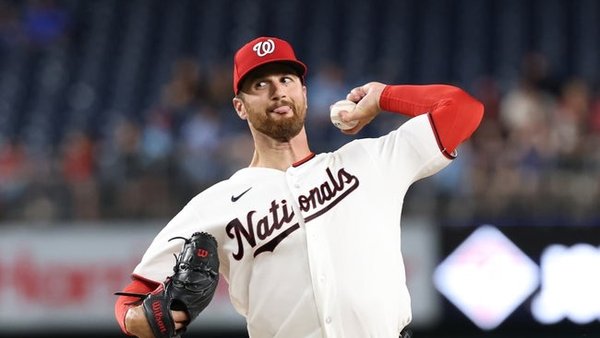
Foster Griffin’s 3.65 ERA and 1.18 WHIP against a White Sox lineup that leads the league in team strikeouts creates a one-sided pitching ledger the 8.5 total doesn’t fully reflect. Cleveland’s .688 team OPS — seventh-lowest in the dataset — means the over needs both offenses to show up, and one of them is structurally built not to.
Davis Martin vs. Foster Griffin: Chicago White Sox at Cleveland Guardians Betting Preview
Chicago’s 7-3 win last night was loud — six runs in the sixth inning, a 12-pitch plate appearance from Tristan Peters, Miguel Vargas going deep — but Tuesday night reshapes entirely around the starting pitching. Foster Griffin takes the mound for Cleveland, and that changes the calculus considerably compared to what Gavin Williams offered Monday.
The market has set this total at 8.5, and on the surface, it looks fair. The White Sox average 4.68 runs per game this season; the Guardians average 4.09. Add those up and you’re already near the number before park factor or pitching quality enters the equation. But the market is pricing in average — and tonight is not an average pitching matchup. Griffin’s 2026 profile belongs in a different tier than what most teams are running out against a divisional opponent with playoff stakes on the line.
The under at -112 is minimal juice. You’re not paying a premium for this position. That near-even price, combined with a genuine pitching gap and Cleveland’s structurally weak offense, creates a reasonable lean — not a slam dunk, but a clean number to work with.
Game Info & Betting Lines
- Date/Time: Tuesday, September 15, 2026 | 6:40 PM ET
- Venue: Progressive Field | Park Factor: 0.98 (slightly pitcher-friendly)
- Probable Starters: Davis Martin (CWS) vs. Foster Griffin (CLE)
- Moneyline: Chicago White Sox +108 / Cleveland Guardians -130
- Run Line: Cleveland Guardians -1.5 (+159) / Chicago White Sox +1.5 (-194)
- Total: 8.5 — Over -108 / Under -112
Why This Number Is Close
The case for the over is real, and I want to acknowledge it honestly. Chicago just hung seven runs on this same Cleveland pitching staff at this exact ballpark Monday night. The White Sox carry genuine power — Vargas and Murakami each have 31 home runs, and Randal Grichuk posted an .885 OPS with an xwOBA of .425. The over side points to that offensive ceiling and says: last night proved runs are available here.
The counter is that last night featured Gavin Williams on the mound, not Griffin. The market isn’t blind — it’s already balancing a strong White Sox offense against a superior Cleveland starter. The total moved to account for that. At 8.5, the market is essentially saying the pitching upgrade on Cleveland’s side offsets the momentum Chicago carries in.
Where I think the market is slightly wrong is on Cleveland’s offensive side of the ledger. The Guardians are not a team that generates runs organically. Their season OPS sits at .688 — seventh-lowest in this dataset — and their -11 run differential tells you they’ve been outscored despite their record. Angel Martínez is day-to-day with a side injury, potentially removing one of their more productive hitters (.728 OPS) from the lineup. Davis Martin is a real pitcher, but Cleveland’s lineup isn’t built to punish him, either. The over needs both offenses to contribute. One of them is structurally limited.
What Separates the Pitching
Griffin and Martin are not equivalent arms, and the gap between them is the backbone of the under thesis. Griffin finished 2026 at 15-5 with a 3.65 ERA, 1.18 WHIP, and 162.2 innings pitched — elite workload with command to match (43 walks in 162+ innings). His 8.08 K/9 is particularly relevant against Chicago’s lineup, which has posted 1,380 team strikeouts this season. His cutter sits at 32.3% usage, averaging 88.5 mph with a .333 xwOBA against — a high-usage pitch that generates solid contact suppression. His changeup, thrown 11.4% of the time at 82.4 mph, holds opposing hitters to just a .276 xwOBA with a 32.0% whiff rate. That’s a plus offering against swing-heavy hitters.
The matchup data shows why Griffin creates problems for Chicago’s middle of the order specifically. Murakami carries a 34.7% strikeout rate — the highest K% among Chicago’s key hitters — and his .476 xwOBA reflects genuine power, but against Griffin’s changeup and cutter combination, swing-and-miss is the most likely outcome. Vargas makes more contact (17.5% whiff rate) but has a small BvP sample of 3 PA with 0 hits against Griffin. Kyle Teel bats second with a 34.7% whiff rate — another high-K profile in the heart of an already strikeout-prone lineup.
Martin is a legitimate mid-rotation arm — a 4.05 ERA and 1.31 WHIP in 135.2 innings isn’t a liability. His curveball generates a 39.7% whiff rate and holds opponents to a .262 xwOBA, his best put-away offering. The concern is his 13 home runs allowed in those innings, which matters against Cleveland’s relatively light offensive profile. Steven Kwan is hitting .538 in 15 plate appearances against Martin with just one strikeout — the most relevant BvP signal in this dataset, and a legitimate worry for Martin early in counts. But Kwan (barrel rate 0.4%, hard-hit 8.2%) isn’t going to beat you with power. The gap between these two starters is real: Griffin’s WHIP is 0.13 lower, his ERA is 0.40 better, and his K rate is meaningfully higher against a lineup built to swing through pitches.
Park Factor and Run Environment
Progressive Field carries a 0.98 park factor for runs — a nudge toward pitchers, not a hammer. It won’t single-handedly suppress scoring, but in a game where the pitching already leans toward the under, that marginal run-suppression is a confirming signal rather than the driving argument. Don’t build your case around the park; build it around Griffin and Cleveland’s structural offensive limitations, and let the park factor do the small work it’s designed to do.
The Pushback
The numbers project 8.9 total runs — which technically sits over the 8.5 line, not under. That’s the honest tension in this play. The projection gap is just 0.4 runs, well within any reasonable margin of uncertainty, but it does mean the lean here is modest rather than commanding. I’m not ignoring that.
Chicago’s bullpen is also thinner than ideal. Leasure and Brazoban are both unavailable, which creates real attrition risk if Martin exits early or struggles. A short outing from Martin doesn’t just affect his run prevention — it accelerates the exposure to a depleted ‘pen. That’s a legitimate over lever.
Martin’s 13 home runs allowed in 135.2 innings is the other live wire. Cleveland doesn’t have a power-heavy lineup — 143 team home runs ranks toward the bottom of the league — but José Ramírez exists, and Nathaniel Lowe (xwOBA .413) can do damage. One swing can neutralize a half-inning of Griffin’s dominance on the other side.
None of that changes my lean. It just clarifies what this bet is: a moderate, disciplined play on a real pitching gap at minimal juice, not a high-conviction power move. If the line were 8.0 or the juice were -130, I’d pass. At 8.5 and -112, the math still works in favor of the under.
The Play
Progressive Field. Griffin vs. Martin. A Cleveland offense sitting at .688 OPS with multiple relievers on the IL for Chicago. The under at 8.5 (-112) is the right side of this game — not because it’s a lock, but because the pitching quality and offensive limitations point in one direction, and the price doesn’t penalize you for being right.
Bet: Total Under 8.5 (-112) — 2 units | Moderate confidence