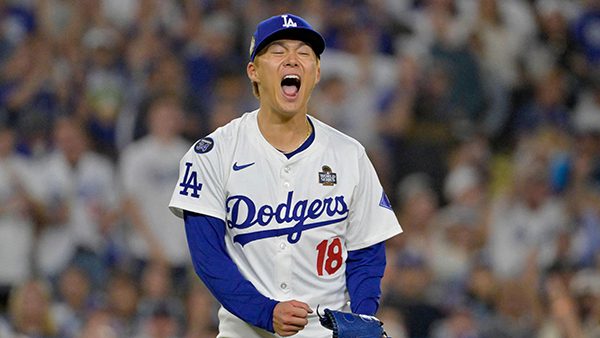
Yoshinobu Yamamoto’s 2.62 ERA and .217 xwOBA split-finger walk into a Cincinnati lineup carrying 1,434 strikeouts and a .229 batting average — yet the 8.5 total still leans on both offenses contributing meaningfully. With Shohei Ohtani sidelined and Rhett Lowder’s sinker getting punished at a .410 xwOBA, the run environment here is far less balanced than the posted number implies.
Rhett Lowder vs. Yoshinobu Yamamoto: Los Angeles Dodgers at Cincinnati Reds Betting Preview
The Dodgers took yesterday’s series opener 4-1, with Tarik Skubal spinning seven shutout innings — the bullpen allowed the lone Cincinnati run, a 457-foot De La Cruz moonshot off Evan Phillips in the ninth that was more spectacle than substance. Now the pitching matchup shifts dramatically, and what follows is a cleaner version of the same argument the market already rewarded once this series.
Yoshinobu Yamamoto is the anchor here. His 2.62 ERA and 0.88 WHIP over 172 innings represent one of the sharpest starter profiles in the National League, and he’s being asked to neutralize a Cincinnati lineup hitting .229 with a .703 OPS and 1,434 strikeouts on the season. That’s a structural mismatch the line at 8.5 only partially prices in.
The Dodgers moneyline at -246 is categorically off the table — that price exceeds any reasonable juice threshold for a single-game bet. What’s left is finding where the value lives. The under at -112 is the cleanest expression of Yamamoto’s dominance, and this article builds the case for why the Reds’ half of this total is likely to come in well short of what the market needs to push the number past 8.5.
Game Info & Betting Lines
- Date/Time: Tuesday, September 15, 2026 | 6:40 PM ET
- Venue: Great American Ball Park (Park Factor: 1.10 — hitter-friendly)
- TV: MLB.TV, SportsNet LA, Reds.TV
- Probable Starters: Yoshinobu Yamamoto (LAD) vs. Rhett Lowder (CIN)
- Moneyline: Los Angeles Dodgers -246 / Cincinnati Reds +199
- Run Line: Cincinnati Reds +1.5 (+118) / Los Angeles Dodgers -1.5 (-142)
- Total: 8.5 (Over -108 / Under -112)
Why This Number Is Close But Slightly Off
The 8.5 total isn’t irrational. Great American Ball Park carries a 1.10 park factor, which legitimately inflates expected run totals, and Rhett Lowder’s 5.81 ERA and 1.53 WHIP gives the Dodgers a genuine path to a big offensive output. The books are not asleep here — they’ve factored in the park and the starter gap. That’s why this isn’t set at 7.5.
But here’s where I think the market is slightly wrong: the 8.5 total requires both halves of the game to contribute meaningfully. With Yamamoto on the mound, the Reds’ half of the ledger is almost certainly going to land in the 2-3 run range. That forces the Dodgers to put up 6 or more to cash the over — and while Lowder is vulnerable, the Dodgers are also without Shohei Ohtani (15-Day IL, biceps), removing their most dangerous bat from a lineup that averages 4.97 runs per game at full strength.
The numbers project a combined total of 10.1 runs — nominally favoring the over. But that mean projection is doing a lot of work, and I think it’s leaning too heavily on Lowder’s season-long ERA without accounting for two important adjustments: Yamamoto’s current dominance suppresses the Reds’ contribution far below the model’s average-out assumption, and Cincinnati has allowed 47 runs over their last three games heading into this week, reflecting a roster in September freefall rather than a team projecting to score near its season norms. When one pitcher is generating a .217 xwOBA on his best pitch and the opposition lineup is striking out at one of baseball’s highest rates, the distribution skews toward a low-scoring game — and the under is the value side of that variance, not a coin flip.
What Separates the Pitching
The gap between these two starters is significant — and it’s the central reason the under has a viable path even in a hitter-friendly park.
Yamamoto’s arsenal is built to create weak contact and swing-and-miss in equal measure. His split-finger — used 26.7% of the time at 91.4 mph — generates a 32.6% whiff rate and holds hitters to just a .217 xwOBA, one of the more devastating put-away pitches in baseball. His four-seam fastball sits at 96.1 mph with a 23.3% whiff rate and a .329 xwOBA allowed. His slider, though used only 6.0% of the time, whiffs hitters at 30.7%. Against a Cincinnati lineup that strikes out at one of the highest rates in baseball, these aren’t abstract numbers — they translate directly to empty innings.
Tyler Stephenson in the four-hole has a 28.2% strikeout rate and carries a BvP line of 0-for-6 with five strikeouts against Yamamoto. Eugenio Suárez is equally vulnerable — he carries a 33.5% strikeout rate on the season and has managed just 8 plate appearances against Yamamoto with a .143 average and 2 strikeouts. Even Elly De La Cruz — the Reds’ most dangerous bat with a .488 xwOBA — has a 27.8% strikeout rate and is just 2-for-14 with six punchouts in career plate appearances against Yamamoto.
Lowder, by contrast, is a run-prevention liability. His sinker — his most-used pitch at 29.1% usage — generates just a 4.7% whiff rate and allows a .410 xwOBA, which means hitters are making consistent hard contact on his primary weapon. His four-seam fastball at 93.7 mph carries a .369 xwOBA against. The one pitch that keeps him in counts is his slider (.290 xwOBA, 31.1% whiff rate), but it accounts for only 26.2% of his arsenal — not enough to carry the load when his sinker is getting punished at that rate.
The Case Against This Bet (Real Pushback)
There are legitimate reasons to pause here. Elly De La Cruz is one of the most dangerous hitters in baseball regardless of opponent — his 9.6% barrel rate, 34.1% hard-hit rate, and .488 xwOBA make him a one-swing threat in any count, and Yamamoto has already allowed 19 home runs on the season, so he’s not untouchable. De La Cruz’s 457-foot shot Monday was off a reliever, but his power doesn’t disappear against elite starters.
Lowder’s volatility is also a real concern in the other direction. A 5.81 ERA starter in a 1.10 park factor environment can turn a contained game into a 7-run Dodgers outing in a hurry. If Los Angeles bats around once or twice early, the total gets there without the Reds needing to contribute much at all.
And the Reds did just salvage Sunday’s series finale against Milwaukee, 4-3 — a sign that even a team in September freefall can scrap together enough contact to be dangerous against a righty they haven’t seen in a while.
Run Environment & Game Shape
If Yamamoto pitches to his season profile — and there’s every reason to expect he will, given his 0.88 WHIP, the Reds’ 1,434 team strikeouts, and his .217 xwOBA split-finger working against a lineup with three hitters carrying K rates above 27% — Cincinnati is looking at a 2-3 run game at most. The BvP data reinforces this: Stephenson is 0-for-6 with five strikeouts, Suárez is hitting .143 with 2 punchouts in 8 plate appearances, and even De La Cruz has struck out six times in 14 career trips against him.
On the other side, Lowder gives the Dodgers a real offensive ceiling, but Ohtani’s absence is a genuine cap on that upside. Without their most dangerous bat, Los Angeles is likely to score in the 4-5 run range — enough to win comfortably, but not the 6-7 runs needed to push this total north of 8.5 on their own. The realistic game shape here is Dodgers 4-5, Reds 2-3, with a combined total landing around 7-8 — comfortably under the number.
That’s the bet. Under 8.5 at -112, 2 units, moderate confidence. The park factor is real, Lowder’s vulnerability is real, and De La Cruz’s power is real — but Yamamoto’s ability to suppress this specific lineup is more real than any of those factors, and the Reds’ offensive collapse over the last week suggests the market is pricing in a Cincinnati offense that no longer exists at full capacity. Take the under.