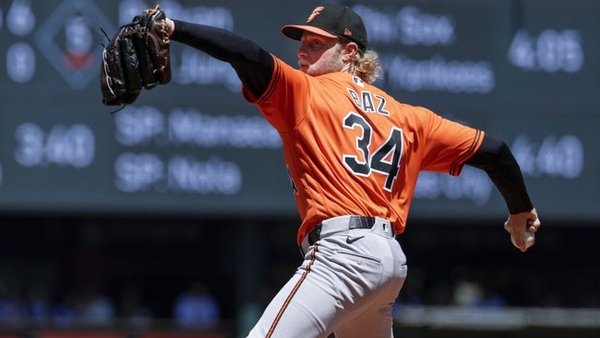
Shane Baz’s 1.35 WHIP over 173 innings is a season-long pattern, not a blip — but the under at -105 is already a dime cheaper than the over in a game where both offenses sit below .710 OPS. The catch is Trey Yesavage’s IL status, which leaves the entire pitching case contingent on a starter whose availability isn’t confirmed.
Trey Yesavage vs Shane Baz: Toronto Blue Jays at Baltimore Orioles Betting Preview
There’s a disclosure that has to come first: Trey Yesavage is listed on the 15-Day IL with a knee injury in the same injury report that names him as tonight’s probable starter. That contradiction is the single most important piece of information for anyone considering a bet on this game. If Yesavage doesn’t take the ball, the entire pitching case for the under shifts depending on who Toronto rolls out instead — and with Berrios, Bieber, Taillon, Ponce, and Corbin all on the IL simultaneously, the Blue Jays’ rotation depth is threadbare. That caveat runs through everything that follows.
Assuming Yesavage pitches — and that’s the market’s assumption, reflected in tonight’s lines — this game has the structural fingerprints of a low-scoring affair. Camden Yards checks in at a 1.01 park factor, essentially a neutral environment. Neither lineup is generating runs at an elite clip. The under is priced at -105 against an over at -115, a subtle lean the market itself is already signaling. That juice discrepancy is a tell worth paying attention to.
The core argument here isn’t that the under is a lock. The case for the under is built on price efficiency, below-average offenses, a pitcher-friendly neutral park, and the belief that the numbers overstate the offensive output of two teams playing meaningless September baseball with depleted rosters.
Game Info & Betting Lines
- Date/Time: Monday, September 21, 2026 — 6:35 PM ET
- Venue: Oriole Park at Camden Yards | Park Factor: 1.01 (neutral)
- TV: ESPN Unlmtd, MLB.TV, MASN, Sportsnet, TVA
- Probable Starters: Trey Yesavage (TOR) — 5-5, 3.65 ERA, 1.14 WHIP (15-Day IL — knee; status uncertain) vs Shane Baz (BAL) — 6-15, 4.11 ERA, 1.35 WHIP
- Moneyline: Toronto Blue Jays -107 / Baltimore Orioles -112
- Run Line: Baltimore Orioles +1.5 (-188) / Toronto Blue Jays -1.5 (+155)
- Total: 7.5 (Over -115 / Under -105)
Why This Number Is Close
The market has set 7.5 for a reason. Both teams carry below-average offenses — Toronto at .694 OPS, Baltimore at .708 OPS — and a neutral park doesn’t inflate those numbers. The over pricing at -115 suggests the books expect some action on the high side, likely driven by Baz’s shaky WHIP and the bullpen uncertainty on both sides. That’s a legitimate counter-argument.
But here’s where the market gets it approximately right: the under at -105 represents genuine value on the low-scoring side relative to the over. When you strip away the noise and look at the structural inputs — two mediocre offenses, one effective starter (if healthy), a neutral environment — the floor of this game is very reachable. The market isn’t pricing teams equal; Baltimore is a marginal -112 moneyline favorite, but the total reflects a genuine tug-of-war between Baz’s baserunner tendencies and Yesavage’s ability to suppress scoring.
What Separates the Pitching
Yesavage’s profile — 3.65 ERA, 1.14 WHIP across 93.2 innings — reads as a genuinely efficient arm for a younger starter. His arsenal is built on three pitches: a 94.3 mph four-seam fastball thrown 46.6% of the time that holds hitters to a .312 xwOBA, a split-finger generating a 39.1% whiff rate and .257 xwOBA, and a slider at 37.3% whiff rate with .259 xwOBA. The two secondary offerings are legitimate swing-and-miss pitches that suppress hard contact. His BB total of 46 across 93.2 innings is manageable — not dominant, but not a walk machine either.
Baz presents a more complicated picture. The 4.11 ERA is digestible, but the 1.35 WHIP signals consistent baserunner issues. His four-seam sits at 95.9 mph — the velo is there — but hitters produce a .338 xwOBA against it with only a 13.3% whiff rate. That’s a fastball that gets hit. His best offering is the knuckle curve at 27.7% whiff rate and .278 xwOBA, but he leans on his changeup (9.3% usage, .358 xwOBA) far too often for a pitch that doesn’t miss bats. The cutter at .339 xwOBA is similarly hittable.
The gap between these two arms is real when it comes to baserunner management. Yesavage limits traffic; Baz creates it. That said, Baltimore’s lineup has the heavier power threat — Pete Alonso carries a .484 xwOBA with a 7.1% barrel rate, and Coby Mayo’s .451 xwOBA with a 6.4% barrel rate makes him a genuine damage threat. Meanwhile, on the Toronto side, Kazuma Okamoto carries a 6.6% barrel rate to go with his .421 xwOBA and 33 home runs — he can punish any mistake in a hurry. George Springer, batting fifth as Toronto’s DH, is roughly 1-for-15 in his career against Baz (a .067 average across 15 plate appearances) with four strikeouts — that’s a favorable matchup for Baltimore in a spot where the Blue Jays would otherwise want run production.
The Pushback
The honest version of the counter-argument starts with Baz’s WHIP. A 1.35 WHIP over 173 innings isn’t a small-sample anomaly — it’s a season-long pattern of putting runners on base. Baz’s tendency to load the bases gives Toronto’s middle of the order repeated opportunities to punish him, and Okamoto’s .421 xwOBA and 33 home runs make him a threat to turn any first-and-third situation into a three-run inning. That’s real risk.
The numbers also sit above 7.5 when you account for bullpen arms entering mid-game on both sides. Both teams’ relievers are operating shorthanded, and late-game scoring spikes are a legitimate concern. At a projected 9.1 combined runs, the raw scoring expectation technically clears the posted total — that’s the strongest analytical case against the under. The -105 price is what makes the under worth taking despite that gap: you’re getting a better number on the low-scoring side, and the structural inputs (two below-.710 OPS offenses, a neutral park, September meaninglessness) argue for regression toward the floor, not toward the ceiling.
Run Environment & Game Shape
Both teams are trending toward low-leverage September baseball. Toronto comes in at 77-79, Baltimore at 75-81 — neither club is in a genuine playoff race with six games left, and the recent performance backs that up. The Blue Jays just dropped two of three to Texas before salvaging Sunday’s finale. The Orioles got shut out back-to-back by Milwaukee over the weekend, managing just four hits across two games. These are not offenses catching fire heading into Monday night.
The park isn’t doing any favors for the over either. A 1.01 park factor at Camden Yards is functionally neutral — there’s no atmospheric or dimensional edge that inflates run scoring. Wind, roof status, and other environmental factors are non-factors in a standard open-air neutral park. The game shape — a younger starter with swing-and-miss secondaries against a lineup that strikes out 1,111 times on the season, opposed by a WHIP-challenged veteran against an offense that’s been blanked twice in its last three — points toward a game that stays in the mid-to-low scoring range.
Baz’s .699 xwOBA on “Other” pitch types (0.0% usage) is noise, but his changeup problem is real: .358 xwOBA on a pitch he throws 9.3% of the time signals a genuine soft spot that Toronto’s better hitters can exploit. Still, Toronto’s .694 team OPS suggests those opportunities won’t reliably convert. The Blue Jays strand runners — and against a WHIP-challenged starter, that’s the scenario that keeps the final score manageable.
Strip this down to its essentials: two below-average offenses, a neutral park, one arm (Yesavage, health permitting) who limits traffic, another arm (Baz) who allows traffic but faces hitters who can’t consistently capitalize, and an under price that’s a full dime cheaper than the over. The juice gap alone makes this worth a lean-unit play.
Bet: Under 7.5 (-105) — 1 unit, lean confidence.