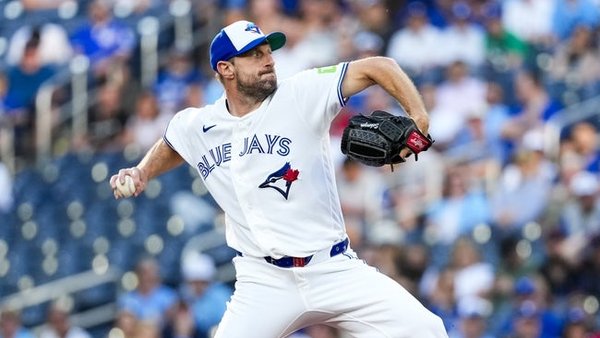
Max Scherzer’s 1.73 HR/9 rate is walking into a Baltimore lineup that has slugged 192 home runs this season — yet the Orioles are priced at just -126, a number that treats this like a standard coin-flip rather than a meaningful pitching mismatch. Chris Bassitt isn’t dominant, but the gap between these two starters in run-prevention profile is the sharpest variable on the board today.
Max Scherzer vs. Chris Bassitt: Toronto Blue Jays at Baltimore Orioles Betting Preview
Yesterday’s series opener between these two clubs ended in a scoreless result, which sets up today’s finale with legitimate intrigue around which offense wakes up first. The answer, I think, depends heavily on who’s on the mound — and that’s where Baltimore holds a meaningful edge that the -126 moneyline price doesn’t fully capture.
Max Scherzer is not the same pitcher he was three years ago. His 6.07 ERA and 3-8 record this season aren’t outliers — they’re the result of a pitcher who has surrendered 14 home runs in just 72.2 innings, a HR/9 rate near 1.73 that ranks among the worst in the league. Against a Baltimore lineup that leads the AL East in home runs and features three hitters with barrel rates above 6% — assuming Samuel Basallo (day-to-day, head) is available — this matchup profiles as a significant liability. Chris Bassitt at 4.64 ERA and 8-5 isn’t dominant, but he’s a different class of pitcher than what Toronto is sending out today.
The moneyline at -126 is a reasonable price for a real pitching edge. That’s the core thesis, and the rest of this falls in line around it.
Game Info & Betting Lines
- Date/Time: Wednesday, September 23, 2026 | 1:35 PM ET
- Venue: Oriole Park at Camden Yards | Park Factor: 1.01 (neutral-to-slightly hitter-friendly)
- Probable Starters: Max Scherzer (TOR) vs. Chris Bassitt (BAL)
- Moneyline: Toronto Blue Jays +104 / Baltimore Orioles -126
- Run Line: Baltimore Orioles -1.5 (+169) / Toronto Blue Jays +1.5 (-206)
- Total: 7.0 (Over -118 / Under -102)
Why This Number Is Close — But Leans Baltimore
The market is doing a reasonable job of balancing this game. Toronto at +104 isn’t absurd — the Blue Jays’ team pitching ERA of 3.92 is actually better than Baltimore’s 4.11, meaning if Scherzer exits early (which his track record this season suggests is possible), the Toronto bullpen can genuinely hold things close. The 7.0 total signals the market expects a pitcher-driven game, which works in the Blue Jays’ favor if Bassitt settles in and limits damage.
The case for Toronto is real: both clubs are below .500 and playing out the string, late-season motivation is murky on both sides, and a 7-total game between two middling offenses can swing on one swing of the bat. The market isn’t wrong to price this competitively.
But here’s where the price leans slightly off: it treats Scherzer as merely a below-average starter when his HR/9 profile suggests he’s actively dangerous to run out against a power-heavy lineup. Baltimore’s .709 OPS outpaces Toronto’s .692, and the Orioles carry 192 team home runs compared to Toronto’s 149 — a 43-HR gap that matters a great deal when the opposing starter is giving up a homer per every five innings. Baltimore at -126 is a fair price for an unfair pitching matchup.
What Separates the Pitching
Scherzer’s primary vulnerability starts with his four-seam fastball. He’s leaning on it at a 48.2% usage rate — nearly half his pitches — and it’s generating only a 15.1% whiff rate at 93.1 mph. That’s not a swing-and-miss pitch at this stage of his career; it’s a pitch hitters are sitting on and squaring up. He does generate better swing-and-miss with his curveball (28.1% whiff) and slider (26.0% whiff), but both still produce elevated xwOBA against (.286 and .353 respectively), meaning hard contact follows when hitters do connect. Compounding that: his cutter, used just 5.4% of the time, carries a .371 xwOBA against with only a 10.0% put-away rate — a secondary problem that layers on top of the fastball exposure. For a pitcher whose survival depends on deception, a high-usage fastball that doesn’t miss bats is the central issue.
Now overlay that against Pete Alonso — .488 xwOBA, 7.3% barrel rate, 33.3% hard-hit rate. His split against right-handed pitching sits at .495 xwOBA. That’s elite contact quality facing a starter who has already allowed 14 HR this season. It’s worth remembering that just two nights ago in this same series, Alonso homered twice on Monday — one off starter Trey Yesavage in the first inning and one off submarine righty Tyler Rogers in relief. The bat is live, the matchup is favorable, and Scherzer’s profile against hard-contact hitters has been punishing all season. Dylan Beavers leadoff is another angle worth tracking — his vsRHP xwOBA of .380 gives Baltimore a genuine threat at the top of the order, and his BvP line against Scherzer (6 PA, .500, 1 HR) adds a small but meaningful data point.
One note on the rest of the middle order: Coby Mayo (.449 overall xwOBA) and Christian Encarnacion-Strand (.432 overall xwOBA) are legitimate power threats, but their splits against right-handed pitching tell a different story — Mayo’s vsRHP xwOBA is .372 and CE-S checks in at .344. Both are significantly more dangerous against lefties (Mayo .573, CE-S .606). Scherzer is right-handed, so the matchup logic cuts against leaning too hard on that duo. The primary power matchup here runs through Alonso (.495 vsRHP) and Beavers (.380 vsRHP), not the middle of the order. Bassitt, by contrast, while not dominant, gives Baltimore the better innings shape — he avoids the extended bad outings that Scherzer has produced regularly this season. The gap between these two starters in run-prevention profile is the largest single factor in this game.
The Pushback
The honest concern here is that neither team has much to play for. Baltimore sits at 76-81, Toronto at 77-80 — both out of the AL wild-card picture, both playing out September. End-of-season motivation is genuinely murky, and Scherzer has enough guile to survive five innings even when his stuff is below average. The Toronto bullpen ERA of 3.92 at the team level is functional, not a liability. If Scherzer gets through five innings with two runs allowed, the Blue Jays are right there. I’m also not discounting Samuel Basallo’s day-to-day status — if he’s out of the lineup, Baltimore loses one of their better barrel threats and the depth of their power core thins out. That’s a real variable heading into first pitch.
Why the Moneyline — Not the Run Line or Total
The run line at Baltimore -1.5 (+169) is tempting but the wrong vehicle. The numbers project this as a one-run game — Baltimore 4.9, Toronto 4.5 — and asking Baltimore to cover by two in a tightly projected matchup between two middling offenses is too much to ask, even with the pitching edge at the SP level. The +169 might look juicy, but it’s priced that way for a reason.
The total at 7.0 doesn’t appeal either. The starting pitching discrepancy cuts strongly in one direction — Baltimore’s advantage — but bullpen parity levels the run-environment picture out. Playing the over at -118 feels like paying juice on the wrong side of that equation. The under at -102 is reasonable but too dependent on Scherzer executing at a level he’s rarely reached this season. That’s not a reliable hook.
The projected score of Baltimore 4.9, Toronto 4.5 suggests a one-run game is within range, which means the moneyline is exactly the right vehicle here. A low-total, tight game favors the team with the pitching edge at the starting pitcher level — and that’s Baltimore today. The juice at -126 is acceptable for a real structural edge: Scherzer’s four-seam fastball is getting hit hard, his HR/9 is catastrophic, and Alonso at .495 vsRHP is the most dangerous bat in this lineup against exactly this type of arm. Bassitt isn’t an ace, but he doesn’t need to be — he just needs to be better than Scherzer, and on paper and by the numbers, he is.
The Pick
Baltimore Orioles Moneyline -126 | 2 Units | Moderate Confidence
The starting pitching gap is real, the price is justified, and the Alonso-to-Scherzer matchup is the most actionable single-hitter angle on the board today. This is not a hammer — it’s a measured two-unit play on a genuine edge at a price that doesn’t require the Orioles to win by multiple runs. Moneyline is the right vehicle. Baltimore wins this one.